
Jump to section8 sections
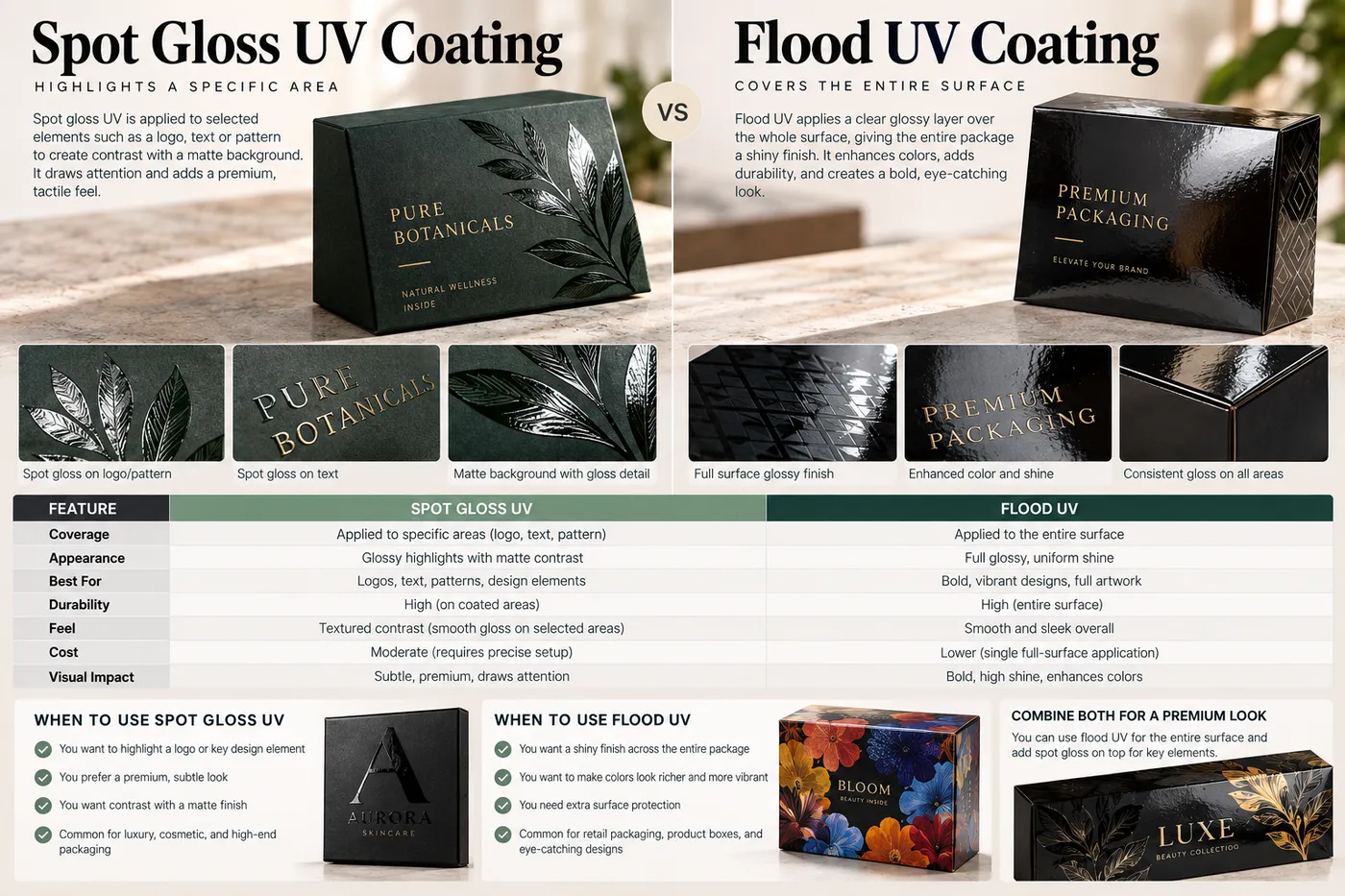
Spot gloss UV coating is applied to selected areas of a print. Think of a logo, an image, or a line of text. The surrounding areas stay matte. Flood UV applies a full-coverage glossy coat to the entire surface instead. Spot gloss creates contrast and texture. Flood UV gives uniform high-shine protection across the whole box.
Spot gloss and flood UV are both part of our broader packaging glossary, which covers every finish and structural term in this cluster.
This guide covers both coating styles in plain terms. We'll walk through how each one applies. We'll also compare cost, durability, and feel. For a broader look at UV coating basics, see our guide to aqueous coating vs UV coating.
What is UV coating?
UV coating is a liquid coating cured instantly under ultraviolet light on press. It dries in seconds, not minutes. That's different from aqueous coating. Aqueous coating is water-based. It dries more slowly, with a softer finish. For the deeper comparison between UV coating and film lamination, see our guide to UV coating vs lamination.
Both spot gloss and flood UV start from this same base process. The difference is where the coating lands. It's also how much of the surface it covers.
Spot gloss / spot UV explained
Spot gloss, also called spot UV, coats only chosen areas of the design. A logo gets a glossy hit. The rest of the panel stays matte or uncoated. That contrast is the whole point. Light catches the glossy area. It draws the eye straight to it.
Getting spot gloss right takes precise registration on press. The coating unit has to land the gloss exactly on the printed graphic. Miss by even a small margin, and a visible halo or gap shows up at the edge. Flood UV carries no such risk. It covers the entire surface, with no edges to miss. Competitor glossaries rarely mention this registration challenge. It matters once a brand sees a misaligned proof and wonders why the gloss looks slightly off.
Spot gloss pairs naturally with a matte laminate base. For more on that combination, see our guide to matte vs gloss lamination. The gloss accent reads as more dramatic against a flat matte background. It reads as less dramatic against an already-shiny surface.
I've seen a cosmetics brand request spot gloss on a tiny icon less than a quarter-inch wide. The press run needed three proof rounds to get registration tight enough. A design with larger, simpler shapes would have avoided that back-and-forth.
Spot gloss also shows up often on retail packaging. A brand often wants one specific element to catch light at a glance from the shelf. A logo or an icon works well for this.
Flood UV explained
Flood UV coats the entire printable surface in one even pass. There's no registration risk. The coating doesn't need to align with anything underneath. That makes flood UV faster to set up. It's also more forgiving on press than spot gloss.
The main draw of flood UV isn't just shine. It's protection. A full glossy coat resists scuffing, moisture, and fingerprints better than an uncoated or matte surface. That matters for packaging that travels through a supply chain with a lot of hand contact.
Flood UV works well on bright, colorful designs especially. The gloss amplifies color saturation across the whole surface. It isn't limited to one accent area the way spot gloss is. A busy, color-heavy box benefits more from flood UV. A single spot accent would compete with an already-loud design instead of complementing it.
Flood UV also runs faster on press than spot gloss in most cases. Fewer registration checks are needed before a full production run starts. That can shave real time off a tight turnaround.
Durability and handling
Both coatings add real scuff resistance compared to an uncoated panel. Flood UV has the edge in raw protection, since it covers every inch of the surface. A box that gets handled a lot during fulfillment or retail display benefits more from that full-coverage shield.
Spot gloss protects only the coated area. The rest of the panel still relies on the paperboard or ink alone for scuff resistance. That's rarely a problem in practice. Most designs put spot gloss on a logo, not a high-wear corner or edge.
Neither coating holds up well in prolonged wet conditions. Both are built for handling, light moisture exposure, and shelf presentation, not full waterproofing. A product needing real water resistance calls for a different approach entirely. A plastic liner or coated film works better than either UV coating style.
Cost and minimum order quantities
Spot gloss costs more per unit than flood UV in nearly every case. The registration tooling and extra press pass add cost that a single flood pass doesn't carry. For small logos or simple shapes, that premium is usually modest. For intricate artwork, it can add up fast.
Minimum order quantities for both coatings vary by printer and press setup. Flood UV is often available at lower MOQs, since it doesn't require the same registration setup cost per run. Request a custom quote to get exact numbers for a specific design and print volume.
Comparing spot gloss and flood UV
Spot gloss (spot UV) | Flood UV | |
|---|---|---|
Coverage | Selected areas only | Entire surface |
Visual effect | High contrast, draws the eye to one spot | Uniform shine across the whole panel |
Relative cost | Higher (registration + tooling) | Lower (simpler single-pass application) |
Durability | Protects only the coated area | Protects the full surface |
Feel | Mixed texture (glossy spot, matte elsewhere) | Uniform glossy feel |
Compatible substrates | Works best on matte or uncoated stock | Works on most coated or uncoated paperboard |
Can you combine flood and spot?
Yes. A common approach runs a flood matte coating across the whole box. It then adds a spot gloss hit on the logo. That combination gets both benefits at once. Full-surface protection comes from the flood coat. A high-contrast accent comes from the spot gloss.
According to PRINTING United Alliance, combination finishing techniques like this remain a very active area of print innovation. Brands keep looking for ways to stand out on crowded shelves. This flood-plus-spot approach costs more than either coating alone. It needs two separate coating passes. For brands with the budget, it delivers a result neither coating achieves alone.
Which to choose
Choose spot gloss when a specific design element needs to stand out. A logo, an icon, or a headline are good candidates. It works best on a simple, well-defined shape. Fine detail or small text raises the risk of registration problems.
Choose flood UV when the goal is full-surface protection and uniform shine. That's especially true on a bright or color-heavy design. One spot accent would get lost there, or compete with the rest of the artwork.
If neither feels like a perfect fit on its own, it's worth comparing both. Our broader guide to spot UV coating covers additional application details and substrate notes not repeated here.
One limitation worth noting: exact pricing and registration tolerances vary by printer, press type, and design complexity. Request a custom quote for exact costs on your specific artwork and run size.