
Jump to section7 sections
Quick answer: Pharmaceutical packaging kits are custom outer boxes. They're folding cartons or rigid boxes with an insert tray and printed panels. Each kit fits your container. We check label space before the dieline is set. Many formats start from 50 units.
*Last updated: October 2026. This is general information, not legal or regulatory advice.*
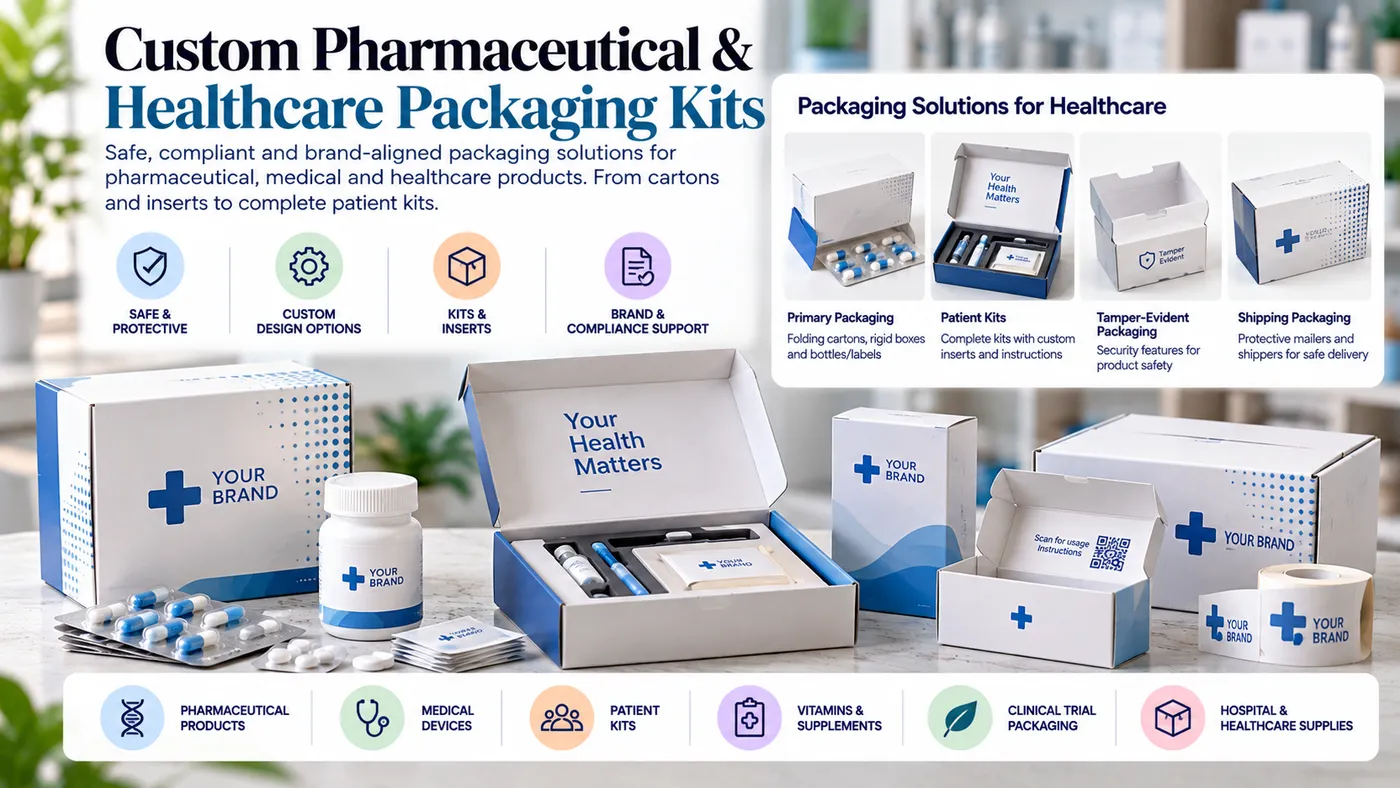
Pharmaceutical packaging kits serve supplements, OTC products, trial supply, diagnostic tests, and device cartons. We make the outer box and the insert. We don't make primary containers or sterile barriers, and we don't fill them. The table shows who orders these kits and what they need.
Buyer type | What they order | Key requirement |
|---|---|---|
Supplement and nutraceutical brands | Folding carton or rigid box kit | Supplement Facts panel space, food-safe board |
OTC drug brands | Folding carton with Drug Facts panel | Tamper-evident feature, child-resistant closure |
Clinical trial sponsors and CROs | Blinded outer carton with insert | Variable data fields, blinding, GMP board |
Diagnostic test kit brands | Folding carton with compartmented insert | IVD labelling, tamper-evident, IFU space |
Medical device brands | Secondary carton with UDI barcode space | UDI HRI, compliance panel, IFU reference |
Wellness and gift kit brands | Rigid box with multi-product insert | Multi-component layout, brand-forward print |
Veterinary supplement brands | Folding carton or rigid box | NASC compliance elements, lot and expiry fields |
Key takeaway: Plan the label panels first. The label copy sets how much print space the box needs. That sets the structure.
What Custom Pharmaceutical & Healthcare Packaging Includes
Custom pharmaceutical packaging is one set. It has an outer box, an insert tray, and printed panels. We design it around one product and its label rules. Every kit is made to order, and we confirm panel space first.
This suits brands and buyers ordering mid-size runs of 50 to 2,000 units. It isn't for sterile primary packaging. Still choosing a quantity? Our guide to custom packaging MOQ by format shows how run size affects unit cost.
Pharmaceutical Packaging Kit Formats
The right format depends on the container, the part count, and where the kit lands. That might be a shelf, a fulfilment center, a clinic, or a sample cabinet.
Format | Best for | Insert options | Label panel space | MOQ direction |
|---|---|---|---|---|
Folding carton (tuck-end) | Single supplement bottle, OTC product, diagnostic kit | Insert card or fitted tray | Good, all four panels | Lower |
Folding carton (auto-bottom) | Multi-component kits needing a stable base | Fitted paperboard tray | Good | Lower |
Rigid lid and base | Premium supplement kits, physician samples, starter kits | Paperboard tray, foam, or compartmented insert | Good, full surface | Slightly higher |
Sleeve and tray | E-commerce wellness kits, subscription sets | Tray sized to contents | Good, sleeve carries copy | Lower |
Multi-compartment rigid | Multi-period trial kits, multi-product device sets | Fixed or removable dividers | Full surface | Confirm with quote |
A folding carton ships flat and folds up when you fill it. It costs less and suits standard supplement and OTC formats. A rigid box is built on thick board. It protects more and suits multi-part kits and physician samples. I'd pick rigid only when the unboxing is part of the product. Otherwise, a carton does the job.
Not sure which fits? Our guide to rigid boxes vs folding cartons covers the trade-offs. You can also browse our healthcare kit formats or rigid boxes.
Label Panel Planning for Pharmaceutical Packaging Kits
We check every kit for label space before the dieline is set. The required items depend on your product type. Confirm the exact copy with your regulatory team first.
Product type | Typical panel elements | Regulation reference |
|---|---|---|
Dietary supplement | Supplement Facts panel, ingredient list, net quantity, manufacturer name and address, disclaimer | 21 CFR Part 101 |
OTC medication | Drug Facts panel, net quantity, tamper-evident statement, lot and expiry fields, NDC number | 21 CFR Part 201, 21 CFR 211.132 |
Nutraceutical or functional food | Nutrition Facts or Supplement Facts (confirm with regulatory team), ingredients, net quantity | 21 CFR Part 101 |
Clinical trial product | Protocol number, lot and expiry fields, patient identifier, blinding identifier, storage conditions | ICH E6, local requirements |
Medical device (Class I/II) | UDI barcode and HRI, intended use, lot, expiry, IFU reference, symbols | 21 CFR Part 801, EU MDR |
IVD diagnostic | Intended use, lot, expiry, storage conditions, regulatory markings | 21 CFR Part 809, EU IVDR |
Veterinary supplement | Caution statement, lot, expiry, net quantity, NASC seal if applicable | NASC guidelines |
We plan panel space around the copy you give us. The copy itself is your responsibility. Rules change, so check each reference with your advisers and the current FDA guidance.
From Brief to Approved Kit
Here's how an order for pharmaceutical packaging kits moves from brief to shipment.
1. Confirm your product type. Say if it's a supplement, OTC product, trial product, test, or device. Share the label copy your team approved. 2. Measure the filled container. Give length, width, height, weight, and any fragile spots. List every kit part with its size and order. 3. Send the brief. Include sizes, parts, label copy, quantity, artwork status, and destination. Our packaging RFQ template shows what to send. 4. Review the dieline. We draw it around your sizes and panel copy. You check the structure, insert, and panels before artwork goes on. 5. Approve the digital proof. It shows the full printed surface. Production starts once you approve the proof and terms. 6. Production and US shipping. Standard production runs from 7 business days after proof approval. Our guide to lead times shows what adds time.
Measure the filled container, not the empty one. A full bottle with its cap and band is often bigger than the spec sheet says. That one detail can change an insert layout.
Commercial Details at a Glance
Planning area | Direction | What changes it |
|---|---|---|
Minimum order | Many formats from 50 units | Confirm the minimum for your structure |
Production | From 7 business days | Clock starts after proof approval |
Design support | Dieline and proof review | Artwork stays subject to structural review |
Label panel space | Confirmed before the dieline is drawn | Label copy must arrive first |
US shipping | Available on the standard route | Confirm destination in your quote |
Pricing | Confirmed in your quote | Structure, insert, material, finish, print, and quantity |
Inserts shape the layout more than buyers expect. Our custom packaging inserts guide compares paperboard, corrugated, pulp, and foam. See how we build orders on our manufacturing page.
Frequently Asked Questions
What products do you make pharmaceutical packaging kits for? We make outer packaging for supplements, OTC products, trial supply, diagnostic kits, Class I and II devices, dental supplies, and vet supplements. That means the carton or rigid box plus the insert. Sterile primary packaging and filling are outside our scope.
Do you make compliant packaging for FDA-regulated products? We build the carton to your spec and label copy. Compliance of the copy is your job. Have your regulatory team confirm all label content before we set the dieline.
What is the minimum order for pharmaceutical packaging kits? Many formats start from 50 units, in both folding cartons and rigid boxes. The final minimum depends on structure, material, print, and finish. Send your kit brief for a quote.
Can the kit include a printed insert card, patient diary, or leaflet? Yes. Printed cards, leaflets, diaries, and dosing cards can go in the brief. Share the page count, size, and copy for one quote.
Can you produce blinded clinical trial packaging? Yes, to your protocol. Blinded cartons carry no active ingredient branding. They use protocol identifiers. Lot, expiry, patient ID, and site code fields stay blank on the dieline.
What's the difference between a folding carton and a rigid kit box? A folding carton costs less and folds up at filling. A rigid box is thicker and protects more. It suits multi-part kits and physician samples. Choose by the protection and presentation you need.
Can one insert hold bottles, sachets, and printed guides together? Yes. A paperboard insert with compartments holds each part in a fixed spot. Send the part list, sizes, and order for a layout review.
How long does production take? Standard production is from 7 business days after proof approval. The clock starts at approval, not at the quote. Ready label copy and print-ready art shorten the process.
Pick Pharmaceutical Packaging Kits by Label Space First
Pharmaceutical packaging kits work best when label space, container size, and insert layout are settled together. Start with approved copy. Measure the filled container. Pick the simplest structure that protects the product.
Ready to brief a kit? Get a free quote. We'll review your panel space and confirm the minimum and timeline with your quote.