
Most brands decide between a rigid box and a folding carton the same way: they look at the per-unit cost, wince at the rigid box price, and go with the folding carton. Or they want to look premium, order rigid boxes, and discover three months later that 40% of customers are immediately discarding a $4 box they’ll never see again.
Both can be wrong. Cost matters — but it’s the last question, not the first.
The right question is: what job is this box actually doing? Not aesthetically. Structurally, logistically, and in the specific moment your customer’s hands are on it.
This guide covers the rigid boxes vs folding cartons decision properly — what actually separates them structurally, when each one wins, and a third option most brands miss entirely.
Rigid Boxes vs Folding Cartons: What Actually Makes Them Different
It’s not just feel. The structural difference between rigid boxes and folding cartons is real, and it matters for how they perform.
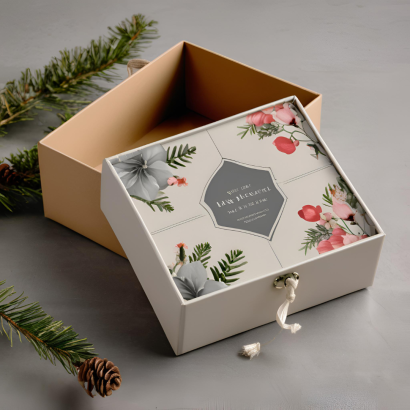
Rigid boxes (also called setup boxes or set-up boxes) are built from thick greyboard or chipboard — typically 1.5mm to 3mm — pre-glued at the corners and wrapped in decorative paper, foil, or fabric. They cannot be knocked flat. They ship assembled. The lid and base are separate pieces. The structure holds because the thick board and glued corners carry the load — not a scored fold.
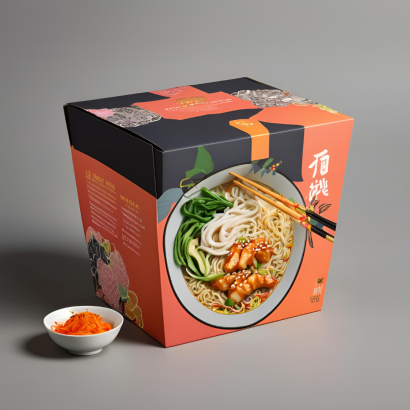
Folding cartons are made from paperboard — SBS (Solid Bleached Sulfate), CUK (Coated Unbleached Kraft), or similar grades specified by the Paperboard Packaging Council — scored and folded flat. They ship and store flat, get assembled at the point of fill, and hold their shape through a combination of score lines and tuck-style closures. They’re the dominant retail packaging format globally for good reason: economical, printable, and compact in storage.
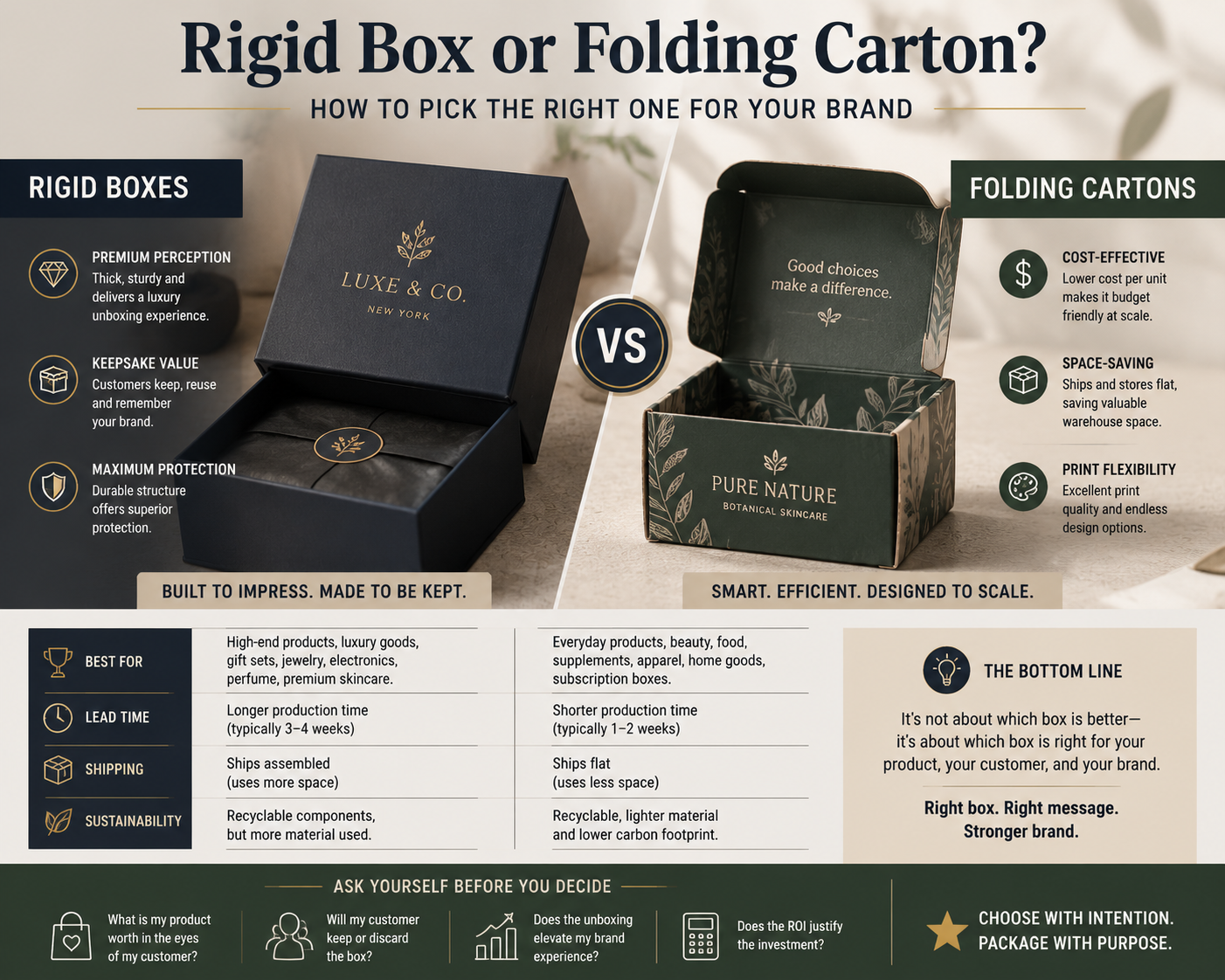
The critical difference isn’t premium vs. budget. It’s built-flat vs. can’t-be-flat.
A rigid box maintains its shape because of thick material and corner construction. It’s structurally overbuilt for most shipping scenarios — which is exactly why it communicates quality before anyone opens it. A folding carton is engineered precision — the right scores in the right places create a structure that holds exactly what it needs to hold, at a fraction of the material cost.
Neither is inherently better. The rigid boxes vs folding cartons question isn’t about budget — it’s about which structure fits the job.
The Cost Reality: Rigid Boxes vs Folding Cartons
Let’s put numbers to it so you can run your own math.
Rigid boxes: At typical DTC first-run volumes (250–1,000 units), expect $2–6 per unit for a standard two-piece lid-and-base rigid box. Add premium wrapping, foiling, or spot UV and it climbs higher. Setup costs are lower than you’d expect — rigid box tooling is simpler than corrugated die-cutting. But the per-unit material cost is high and doesn’t come down dramatically at moderate volumes.
Folding cartons: At the same volume range, $0.30–1.50 per unit is typical for a custom printed folding carton, depending on size, board weight, and print complexity. At 10,000 units, per-unit cost can approach $0.20 depending on spec and print complexity. The economics are fundamentally different.
The premium for a rigid box over a comparable folding carton is roughly 4–6x at low volumes. For a brand at 500 units per month, that’s a meaningful recurring cost difference — not a one-time budget line.
But here’s the math most brands forget: if your rigid box drives a meaningful increase in repeat purchase rate, or generates organic social sharing, the economics can fully justify the premium. Research on packaging and customer retention consistently shows the unboxing experience influences whether customers come back. The per-unit cost comparison only tells half the story.
Pricing and MOQs vary by specification. Request a custom quote for accurate details.
When a Rigid Box Is Worth Every Penny
Some products need a rigid box. Not for vanity — for function.
The product price signals premium. If you’re selling something at $75, $100, or above, the unboxing experience is part of the perceived value. A folding carton on a $120 skincare set creates a gap between what the customer paid and what they received. That gap breeds doubt. A rigid box closes it. The box says: this was considered.
The customer keeps the box. Jewelry boxes, perfume boxes, collector’s editions, gift sets. These get kept. Customers use them for storage, display, or re-gifting. When your packaging has a second life, the rigid box cost amortizes over every use.
The unboxing moment is the marketing. Subscription brands figured this out early: the box IS the product until you open it. If you’re building an unboxing experience that gets photographed and shared, the tactile experience of opening a rigid box — the satisfying lid lift, the reveal — is something folding cartons genuinely cannot replicate.
The product is fragile and gift-adjacent. Jewelry, ceramics, glassware in a gift context. Rigid boxes offer real crush resistance on the corners and top face, and they communicate care to the recipient. Not as a shipping solution — as a gift presentation layer. Our custom gift boxes are worth looking at for this category specifically.
The honest rule of thumb I’ve landed on after working with 10,000+ brands across product categories: if the product costs more than $50 and the customer is buying it as a treat or a gift, the rigid box almost always pays for itself. Under $30, it rarely does. That’s not a judgment — it’s math.
When a Folding Carton Wins Every Time
Folding cartons don’t get enough credit. I’ve watched brands spend 5x on rigid boxes for a product that gets unwrapped in 8 seconds and the box goes in the trash. That’s not a premium experience — it’s a budget problem nobody named yet.
Retail shelf presence. Folding cartons are designed for retail. They stand face-out on a shelf, hold full-color printing beautifully (especially on SBS board), and can be designed to stop someone mid-aisle. Rigid boxes aren’t made for shelf — they’re made for unboxing. If your product sits on a shelf in Target or a boutique, a folding carton is almost always the right structure. Browse retail packaging boxes if that’s your use case — it’s a different spec conversation entirely.
High volume where per-unit cost is real. At 10,000 units per month, the difference between $0.40 per folding carton and $3.50 per rigid box is $31,000 per month. Every month. That number doesn’t need ROI math — it just needs to be run. Unless the product clearly demands rigid, the folding carton wins at that scale and the margin conversation is over.
The box gets discarded immediately. Not every category has a kept-box dynamic. If your customer is buying supplements, food products, or anything where they extract the contents immediately and throw the box away, you’ve paid for a rigid box that went straight to the recycling bin. The folding carton does the same job — shelf protection, transit protection, legal labeling surface — at a fraction of the cost. Choosing the wrong format here is one of the packaging mistakes that cost brands money more often than most realize.
You need flat-pack logistics. Rigid boxes ship and store assembled. That’s fine when you’re at 200 units a month. At 5,000 units a month, the warehouse footprint of assembled rigid boxes becomes a real operational cost. Folding cartons ship flat and get assembled as needed. That affects your 3PL costs, your warehouse layout, and your flexibility to hold stock without bleeding storage fees.
The Option Most Brands Miss: Collapsible Rigid Boxes
There’s a third format worth knowing: the collapsible rigid box, sometimes called a magnetic closure box or foldable gift box.
These look and feel like rigid boxes. They have that same lid-lift reveal, often with magnetic closure. But they’re engineered to fold flat for shipping and storage. The structure is created by a collapsible internal frame with rigid-feeling exterior panels, rather than traditional rigid board construction.
The trade-off: they don’t feel quite as substantial as a true rigid box. A sharp eye can tell. But the cost is meaningfully lower than traditional rigid — typically $1.50–3.50 per unit — and the logistics are far better. For brands who want the rigid box look and feel without the storage and shipping penalty, this format is worth sampling before committing to either extreme.
We’ve seen this work well for mid-tier DTC brands across hundreds of projects: beauty accessories, lifestyle products, items in the $35–60 price range where a true rigid box feels like overspending but a folding carton feels underwhelming. It’s often the format brands land on after running a sample comparison. Easy Box Packaging carries all three formats — rigid, folding carton, and collapsible — so you can actually compare them before committing to a production run.
Four Questions to Answer Before Choosing Rigid Boxes vs Folding Cartons
Before briefing a supplier, answer these:
1. What does your customer do with the box after opening? Keep it, display it, re-use it → rigid. Discard it → folding carton. This single question eliminates most of the ambiguity.
2. What’s the product price point? Under $30 → folding carton almost always. $50–100 → depends on category and brand positioning. Over $100 → rigid box earns its cost. If you’re still not sure which format fits, the custom mailer boxes guide covers a third structural option worth comparing before you decide.
3. Is the box going on a retail shelf? Yes → folding carton. No (direct-to-consumer only) → either can work depending on answers 1 and 2.
4. What are your monthly volumes? Under 500 units → rigid is manageable. 1,000–5,000 units → run the real cost math. Over 5,000 units → folding carton’s economics become very hard to argue with unless the product clearly demands otherwise.
FAQ
What’s the main difference between rigid boxes vs folding cartons?
Construction and structure. Rigid boxes are made from thick chipboard, pre-assembled, and cannot be folded flat. Folding cartons are made from lighter paperboard, ship and store flat, and are assembled at point of fill. Rigid boxes cost significantly more per unit but communicate premium quality. Folding cartons are the dominant retail packaging format globally.
Are rigid boxes worth the extra cost?
For products over $50 in a gift or treat-yourself context, often yes — especially when the unboxing experience drives social sharing or repeat purchases. For high-volume commodity products or anything customers immediately discard, the cost premium rarely justifies itself. Run the math for your specific volume and product.
What are folding cartons best for?
Retail shelf placement, high-volume products, anything where the box gets immediately discarded, and brands that need to hold stock flat to manage warehouse and 3PL costs. They also print beautifully and can look genuinely premium at the right spec.
What is a collapsible rigid box?
A format that looks and feels similar to a traditional rigid box but folds flat for shipping and storage. Typically uses magnetic closures. Cost sits between folding cartons and traditional rigid boxes. Good option for mid-tier DTC products where logistics matter but the experience has to feel elevated.
Can folding cartons look premium?
Yes. Soft-touch laminate, embossing, foil stamping, and spot UV on a folding carton can create a premium feel at significantly lower cost than rigid. The limitation is tactile — a folding carton will never have the satisfying weight and rigidity of a true set-up box. But visually, a well-executed folding carton holds its own.
What board type is best for folding cartons?
SBS (Solid Bleached Sulfate) gives the brightest white printing surface — ideal for beauty, food, and anything where print quality and color accuracy matter. CUK (Coated Unbleached Kraft) is stronger and has a more natural, sustainable-looking kraft exterior. Choose based on your brand aesthetic and whether print vibrancy or sustainability signals matter more to your customer.
The rigid boxes vs folding cartons decision looks obvious on paper. It usually isn’t. Get samples before you decide — the difference is something you feel, not something you read about. And nine times out of ten, the brand that goes rigid when they should’ve gone folding carton is the one that comes back six months later saying the economics don’t work. Run the math. Hold the samples. Then decide.