
Jump to section10 sections
- Flat Pouch vs Stand Up Pouch: Three Formats Defined
- Size Comparison for the Same Fill Weight
- When Flat Pouches Win
- When Stand-Up Pouches Win
- When Side-Gusset Bags Win
- How Format Affects Print Area
- Cost Comparison by Format
- Frequently Asked Questions
- When a Standard Format Doesn't Fit
- The Bottom Line
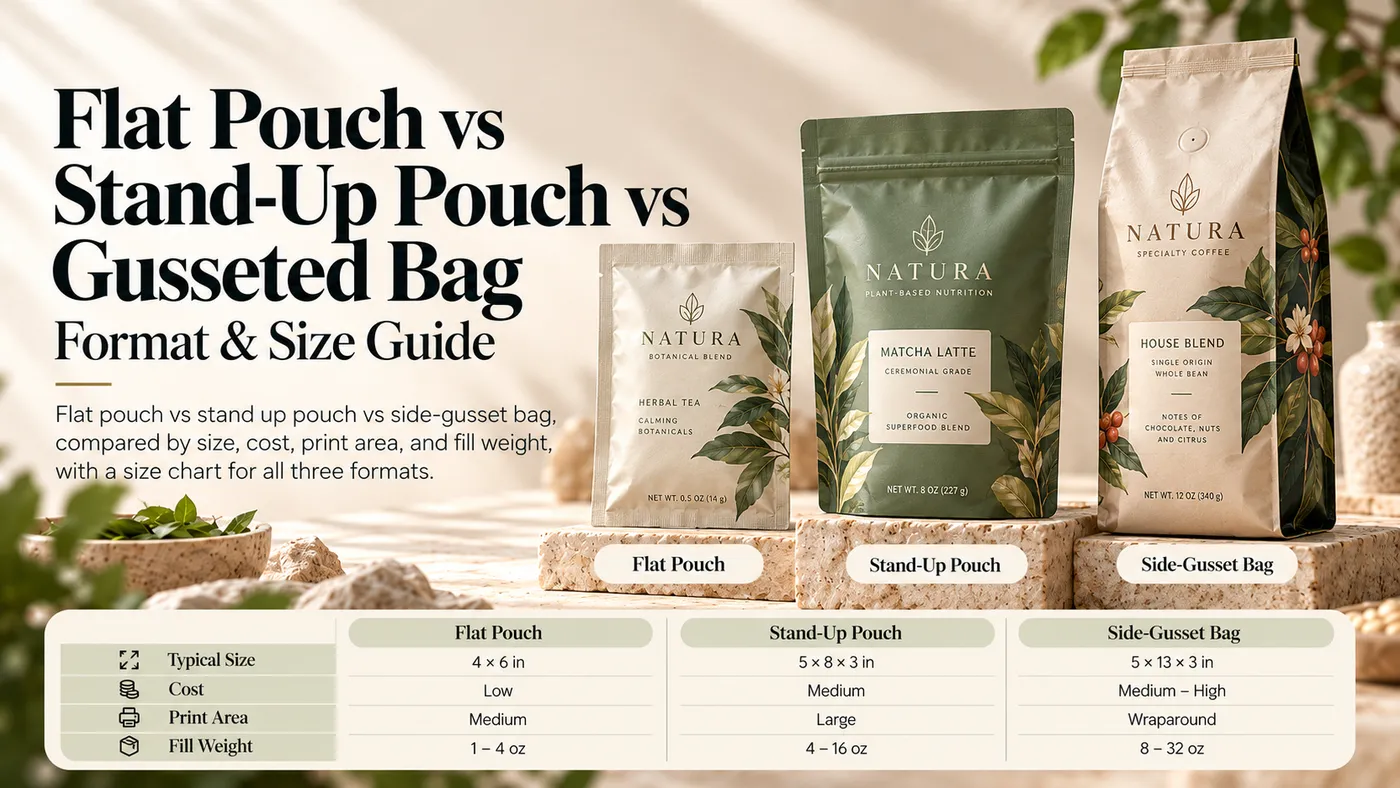
Quick answer: A flat pouch (3-side or 4-side seal) lies flat on a shelf. It's compact and lower cost. It suits products under 4 oz. A stand-up pouch has a gusseted bottom that lets it stand upright. It works better for 6 oz and above. It gives superior retail presence and is easier to reseal and pour from. A side-gusset bag sits between the two, built for bulk and foodservice volumes at 5 lb and up. Choosing flat pouch vs stand up pouch comes down to fill weight, shelf placement, and budget.
Flat Pouch vs Stand Up Pouch: Three Formats Defined
A flat pouch, also called a pillow pouch, seals on three or four sides with no gusset. It lies flat in every direction. It's the simplest and cheapest flexible format to produce.
A stand-up pouch, also called a doypack, adds a folded bottom gusset. That gusset unfolds when filled and lets the pouch stand upright on a shelf. It's the format most CPG brands picture when they hear "pouch."
A side-gusset bag folds on the sides instead of just the bottom. It's built to hold more volume without ballooning out of shape. It shows up most often in bulk and foodservice packaging rather than single-serve retail.
Size Comparison for the Same Fill Weight
Fill Weight | Flat Pouch (W×H) | Stand-Up Pouch (W×H×Gusset) | Side-Gusset Bag (W×H×Gusset) |
|---|---|---|---|
2 oz | 3.5" × 6" | 3" × 5" × 1.5" | 4" × 6" × 2" |
8 oz | 5.5" × 9" | 5" × 8" × 3" | 6" × 9" × 3" |
1 lb | 6.5" × 10.5" | 6" × 10" × 3" | 7" × 11" × 3.5" |
5 lb | 10" × 15" | 9" × 13" × 4" | 10" × 15" × 4.5" |
A flat pouch needs a larger flat footprint than a stand-up pouch of the same fill weight. It has no gusset volume to draw on. These figures are scaled estimates based on common industry sizing conventions, not a fixed universal standard. Confirm exact dimensions with your supplier once a format is chosen.
When Flat Pouches Win
Flat pouches win for samples and single-use products. They work well for anything under 4 oz, where shelf-standing isn't the point. Low minimum order quantities favor flat pouches too, since tooling costs stay lower.
A flat pouch also works for tabletop display formats, like spice packets or single-serve condiments. It's the right call anywhere cost matters more than shelf presence.
When Stand-Up Pouches Win
Stand-up pouches win on retail shelves. The upright profile gives a brand a bigger printed face than a flat pouch of the same volume. That's real shelf real estate a flat pouch can't match.
Stand-up pouches also win for repeat-use products in the 6 oz and up range. A reseal zipper matters more once a shopper expects to open the bag more than once. Premium branding leans on stand-up pouches for this reason, even when a flat pouch would cost less.
When Side-Gusset Bags Win
Side-gusset bags win at bulk and foodservice volumes. Once fill weight crosses roughly 5 lb, a side-gusset holds its shape better than a stand-up pouch's single bottom fold. Coffee wholesale accounts lean on this format heavily.
A side-gusset bag isn't usually the right call for a single-serve retail product. The extra material cost only pays off once volume gets large enough to need it.
How Format Affects Print Area
A stand-up pouch has a smaller usable print panel than its total size suggests. The gusset area folds inward and isn't visible once the bag is filled. Designers have to account for that dead zone or risk cutting off part of the artwork.
A flat pouch uses nearly its entire surface as usable print area. There's no folded gusset eating into the design space. That's one more reason flat pouches work well for simple, low-cost branding.
Cost Comparison by Format
A flat pouch is the cheapest format to produce. A stand-up pouch typically adds 15 to 30% over an equivalent flat pouch. That added cost comes mostly from the extra material and forming steps the gusset needs. A side-gusset bag's cost varies more by size, since material use scales up faster at bulk volumes.
Flat pouch vs stand up pouch decisions often come down to this cost gap weighed against shelf presence. A brand selling high volume at low margin often picks flat. A brand selling premium product at retail usually picks stand-up despite the added cost.
Frequently Asked Questions
What is the main difference between flat pouch vs stand up pouch? A flat pouch lies flat with no gusset. A stand-up pouch has a folded bottom gusset. That gusset lets it stand upright on a shelf.
Is a flat pouch cheaper than a stand-up pouch? Yes. A flat pouch is typically the cheapest flexible format. A stand-up pouch usually adds 15 to 30% in cost over an equivalent flat pouch.
What fill weight is best for a stand-up pouch? Stand-up pouches work best at 6 oz and above. Below that weight, a flat pouch is usually more cost-effective and still practical.
What is a doypack? A doypack is another name for a stand-up pouch. It has a folded bottom gusset that lets it stand upright on a shelf.
When should I use a side-gusset bag instead of a stand-up pouch? Side-gusset bags work best at 5 lb and above. That range is common in bulk or foodservice packaging. Below it, a stand-up pouch usually holds its shape just as well for less material.
Does a stand-up pouch have less usable print space than a flat pouch? Yes. A stand-up pouch's gusset folds inward and isn't visible once filled. That shrinks the usable print panel compared to a flat pouch of the same size.
Can a flat pouch stand upright on a shelf? No. A flat pouch has no gusset. It lies flat in every direction and can't stand on its own without a display stand or rack.
Is a 3-side seal pouch the same as a flat pouch? Yes. A 3-side seal pouch is a type of flat pouch. It's sealed on three sides, with the top left open for filling before the final seal.
When a Standard Format Doesn't Fit
The three formats above cover most flexible packaging needs. A hybrid product line can call for a mix of formats. So can an unusual fill weight or a specific shelf-display requirement. Standard pouch formats are the right starting point for almost any product. When a product doesn't fit, EBP cuts flat, stand-up, and side-gusset pouches to any custom size and spec.
The Bottom Line
Flat pouch vs stand up pouch comes down to fill weight, shelf presence, and budget. Flat wins under 4 oz and on cost. Stand-up wins at 6 oz and up and on shelf presence. Side-gusset wins at bulk volumes above 5 lb. Need custom dimensions or a specific format? Get a free quote. We run mylar pouches in any format and size.