
Jump to section9 sections
- What Is a Pharmaceutical Packaging Kit?
- 1. Supplement Packaging Kits
- 2. OTC Medication Packaging Kits
- 3. Clinical Trial Packaging Kits
- 4. Medical Device Packaging Kits
- How to Choose Among Pharmaceutical Packaging Kits
- Getting a Brief Together
- Pharmaceutical Packaging Kits FAQ
- Choose the Kit by Its Panel First
Quick answer: A pharmaceutical packaging kit is the outer box, insert tray and printed panels around a primary container. There are four main types. Supplement kits carry a Supplement Facts panel. OTC kits carry a Drug Facts panel and tamper-evident features. Clinical trial kits are blinded, with variable data fields. Device kits carry a UDI barcode and IFU reference.
*Last updated: November 2026.*
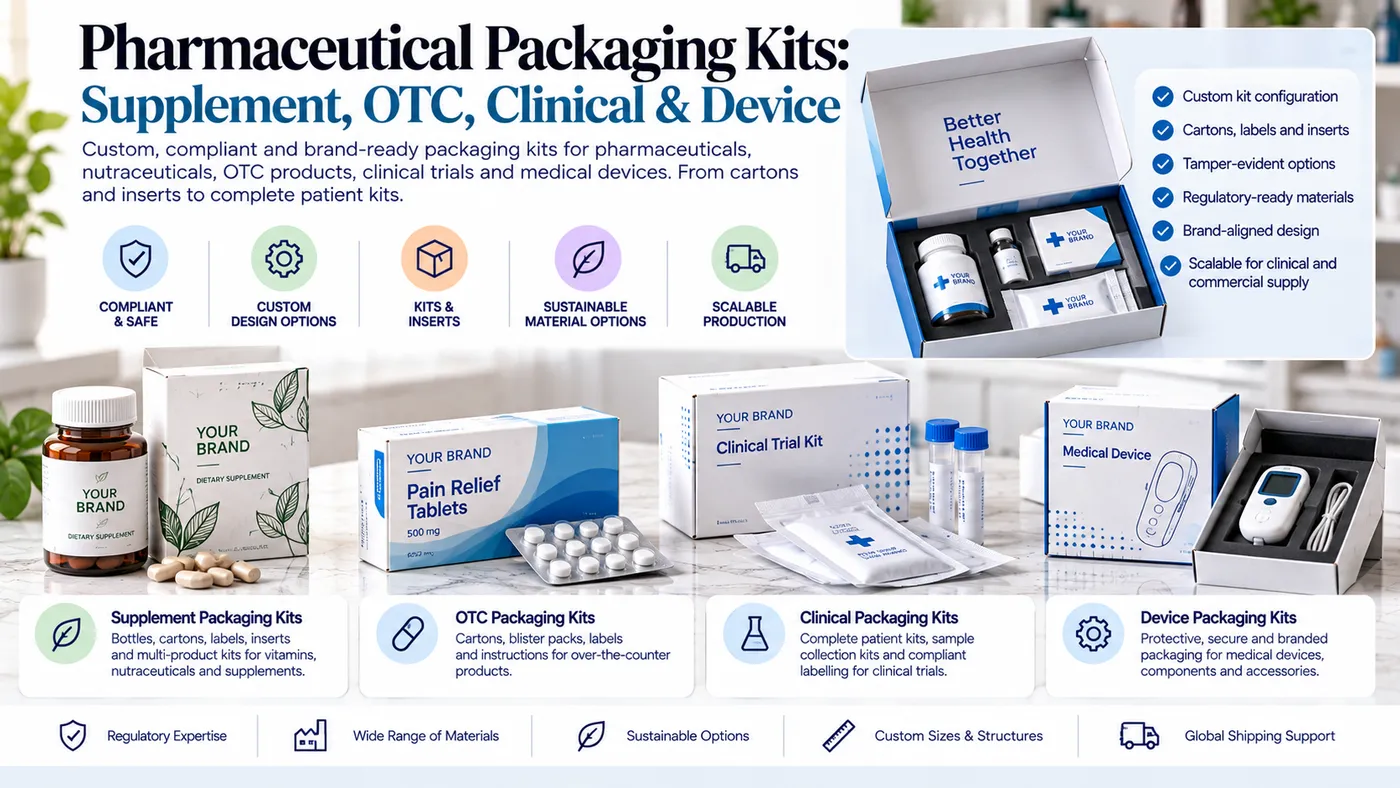
Not all pharmaceutical packaging kits work the same way. A retail supplement kit and a clinical trial carton need different panels, inserts and structure. The table below compares the four types.
Kit type | Primary regulatory reference | Key panel requirement | Tamper-evident | Blinding required |
|---|---|---|---|---|
Supplement | 21 CFR Part 101 | Supplement Facts | No (but common for retail) | No |
OTC medication | 21 CFR Part 201, 211.132 | Drug Facts | Yes | No |
Clinical trial IMP | ICH E6, local regulations | Protocol and patient ID fields | Confirm per protocol | Yes |
Medical device | 21 CFR Part 801, EU MDR | UDI barcode and HRI | Confirm per device class | No |
Key takeaway: The box follows the container and the handoff point. The panels follow the rules. Plan both before the dieline is drawn.
What Is a Pharmaceutical Packaging Kit?
A pharmaceutical packaging kit is the secondary packaging around a primary container. It's the outer box, the inner insert tray and the printed panels. It isn't the vial, bottle, blister or pouch itself. The kit is sized around the filled container. We review panel space before the dieline is final.
Four groups order these kits most often. They are supplement brands, OTC brands, trial sponsors, and device companies. Each has its own needs. Our full guide to custom pharmaceutical and healthcare packaging kits covers the ordering process.
1. Supplement Packaging Kits
Supplement kits are the most common start. They cover supplements, vitamins, protein blends and nutraceuticals. They sell direct, in retail, or by subscription.
What the structure must do. The outer box needs room for a full Supplement Facts panel. That means the ingredient list, net quantity, maker name and address, and any structure/function note. The insert holds the container still in transit. That's usually an amber HDPE bottle, a glass jar or a sachet.
Typical formats. A folding carton, tuck-end or auto-bottom, suits a single-bottle retail product. A rigid lid and base suits premium kits and gift sets. A sleeve and tray suits e-commerce subscription kits.
Panel reference. 21 CFR Part 101 covers the Supplement Facts panel. Have your regulatory team confirm all copy first.
Insert options. A fitted paperboard insert, a foam insert, or a divided tray for bottle, sachet and dosing guide.
2. OTC Medication Packaging Kits
OTC drug kits are more regulated than supplement kits. The carton must carry a Drug Facts panel in the FDA format. It also needs tamper-evident features. Many products add child-resistant closure features too.
What the structure must do. The Drug Facts panel has a minimum type size. 21 CFR 201.66 sets it at 6-point. Check the current text with your regulatory team. Ingredients, uses, warnings and directions each need clear space. Lot and expiry fields are marked on the dieline before print.
Typical formats. A tuck-end carton with a tuck lock or tear strip shows tampering. An auto-bottom carton suits heavy or multi-part kits.
Panel reference. 21 CFR Part 201 and 21 CFR 211.132 apply. Plan for the Drug Facts panel, net quantity, a tamper-evident statement, lot and expiry fields, and the NDC number.
Insert options. A fitted insert card, leaflet space, or a tray for mixed kits.
3. Clinical Trial Packaging Kits
Clinical trial kits are outer packaging for trial drugs, called IMPs. It's a specialist category. The carton must support blinding and variable data. It also needs trial IDs that change by protocol and country.
What the structure must do. Blinded cartons show no active ingredient branding. They carry a protocol number and a patient ID field. They also carry a visit or period field, lot and expiry fields, storage conditions, and adverse event contact details. Variable fields are blank print areas on the dieline. The clinical packager fills them in during fill and finish.
Typical formats. A tuck-end or auto-bottom carton suits one dosing period. A multi-part carton suits several periods.
Panel reference. ICH E6 and local rules apply. Rules vary by country. Confirm the exact labelling standard with your regulatory affairs team.
Insert options. A tray for each dosing period, a diary holder, or an instruction card.
4. Medical Device Packaging Kits
Device kits cover the outer carton around a device. They don't cover the sterile barrier, such as a pouch or blister. That's primary packaging. The carton carries a UDI barcode with its human-readable text, an intended use statement, and an IFU reference.
What the structure must do. The carton needs a set panel for the UDI barcode and HRI. A clear quiet zone keeps it scannable. It also carries lot and date fields. Add any markings your class needs, such as CE for the EU. The insert holds the device and accessories still.
Typical formats. A folding carton suits single-device kits, such as diagnostic or dental devices. A rigid lid and base suits multi-part kits, such as office starter packs or home kits.
Panel reference. 21 CFR Part 801 and EU MDR apply. Plan for the UDI barcode and HRI, intended use, lot, dates, an IFU reference, and symbols under ISO 15223-1. Have your regulatory team confirm all labelling first.
Insert options. Foam, a paperboard tray, or a divided insert. Device shape and fragility decide.
How to Choose Among Pharmaceutical Packaging Kits
When choosing pharmaceutical packaging kits, start with the regulated panel. Then pick the structure. Container size, part count and handoff point decide the format.
Handoff point | Common structure | Why |
|---|---|---|
Retail shelf | Folding carton | Lower cost, all four panels carry copy |
E-commerce subscription | Sleeve and tray | The sleeve carries copy, the tray holds parts |
Clinical dispensing | Folding or multi-compartment carton | Period-by-period layout, blank data fields |
Physician office | Rigid lid and base | Protects more, better opening experience |
My opinion: the panel decision comes first. A beautiful rigid box that can't fit a Drug Facts panel is a redesign waiting to happen.
Getting a Brief Together
Every one of these pharmaceutical packaging kits needs the same starting information. Gather these five items before you ask for a dieline:
Item | What to include |
|---|---|
Category | Product type and the rules that apply |
Container | Filled size (L × W × H) and weight |
Components | Every part, with sizes and display order |
Label copy | Panel text confirmed by your regulatory team |
Order details | Quantity and delivery destination |
Send these in the quote form. We draw the dieline around the real container sizes and the confirmed copy. Production starts only after you approve the proof.
Compare formats on our pharmaceutical and healthcare kits page. Or go straight to the page for your product:
Product | Kit page |
|---|---|
Supplements | |
OTC drugs | |
Clinical trials | |
Devices and tests | |
Premium kits |
Pharmaceutical Packaging Kits FAQ
How do supplement and OTC kits differ? Supplement kits carry a Supplement Facts panel (21 CFR Part 101). OTC kits carry a Drug Facts panel (Part 201) and need tamper-evident packaging (21 CFR 211.132). Your regulatory team confirms the panel content first.
Does clinical trial packaging have to be blinded? In most randomised controlled trials, yes. Blinded cartons show no drug branding and use protocol codes. The protocol and local rules set the exact labelling. Confirm with your regulatory affairs team.
What is a UDI barcode? A UDI is a barcode plus readable text that identifies a device. It's required under 21 CFR Part 830 in the US and EU MDR in the EU. It sits on the carton with a quiet zone on all sides. We map the panel before artwork.
Can one kit structure serve both supplements and OTC products? The physical structure can be the same. A tuck-end carton with a fitted insert can carry either panel. What changes is the copy and, for OTC, the tamper-evident feature. We review the dieline for each category.
What is the minimum order? From 50 units for folding cartons and rigid boxes. Your quote confirms the minimum for the structure you choose.
Do you make the primary container or the sterile barrier? No. We make outer packaging only: the box and insert. Vials, bottles, blisters, sterile pouches and filling are outside scope.
Who owns label compliance? The brand is. We plan panel space around the copy you provide. Have your regulatory team confirm all label content before dieline review.
How long does production take? From 7 business days after digital proof approval on the standard route. The clock starts at proof approval, not at the quote.
Choose the Kit by Its Panel First
Pharmaceutical packaging kits differ most in their label panels, not their boxes. Supplement, OTC, clinical and device kits each need different space and different fields. Decide those first, and the structure follows. This guide isn't legal or regulatory advice. Check every rule with your own team.
Ready to brief a kit? Get a free quote. We'll confirm the structure, minimum and timeline with your quote.