
Jump to section11 sections
- What plastic free packaging actually means
- Plastic free alternatives for boxes
- The lamination problem
- Is aqueous coating plastic free?
- Window patches: PET vs alternatives
- Packaging material table
- Which should you choose?
- Questions to ask your supplier
- What to send your packaging manufacturer
- Can you legally call it plastic free packaging?
- Key takeaway
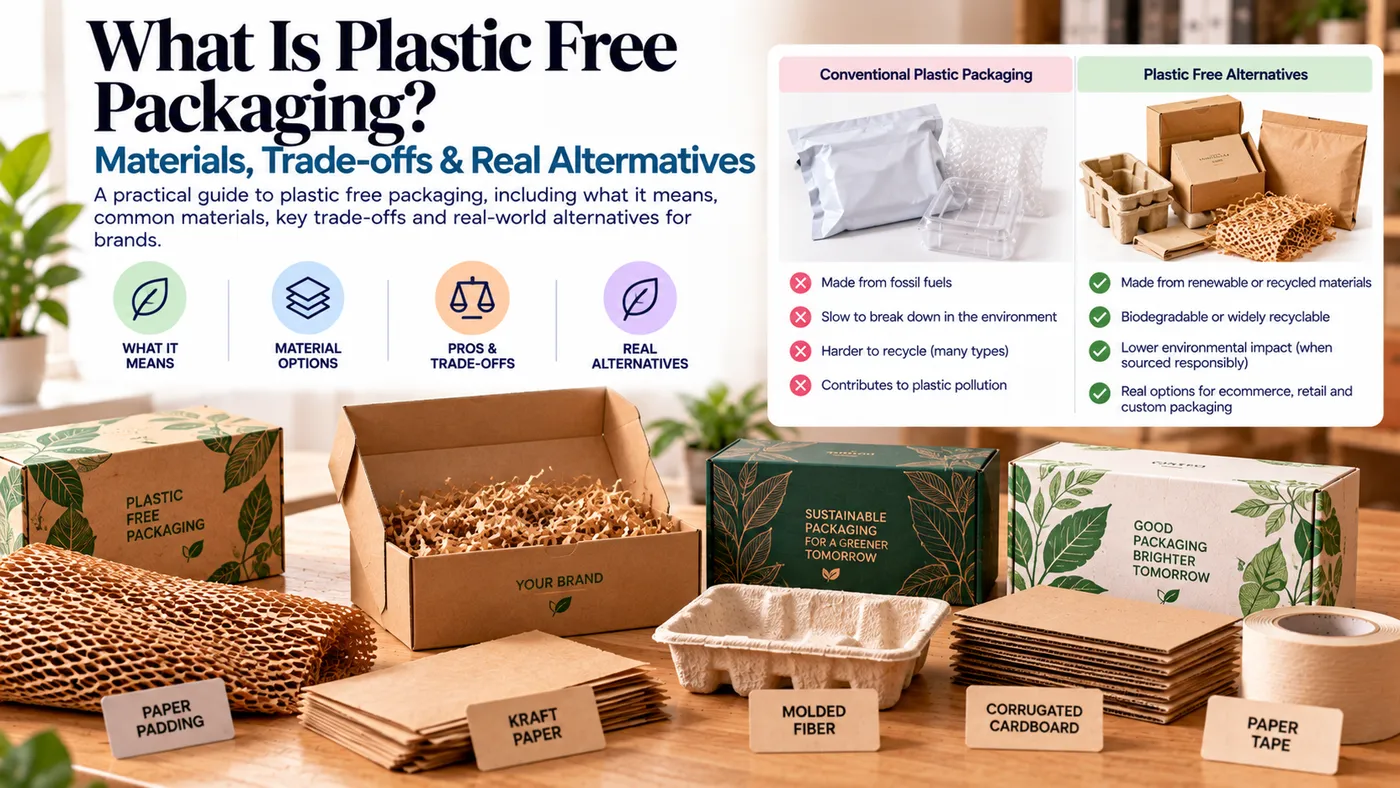
Plastic free packaging means no plastic film, coating, laminate, window, or tape anywhere in the pack. It's paper, board, metal, or glass only. In practice, most "eco" boxes still hide plastic. Think polyethylene coating on kraft, plastic laminating film, or PET window patches. Real plastic free packaging starts with an honest list of every layer. Then you weigh what each swap costs in looks and protection.
What plastic free packaging actually means
A box can be 95% paper and still not be plastic free. One film layer is enough to change the answer.
The FTC's Green Guides help here. They say a "free-of" claim is deceptive if the substance was added intentionally or sits above trace levels. A laminate is added on purpose. So plastic free should mean none in the pack, not "mostly paper." That's my reading, not legal advice.
Where does hidden plastic show up?
- PE-coated board. A thin polyethylene layer makes kraft or board moisture and grease resistant. It's common on cups and food trays.
- Laminating film. Matte, gloss, and soft touch laminates are plastic films bonded to paper. They're commonly polypropylene-based or polyester-based. Ask which.
- Window patches. The clear film in a window box is often PET. Ask for the film type.
- Tape and labels. Poly tape, film labels, and pressure-sensitive adhesives all count.
- Adhesives and coatings. These are grey areas. No universal rule says whether they count, so get your supplier's definition in writing.
Plastic free alternatives for boxes
Four swaps cover most plastic free packaging orders.
- Uncoated kraft. It feels dry, fibrous, and slightly rough. Ink sits flat and colors look muted. It scuffs, and it absorbs oil and moisture. See our guide to kraft paper or browse kraft paper boxes.
- Water-based (aqueous) coating. It gives light scuff and moisture resistance without a film. It isn't automatically plastic free, as the next sections explain.
- Tissue paper. Plain paper tissue replaces poly wrap or film-lined void fill. Ask for uncoated tissue.
- Paper tape. Water-activated paper tape replaces poly tape. Ask what the adhesive is, because the paper alone isn't the whole product.
Fewer layers also makes the recycling and composting story simpler. Our recyclable vs compostable packaging post covers those terms. Terms like these are all defined in our packaging glossary.
The lamination problem
Lamination is a plastic film pressed onto printed board. It gives the soft touch feel and the gloss people love. It also adds a layer that paper mills must separate.
In general, a mill has to pull film layers off the fiber before it can reuse the paper. Matte and gloss films both add that step. Whether a given laminated box is accepted depends on the mill and the film.
Your realistic plastic free packaging options are:
- No finish. Uncoated stock, printed directly.
- Aqueous coating. A thin liquid layer instead of a film.
- PLA-based laminate. It's plant-derived, but it's still a bio-based plastic.
On PLA, Michigan State University researchers report it can break down in industrial composters. They also say many industrial composters still decline it. Microbes can't normally digest it at home. So "compostable laminate" depends on a facility near you.
I'd skip lamination on kraft entirely. The rough texture is the finish. Compare the film options in matte vs gloss lamination if you need one.
Is aqueous coating plastic free?
Not automatically, so plastic free packaging claims need care here. Aqueous means water-based. The coating is a polymer resin dispersed in water, and many are acrylic-based. Notpla, a maker of seaweed-based coatings, argues these dispersions still count as plastic. It sells a rival coating, so weigh that. Formulas differ, and I haven't seen a standard that settles the definition.
Treat aqueous coating as "no film, but a polymer layer may remain." Our aqueous vs UV coating guide covers performance. Ask for the composition in your quote.
Window patches: PET vs alternatives
A patched window adds a separate film to the board. That film is often PET. For plastic free packaging, a patch is a deal-breaker unless the film itself is plastic free. Our window patching guide covers how it's applied.
Your choices are:
- Open cutout. No film. The product is exposed to dust and fingers.
- Bio-based film. Some suppliers offer it. Ask for certification and which disposal route it needs.
- No window. Print the product image, or add a small die-cut peek.
For candles, soap, and sealed goods, an open cutout works. For bakery and loose food, it usually doesn't.
Packaging material table
Material | Contains plastic? | Plastic free alternative | Trade-offs |
|---|---|---|---|
Kraft board with PE coating | Yes, PE layer | Uncoated kraft | Absorbs grease and moisture |
Matte or gloss laminated board | Yes, film layer | Uncoated or aqueous coated | Less scuff protection, flatter color |
Aqueous coated board | Possibly, polymer resin | Uncoated board | Looks plainer; ask for composition |
Window patch | Usually, clear film | Open cutout or no window | Product exposed, or less visible |
Poly tape or film labels | Yes | Paper tape, paper labels | Check the adhesive |
Poly mailer | Yes | Paper mailer, corrugated box | Less water resistance |
PLA film | Yes, bio-based plastic | Uncoated paper | Needs industrial composting |
Which should you choose?
Match your plastic free packaging choice to the product, not to a slogan.
- Candles and cosmetics. Skip lamination, and expect more handling marks. Use a heavier board and a drop-in paper sleeve.
- Apparel and subscription boxes. This is the easy win. Use uncoated kraft, tissue, and paper tape.
- Bakery and coffee. Grease and moisture are the problem. Ask for a grease-resistant option and exactly what it's made of.
- Ecommerce orders. Corrugated plus paper tape is usually the simplest plastic free setup.
I've seen brands order kraft boxes, then add gloss lamination because the proof looked dull. They ended up with a plastic box in paper clothing. Decide the plastic rule first.
Questions to ask your supplier
- Is every layer, including coatings, adhesive, and tape, free of plastic?
- What is the coating made of? Can I see the specification sheet?
- What film is the window patch, and can I skip it?
- Which certification backs any "compostable" or "recyclable" claim, and for which disposal route?
- What will the board scuff like? Can I see a sample first?
Never assume a box is plastic free. Ask for the material list in your quote. For more on cost trade-offs, see our eco-friendly custom packaging guide.
What to send your packaging manufacturer
- Product dimensions, weight, and quantity
- Box style and whether you want a window
- Your plastic rule: none, or only certain layers
- Artwork status and print method
- Finish you prefer, and one you'd accept instead
- Destination and required date
Can you legally call it plastic free packaging?
Be careful. The FTC's Green Guides warn against unqualified claims like "eco-friendly." Compostable claims need evidence. All materials must break down safely and on time. Recyclable claims need qualifying where facilities reach fewer than 60% of consumers.
Both points come from the FTC Green Guides summary. Check current rules and get legal review before printing a claim.
Key takeaway
Plastic free packaging means checking every layer: coating, laminate, window, tape, and adhesive. The simplest version is uncoated kraft, tissue, and paper tape. Anything more finished needs a written material list.
Limits: this guide isn't legal advice, and material definitions of "plastic" vary by region.