
Jump to section8 sections
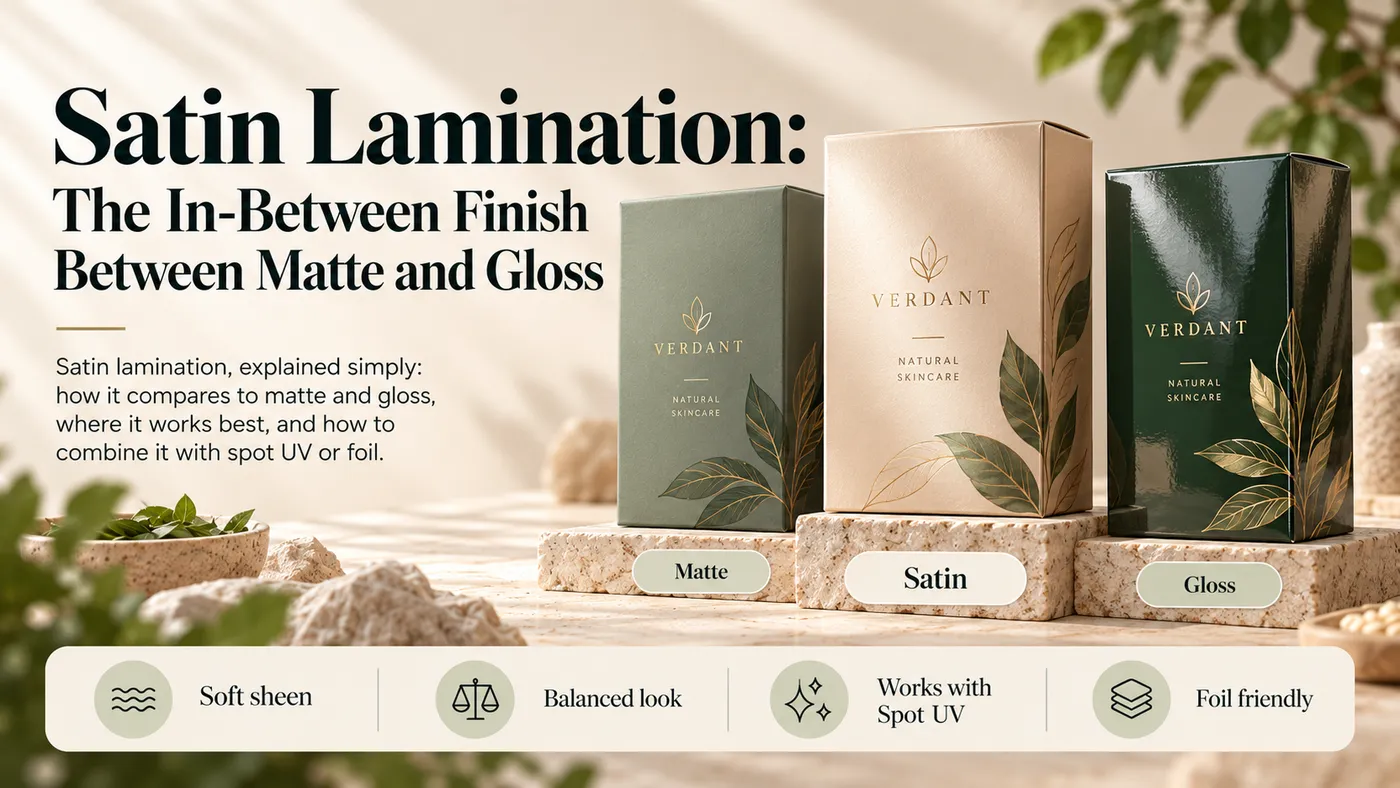
Satin lamination sits between matte and gloss. Some suppliers call it silk lamination instead — it's the same finish under a second name. It has a subtle sheen. That sheen reflects light softly, without the full mirror-effect of gloss laminate. Satin resists fingerprints better than gloss. It also shows color more vividly than matte.
This guide covers what satin lamination actually is. We'll walk through how it stacks up against matte and gloss. We'll also cover where it earns its place on a box. For the full list of finishing terms this one belongs to, see our packaging glossary.
Why the name confuses buyers
Satin and silk aren't the only names floating around for this finish. Some suppliers call it "pearl" lamination instead. Others use a proprietary name tied to their own film manufacturer. The texture and sheen level is usually the same across these names. Still, it's worth asking for a physical sample. Don't assume every supplier's "satin" looks identical.
This naming confusion is one reason satin lamination gets under-ordered compared to matte and gloss. Some buyers don't know to ask for it by name, or by a close synonym. They often default instead to whichever two finishes their supplier leads with on a quote sheet.
What satin lamination is
Satin lamination is a thin plastic film applied over printed paperboard. The film itself has a texture between the two more familiar options. It's not as flat as matte. It's not as reflective as gloss.
Some suppliers brand this exact finish as "silk lamination" instead of satin. The name changes by supplier, but the film and the result are the same thing. Ask for either term, and a knowledgeable printer should know exactly what you mean.
The sheen comes from the film's surface texture, not from any coating added on top. That's a key difference from spot UV. Spot UV sits on top of a laminate, rather than being the laminate itself.
How it compares to matte
Matte lamination has almost no shine at all. Satin lamination adds a visible but gentle sheen on top of that same flat base feel. Side by side, satin reads as slightly more premium and slightly more reflective under direct light.
Color vibrancy is where the two finishes really split. Matte can mute saturated colors a bit, since it absorbs more light than it reflects. Satin lets color pop more than matte does, without going all the way to gloss's high-contrast shine.
Satin also keeps most of matte's soft, tactile hand-feel. It's not identical, but it's close. A brand switching from matte to satin usually keeps the premium touch feel. That's the quality they liked in the first place.
How it compares to gloss
Gloss lamination is the shiniest of the three common finishes. It reflects light almost like a mirror. Satin lamination pulls that reflection way down, while still adding more shine than matte alone.
Fingerprints are the real differentiator here. Gloss shows oil and handling marks fast, especially on dark colors. Satin resists fingerprints noticeably better than gloss, though it isn't fully fingerprint-proof either.
I've seen a brand pick satin specifically to dodge gloss's fingerprint problem. They still saw visible handling marks on a deep navy box at retail. Satin cuts the problem significantly. It doesn't erase it completely on dark, saturated colors.
Where satin lamination works best
Satin lamination shows up most in cosmetics, mid-tier retail packaging, and stationery. These categories want a finish that reads as premium without the stark, almost clinical shine of full gloss.
cosmetics brand launching a new line often picks satin for exactly this reason. It photographs well under studio lighting. It also holds up reasonably well to repeated handling at a counter or shelf.
Mid-tier retail packaging uses satin as a middle-ground choice too. It signals "a step up from basic." It avoids gloss's cost and fingerprint issues across a whole line.
Durability and handling
Satin lamination holds up well under normal retail and shipping handling. The film resists scuffing about as well as matte or gloss. All three use a similar base plastic film. The difference is just the surface texture pressed into it.
Where satin does show wear is under repeated, heavy friction. Constant handling at a busy retail counter is the main case. A light surface haze can build up over time there. It's rarely an issue for e-commerce packaging. Most of those boxes only get handled a handful of times before reaching a customer.
Satin also holds up fine in cold-chain or refrigerated environments. That matters for cosmetics brands storing product before shipping. The lamination film itself isn't affected much by cold storage. An uncoated paperboard surface can fare worse in the same conditions.
Comparing matte, satin, and gloss
Matte | Satin | Gloss | |
|---|---|---|---|
Sheen level | None to minimal | Subtle, soft sheen | High, mirror-like |
Fingerprint visibility | Low | Low to moderate | High |
Color vibrancy | Muted | Vivid | Most vivid |
Relative cost | Baseline | Slightly above matte | Similar to satin |
Tactile feel | Soft, flat | Soft, slightly reflective | Smooth, slick |
Combining satin with other finishes
Satin lamination pairs well with a spot UV accent. A logo or key graphic gets a glossy spot UV hit. The rest of the panel stays in satin's softer sheen. That contrast makes the spot UV element pop more than it would against a full-gloss background. For more on how that coating works, see our guide to spot UV coating.
Satin also works alongside foil stamping without a visual conflict. The foil's metallic shine stands out clearly against satin's muted base. Satin doesn't compete with foil's reflectivity the way a full gloss laminate can.
According to PRINTING United Alliance, finishing and coating choices remain a very active area of print innovation. That's part of why new named variations on satin and silk lamination keep showing up from different suppliers.
Satin lamination and soft touch lamination are two different finishes. They're worth telling apart before you quote a job. Soft touch adds a velvety, rubberized texture. Satin stays closer to a standard laminate feel with just a sheen change. For a deeper look at the matte-to-gloss spectrum, see our guide on matte vs gloss lamination.
One honest limitation worth naming: sheen level and fingerprint resistance can vary slightly between suppliers and film manufacturers. Lighting conditions at retail can change how reflective satin appears too. It may not match exactly how it looked in a proof. A physical sample under your actual lighting conditions is worth checking before committing to a full print run.