
Jump to section8 sections
Soy based ink replaces part of the petroleum-derived oil in an ink with soybean oil. It tests lower for VOC content, but the real-world gain is modest and debated. The benefit depends on two things. One is how much soy oil the ink actually contains. The other is whether your box ever reaches a recycling mill. Ask your printer for the soy percentage in writing before you pay extra.
What counts as soy based ink?
There's no legal definition. The best-known yardstick is the SoySeal, the "Printed with Soy Ink" mark owned by the American Soybean Association (ASA). Its published standards set a minimum soy oil share, measured as a percentage of total formula weight. As of October 2026, the minimum depends on the ink type.
- Sheet-fed ink (the offset category): 20%
- Heat-set ink and UV/EB ink: 7%
- Metallic ink: 10%
- Screen printing ink: 25%
- Black news ink: 40%
So "7% soy oil" isn't a universal rule. It applies to heat-set and UV/EB inks. Soybean oil must also be the main vegetable oil in the formula.
The rest of the ink is still pigment, resin, and additives. A Printing Industries of America environmental executive made this point in a 2013 TriplePundit interview. The seal sets a soy oil amount and says nothing about the other ingredients. The European printing ink association EuPIA adds that SoySeal-marked inks aren't mineral-oil-free.
What soy based ink does well
Give it fair credit. Soy based ink swaps part of a petroleum oil for a renewable crop oil. That's a real change in the raw material.
On the EPA's Method 24 lab test, the PIA executive said soy inks show less VOC content. VOCs are the volatile compounds that evaporate as ink dries. The ASA also says soy ink gives accurate colors and is easier on paper recycling. It adds that soy ink dries more slowly than many inks.
Treat the color and recycling lines as trade-group claims. Color depends far more on pigment, paper, and press control than on the oil. I wouldn't choose soy based ink for color alone.
Where the eco claim gets thin
VOC content isn't VOC emissions. The PIA executive explained that vegetable oils dry by absorbing oxygen. That crosslinking releases VOCs itself. Lower measured content doesn't guarantee lower emissions at the press.
The recycling benefit is contested. The easy de-inking idea traces to a 1991 lab study. That study used ink aged only four weeks, according to the PIA executive. He said fully aged vegetable-oil ink can be harder to remove from pulp. A lab test like INGEDE Method 11 measures de-inkability for a specific print, so ask for one.
Soy farming has its own footprint. WWF says soy conversion is pushing into forests and grasslands, including the Cerrado. It reports that over half of that region's native landscape is gone, largely to livestock and soybean farming. It also lists soil erosion and greenhouse gases. WWF adds that almost 80% of the world's soybean crop goes to livestock feed, so ink is a tiny user. Still, "renewable" doesn't mean "free of impact."
Landfill reality. A box in a landfill gets little benefit from its ink. The paper is the bigger variable, whatever ink sits on it.
I've seen brands print "soy ink" on a box that's also laminated, foil stamped, and sleeved in plastic. The ink was the least important recycling question on that pack.
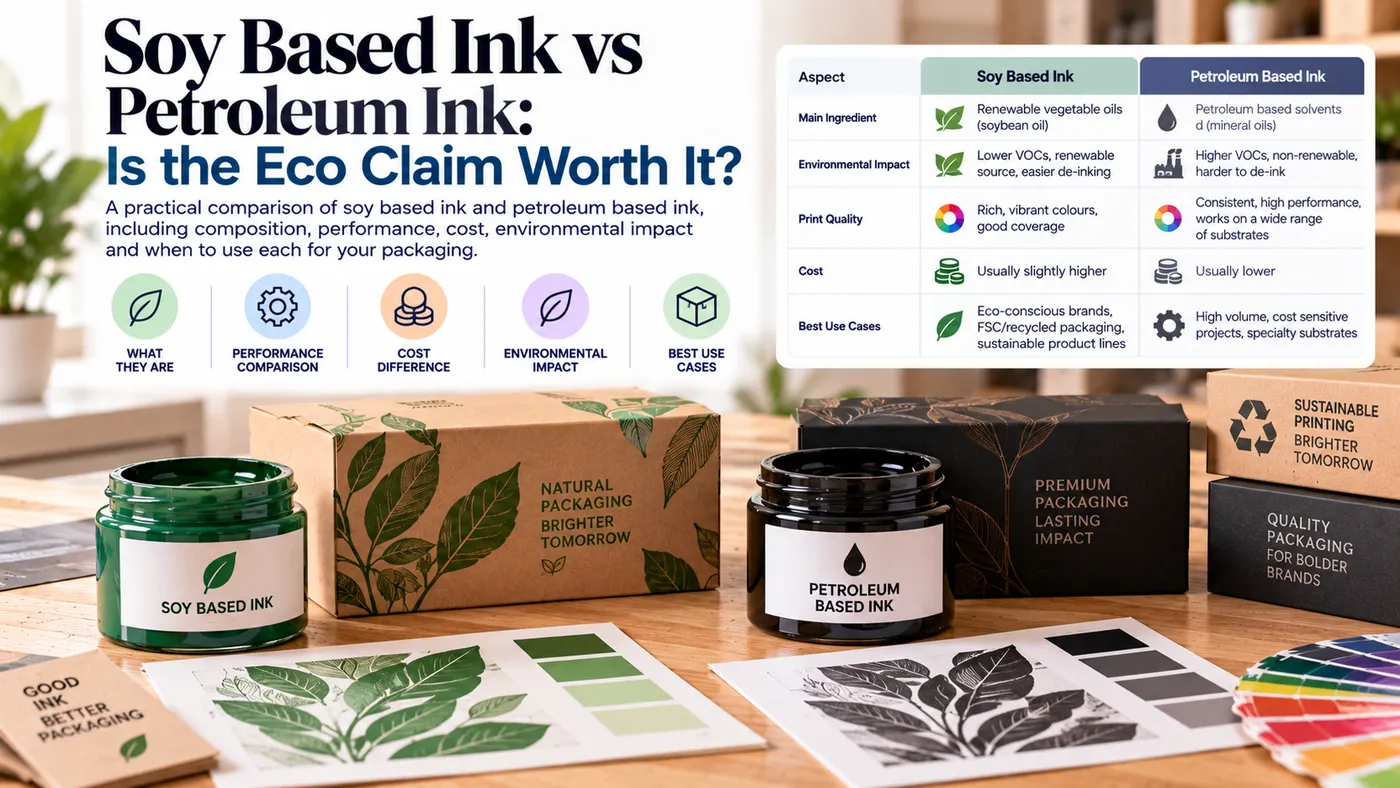
Soy based ink vs petroleum ink: comparison table
This table stays qualitative on purpose. We found no verified data on cost or color gamut, so we don't state any.
Factor | Soy based ink | Petroleum-based ink |
|---|---|---|
Oil in the vehicle | Soy oil share meets a minimum; rest can be mineral oil | Mineral (petroleum) oil |
VOC content (Method 24) | Lower, per PIA | Higher, per PIA |
VOC emissions in use | Disputed; drying releases some VOCs | Varies by press and drying method |
De-inkability | ASA says easier; PIA says aged ink can be harder | Varies by formula and coverage |
Dry time | ASA says slower than many inks | Often the reference point |
Color | Pigment, paper, and press control decide | Pigment, paper, and press control decide |
Cost | Request both options priced | Baseline |
Does soy based ink apply to digital printing?
Not in the same way. Digital presses split into dry toner, liquid ink or liquid toner, and inkjet. HP, for example, calls its Indigo ElectroInk a liquid ink with pigment particles in a carrier liquid. None of these is the oil-based paste ink that the SoySeal sheet-fed standard describes.
The SoySeal standards list news, sheet-fed, heat-set, screen, UV/EB, and flexographic inks. They don't list digital press consumables. Easy Box Packaging prints with digital and offset methods. Whether a soy option exists depends on the press and ink supplier, so ask. Our offset vs digital printing guide explains how the two methods differ.
Which should you choose?
My view: choose soy based ink when it costs little extra and comes with a stated soy percentage. Don't pay a big premium for it. Don't print the claim on your box unless your printer can document it.
Better levers usually exist. These move recycling and sourcing further than ink does:
- Pick recycled-content board where the product allows it. Our post-consumer recycled packaging guide covers the labels.
- Ask about certified fiber. Our FSC certification guide explains the claims.
- Skip plastic laminate and heavy foil on boxes meant to be recycled.
- Keep ink coverage light. Natural kraft with one color is the easiest job for a recycler.
If your customers recycle, the ink matters a little. If they don't, it hardly matters. Our recyclable vs compostable packaging guide explains why those words aren't interchangeable.
What to ask your printer
- Which ink will you use on my job, and who makes it?
- What's the soy oil percentage as a share of total formula weight?
- Does the ink carry the SoySeal, or is it "soy-based" in the supplier's words?
- Does the ink contain mineral oil, and can you share the data sheet?
- Can you share a de-inkability test report for this ink and coverage?
- What's the price and dry-time difference versus your standard ink?
- Which coatings and laminates go on top, and do they affect recycling?
- What exact claim wording am I allowed to print on the box?
For paper options, compare eco-friendly boxes and custom kraft paper. For the wider cost picture, read eco-friendly custom packaging: what it costs and what works. The full term list lives in our packaging glossary.
Key takeaway
Soy based ink is a small, real change in raw materials, not a recycling guarantee. Ask for the soy percentage, skip big premiums, and put your effort into paper, coatings, and recyclability.
Sources and limits: SoySeal figures reflect the ASA's published standards as of October 2026 and can change. Easy Box Packaging doesn't claim SoySeal certification or any specific ink type.