
Jump to section7 sections
FSC stands for Forest Stewardship Council. FSC certified packaging means the paper came from forests managed to FSC's rules. Those rules cover the environment. They also cover local communities. FSC certified packaging can carry the FSC logo. Some stores ask suppliers for that logo. Some brands ask too. It's a claim about where the wood came from. It is not a claim about recycling. It is not a claim about composting either.
This guide covers what FSC certified packaging really means. We'll walk through the three label types you'll see. We'll also cover how to ask a supplier for it. For the full list of sustainability terms this one belongs to, see our packaging glossary.
What is FSC and who runs it?
FSC is a global nonprofit group. It sets rules for careful forest use. It also runs a tracking system. That system follows wood fiber from the forest to your finished box.
A mill, converter, or printer needs an outside check to use the FSC label. An auditor checks the paper trail at each step. That check confirms the fiber in your box really traces back to a certified forest. It's not just a claim on a label. It's a checked one.
FSC certified packaging shows up often in paper, folding carton, and corrugated boxes. Other forest labels exist too, like PEFC and SFI. FSC is simply the best-known name among them. Buyers often ask for it by name, even when another label would meet the same goal.
The three FSC labels
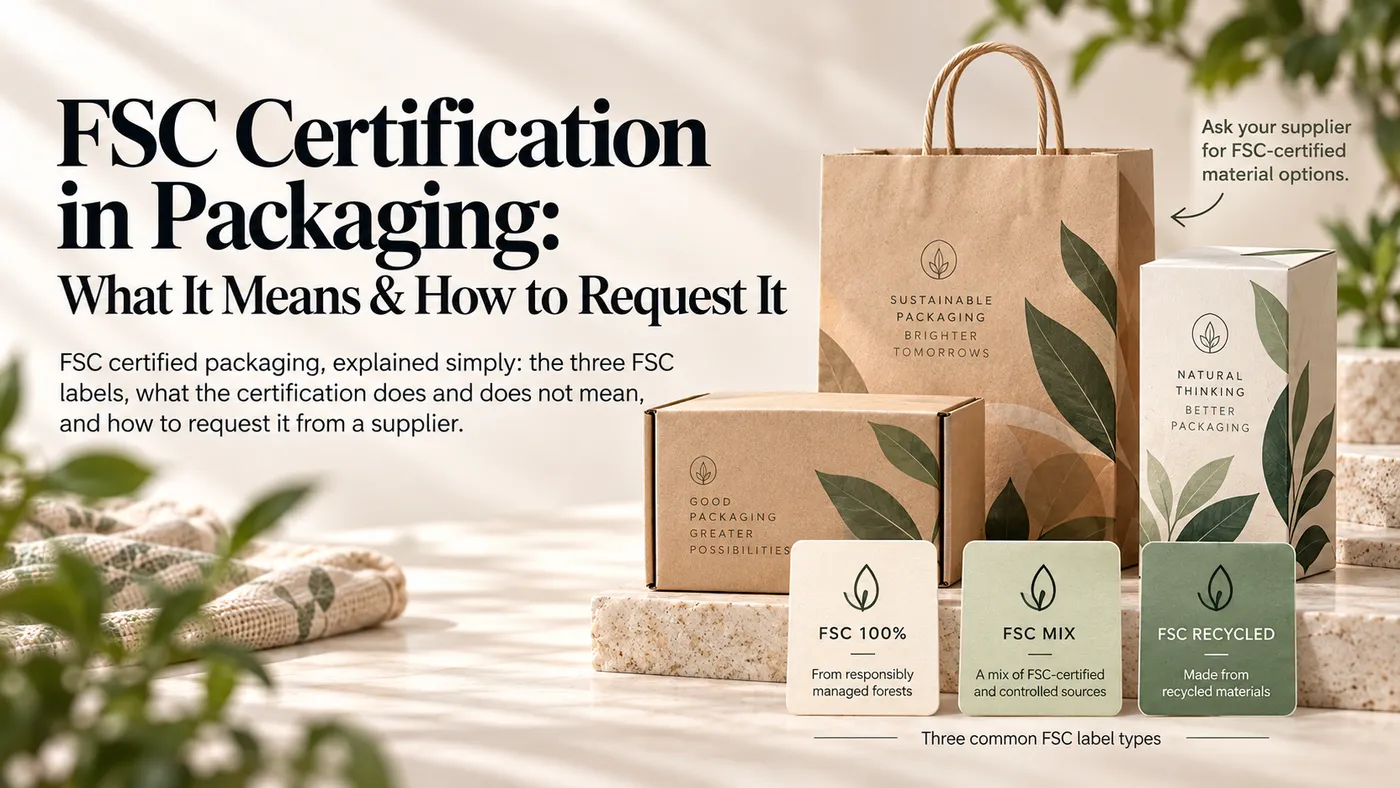
Not every FSC certified packaging claim means the same thing. There are three main label types. The difference matters if you're making a claim to a store buyer or a customer.
FSC 100% means all the virgin fiber came from FSC forests. This is FSC's strongest single-source label.
FSC Recycled means the whole product comes from reclaimed paper. None of the fiber needs to trace back to a forest at all. It's all recycled content instead.
FSC Mix blends FSC fiber with other sources. Those other sources are either recycled or separately checked. This is the most common label on everyday packaging. It's simply cheaper and easier to source than a pure FSC 100% product.
A box marked "FSC Mix" doesn't promise a high share of certified fiber. The blend ratio can vary a lot from supplier to supplier. If a buyer needs an exact fiber percentage, ask for that number directly. Don't guess it from the label alone.
I've seen a brand assume "FSC Mix" meant mostly certified fiber. Their retail buyer later asked for the exact blend percentage. The supplier's actual number came in much lower than the brand expected. That gap caused a real scramble right before a retail audit. Asking the percentage question early would have avoided it entirely.
Why buyers and brands request FSC
Large retailers increasingly ask for FSC certified packaging from their vendors. It's often a condition for getting shelf space at all. This shows up most in big-box retail, grocery, and large buying contracts.
Brands also want it for their own sustainability reports. An FSC claim gives a brand something specific to point to. It can be checked too, unlike a vague "eco-friendly" label that nobody can really verify.
Some brands print the FSC logo right on their box art. That needs its own license from FSC. It also comes with specific rules, on top of the base certification itself. Getting this part wrong is a common slip-up. It's worth checking logo rights before artwork goes to print.
Smaller brands request FSC certified packaging for a different reason too. A clear, checkable label builds trust with their own customers. It backs up a sustainability claim with something real. That beats marketing language alone on the box.
What FSC certification does NOT mean
FSC certified packaging is a claim about sourcing. It's not a claim about what happens to the box after someone uses it. A box can carry FSC certification and still only be recyclable in some cities, not all of them. For the disposal side of that question, see our guide on recyclable vs compostable packaging.
FSC certification also isn't the same as recycled content. FSC Recycled is one specific label for that exact case. But plenty of recycled packaging carries no FSC label at all. Our guide to post-consumer recycled packaging covers that separate system in more depth.
One more thing worth knowing: FSC certified packaging doesn't mean a specific paper grade. Certified fiber shows up in heavy corrugated board. It also shows up in light kraft paper. The label travels with where the fiber came from. It has nothing to do with the paper's weight or finish.
It also doesn't guarantee a specific print finish, coating, or color. A certified box can look exactly like a non-certified one on the shelf. The real difference sits in the paperwork behind it. A customer can't see or feel that difference at all.
How to request FSC-certified packaging from your supplier
Ask your supplier a direct question. Do they hold current FSC certification? A real certificate number should be ready on request. Check that it's still active, not expired.
Say which label you actually need: 100%, Recycled, or Mix. Each one costs differently. Each one has its own sourcing limits too. Being clear up front avoids a mismatched quote later.
Treat logo use as its own, separate ask. Putting the FSC logo on finished packaging needs its own license. That's true even once the material itself already qualifies.
We can't confirm EBP's own certification status here. Ask about FSC-certified stock directly in your quote request instead. A packaging partner should tell you clearly whether that option is open for your order.
What this means for a typical order
Most brands don't need to pick a label in a vacuum. Start with what your retail buyer actually asked for in writing. If no one asked for a specific label, FSC Mix is usually the easiest starting point. It's also the most affordable one for a first run of FSC certified packaging. Save FSC 100% for a premium line. That's where the sourcing story itself becomes part of the brand pitch.
Lead time and minimum order size can shift slightly with a certified stock choice. Not every mill stocks every label in every paper weight. Build in a little extra buffer the first time you switch. Lock in your preferred option once your supplier confirms it's available.
FSC is one piece of a bigger sustainability picture, not the whole thing. For the cost side of going greener across your packaging more broadly, see our guide on eco-friendly custom packaging.
FSC 100% vs FSC Recycled vs FSC Mix
FSC 100% | FSC Recycled | FSC Mix | |
|---|---|---|---|
What the label claims | All virgin fiber from FSC forests | All reclaimed material | Mix of certified, recycled, or checked sources |
Typical paper types | Premium virgin paperboard | Recycled kraft, recycled corrugated | Most common folding carton and corrugated |
Relative cost | Highest | Lowest to moderate | Moderate |
Common use case | Premium retail, brand-forward boxes | Budget-friendly green claims | General commercial packaging |
One honest limit worth naming here: certification status can change over time. Not every supplier offers every FSC label on every paper grade. Rules and label requirements can also shift as FSC updates its own standards. Check current certification and label options directly with your packaging partner. Do this before you print any sustainability claim on a box or in your marketing.