Folded shirt or knit carton
Wrap a folding carton around a folded shirt, sweater, or small knit while keeping the inner fit available for future collections.

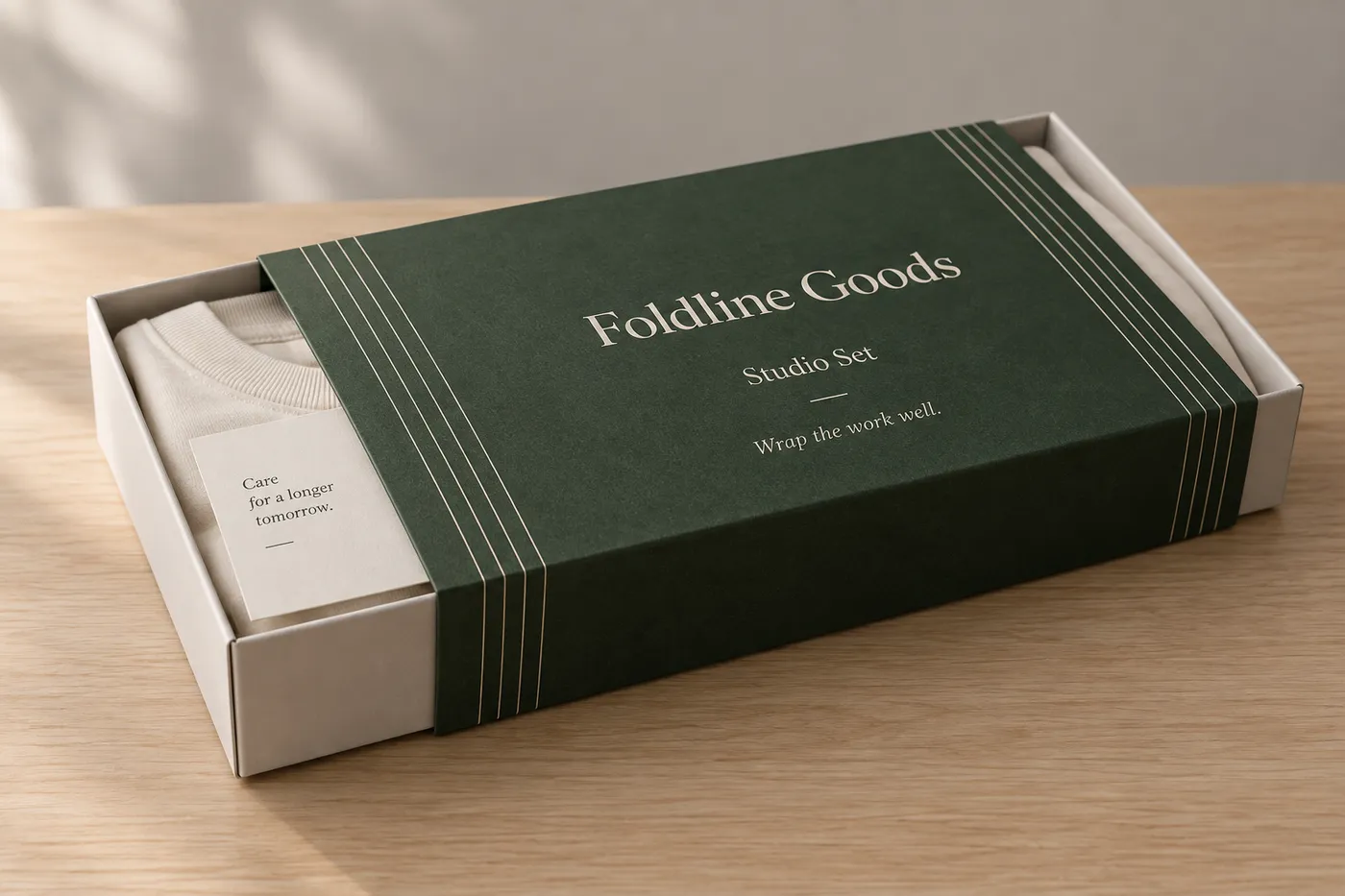
Deep green Foldline Goods apparel sleeve around a shallow carton holding a folded ivory T-shirt.
Sleeve Boxes
A custom apparel sleeve wraps a printed outer panel around an inner carton, tray, or folded garment pack so clothing can arrive with a clear brand presentation without rebuilding the inner fit for every campaign. Share the finished inner-box dimensions, garment fold, sleeve overlap, board direction, artwork coverage, and finish preference so the wrap is sized around the actual pack.
Last updated
Working quote
Product brief
A custom apparel sleeve gives a folded shirt, scarf, accessory, or small clothing set a branded outer face while an inner carton or tray controls the packed shape. That division is useful when the inner pack already fits the garment and the visible message needs to change for a collection, season, retailer, or collaboration. The sleeve is not the whole container; it is the printed layer that slides over the pack, frames the opening, and carries the product story customers read first.
Start with the finished inner pack rather than the loose garment. Measure the width, depth, and height after folding, including tissue, a hangtag, care card, belly band, or any insert that travels inside. Note which face should be front-facing when the sleeve is on, where a seam or opening will sit, and how much of the carton should remain visible. A sleeve can slide from one end for a gradual reveal, or it can be open at both ends when staff need to remove and replace the wrap quickly. The choice depends on the inner structure, the presentation sequence, and the way the apparel is packed.
The overlap is a fit decision, not a decorative margin. A wrap that is too tight can catch on a laminated corner or distort the inner carton; one that is too loose can rotate and hide the front artwork. Supply the finished outside dimensions of the inner carton or tray, its board thickness, the direction of the grain if known, and the points where the sleeve must clear a lid, tuck flap, pull tab, or raised label. If the garment is folded directly into the sleeve, describe the folded footprint and the amount of compression the presentation can accept.
For a retail apparel pack, also explain how the item will be shelved or handed over. A narrow vertical sleeve may keep a size or collection line easy to scan, while a wider horizontal wrap may give a folded knit or accessory more room for the brand mark. Those are layout choices tied to the actual pack; they should not be selected from an empty category silhouette. If several garment sizes share one design, list the finished inner dimensions for each size so the sleeve can be reviewed as a repeatable family rather than one average.
SBS Paperboard gives a smooth printed face for a detailed apparel mark, size callout, or care message. Kraft Paperboard can support a more natural visual direction when the warm base tone is part of the design. Corrugated Board may be considered when the sleeve must coordinate with a sturdier outer pack or a heavier e-commerce presentation. The suitable material depends on the finished inner pack, handling route, desired rigidity, and artwork; the material should be confirmed against those requirements before production.
Matte Lamination can be reviewed when small type, garment composition, or care information needs a lower-glare reading surface. Gloss Lamination, Spot UV, Foil Stamping, and Embossing/Debossing can be considered for selected panels or marks subject to artwork review. Keep the important information away from a sleeve seam, overlap, or edge that disappears under the inner carton. A digital proof should show the flat dieline and the assembled wrap so the front panel, back panel, opening direction, and finish locations can be checked together.
A sleeve can dress a folding carton holding a folded T-shirt, knit, or accessory while leaving the carton available for repeated collections. It can group a small apparel set with a card or hangtag, provided the inner tray or carton keeps each piece in its intended position. A seasonal campaign can use a new printed wrap over a consistent inner pack, which keeps the physical fit stable while changing the message on the shelf or at the unboxing.
The format also suits boutique counter presentation when the sleeve acts as the first label a customer sees. If the garment must hang, breathe, or remain visible through a window, explain that requirement early; a full paperboard wrap may not be the right presentation. Likewise, a fragile embellishment, rigid accessory, or unusually thick fold may need a different inner structure before the sleeve is designed. The useful specification connects the garment's shape and handling to the outer wrap rather than treating every apparel item as a flat rectangle.
Send the assembled inner-box or tray width, depth, and height, the folded garment dimensions, the number and type of inserts, the desired sleeve opening, and the sleeve overlap or seam location if you have a preference. Include the board direction, print coverage, color references, finish requests, quantity, destination, and whether the pack is for retail shelving, a counter handoff, or e-commerce fulfillment. A photo of the packed garment or a physical sample can clarify corners, labels, and the reveal better than a product name alone.
The standard minimum order is 50 units. Production is from 7 business days after digital proof approval, and Free US shipping is available on the standard fulfillment path. Dieline and proof review are included on every order at no extra charge, so the assembled wrap, artwork placement, and finish map can be checked before the run moves forward. A sample kit carries a $44.99 USD shipping charge credited toward the first order when a paperboard direction or printed surface needs to be compared in hand.
The proof should answer a few practical questions: Does the sleeve slide over the actual inner pack without catching? Does the chosen front panel face the customer or packer? Are size, material, care, and collection details legible after the overlap is closed? Do the artwork and any Spot UV, Foil Stamping, or Embossing/Debossing marks stay clear of a fold, seam, or exposed edge? Review the flat dieline and assembled view together, because the same artwork can read differently once the wrap is installed.
A useful apparel sleeve brief keeps the visible message and the physical pack in the same conversation. Once the finished inner dimensions, garment fold, opening direction, board choice, print coverage, and route are known, the quote can address the sleeve as a real component of the apparel presentation rather than a generic band placed around an unknown box.
Proof points
The useful proof shows the flat dieline and the installed sleeve so fit, reading order, and print treatment can be checked against the actual apparel pack.
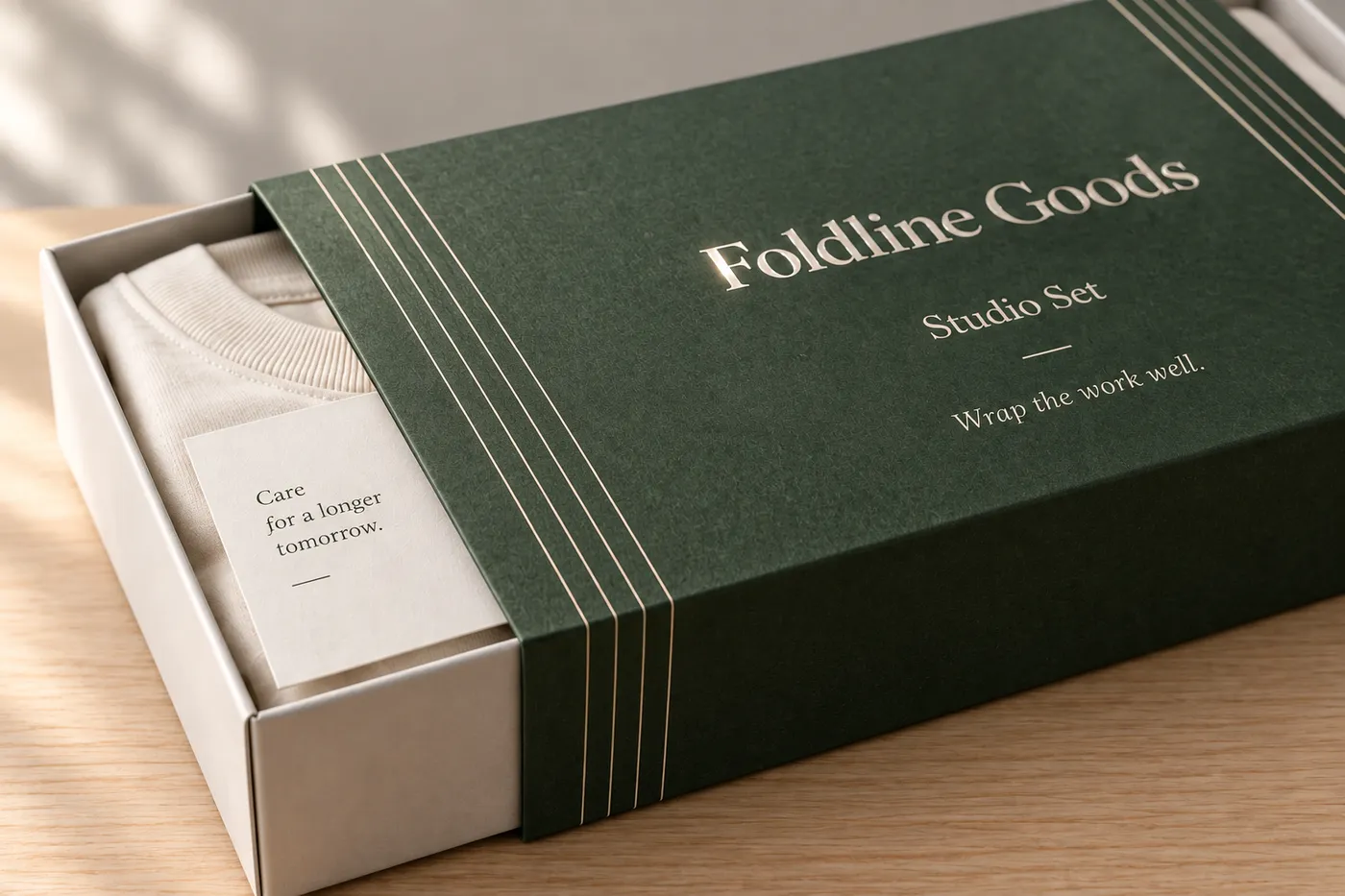
The sleeve is a visible outer layer, while the inner carton or tray controls the garment's packed shape. Finished dimensions, overlap, opening direction, seam location, board, and artwork need to be reviewed together so the wrap sits cleanly and presents the intended panel.
Wrap a folding carton around a folded shirt, sweater, or small knit while keeping the inner fit available for future collections.
Use a sleeve over an inner tray holding a belt, scarf, socks, or a small apparel bundle with a card or hangtag.
Change the printed outer message for a launch or season while keeping a consistent inner carton footprint for the range.
Present a folded garment with a front panel that reads at the counter, provided the pack does not need a window or hanging format.
Add a removable printed wrap around an inner carton when the shipping route and garment presentation benefit from a defined outer layer.
Plan artwork around the sleeve seam, overlap, opening, and the panel customers see first. The supplied dieline and assembled view should show how the mark, size, care, and collection information will read on the finished pack.
An apparel sleeve works when the folded product, inner structure, opening sequence, and printed face agree. Those details guide the quote more reliably than a generic clothing size or an empty box outline.
Finished carton or tray width, depth, height, board thickness, inserts, and labels establish the sleeve footprint and clearance.
One-end or two-end opening, seam position, shelf orientation, and handoff route shape how the wrap is removed and read.
Size, collection, care, and brand details are mapped around the front panel, overlap, edges, and any selected finish.
A complete brief lets the quote and proof focus on the finished garment pack, not a generic sleeve shape.
Provide the assembled inner-box or tray width, depth, height, board thickness, folded garment size, inserts, and each size in the range.
Note the preferred opening direction, overlap, seam location, front-facing panel, retail or e-commerce route, and any clearance concerns.
Send the print files or concept, color references, size and care information, and any Matte Lamination, Gloss Lamination, Spot UV, Foil Stamping, or Embossing/Debossing request.
Check the flat dieline and assembled sleeve for fit, reading order, artwork placement, edges, overlap, and finish locations before approval.
Once the proof is approved, the standard path starts from 7 business days; the standard minimum order is 50 units.
Need help with structure, materials, or production planning? See how we manufacture custom packaging.
Request a sample kit when you need to compare paperboard direction, surface treatment, or printed detail before choosing the sleeve for an apparel range. The kit carries a $44.99 USD shipping charge credited toward your first order.
Shipping charge: $44.99. Credited toward your first order.
Request a Sample KitFind clear answers about fit, materials, and ordering below.
Measure the assembled inner carton or tray from the outside, including board thickness, and record the folded garment footprint, inserts, labels, and any raised or projecting parts. Include the intended overlap and which panel should face the customer.
Yes, when each size is listed with its finished inner-box or folded-pack dimensions. A shared artwork direction can be reviewed across a range, but the sleeve footprint and clearance should be checked for each actual pack rather than based on one average.
SBS Paperboard, Kraft Paperboard, and Corrugated Board are the category material directions. The suitable choice depends on the inner structure, route, desired rigidity, and artwork, so share the packed garment and handling context with the quote request.
Matte Lamination, Gloss Lamination, Spot UV, Foil Stamping, and Embossing/Debossing can be considered for the artwork. Finish locations and detail remain subject to review against the supplied dieline, board, and scale.
The standard production estimate is from 7 business days after digital proof approval. The standard minimum order is 50 units, and the final quote still depends on the finished dimensions, quantity, board, print coverage, finish, and destination.
A sample kit can be requested when you need to compare paperboard or printed surface directions. It carries a $44.99 USD shipping charge credited toward your first order.
Orders start at 50 units and scale up to 500,000 for bulk runs, with pricing from $0.36 per unit on larger quantities. Standard production is from 7 business days after digital proof approval.
Compare nearby products and request the format that best fits your next run.

Available product

Available product
Apparel packaging, sized to the pack
Tell Easy Box Packaging what the sleeve will wrap, how it should open, and which panel should carry the apparel story. We can then review the board, artwork, overlap, and finish as one specification.
Add your product details to see a quote summary.