Retail chocolate bars
A repeatable sheet or band can keep the collection name and flavor face consistent on a shelf while staff replenish the same format.

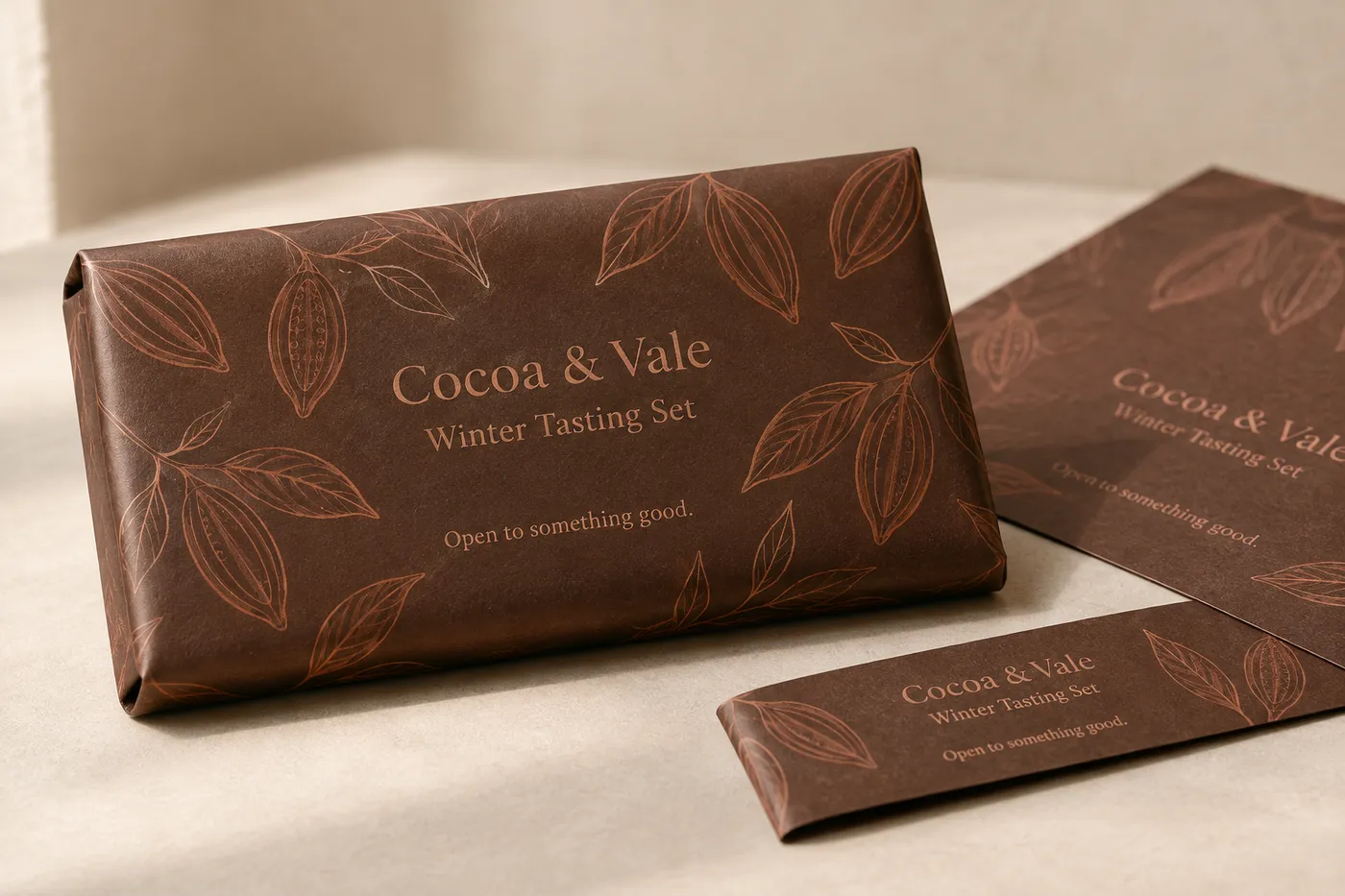
Custom chocolate wrapping paper folded around a branded chocolate bar with a visible front panel and tidy paper overlap.
Chocolate Boxes
Custom chocolate wrapping paper planned around the finished chocolate, fold or band format, printed panel, and handoff. Share the packed dimensions and count first, then choose a sheet, roll, band, or paperboard wrap that keeps the collection name readable after folding
Last updated
Working quote
Product brief
Custom chocolate wrapping paper starts with the finished chocolate, not with a pattern. Count the pieces, measure the longest edge and tallest profile, and note whether each item is a bar, a cup, a truffle, or a small gift bundle. A single bar may need a simple sheet and a fold-over seal, while a mixed set may need separate wraps, a belly band, or a printed sheet used inside a presentation box. The artwork and the sheet size should follow that actual handoff.
Describe the moment after wrapping. A retail bar may need a clear front panel and a repeatable fold for replenishment. A wedding favor may need a short message and a compact fold around one or two pieces. A tasting set may use coordinated sheets for several flavors, with a color or name panel that lets staff identify the assortment before opening it. Direct-to-customer orders may place the wrapped chocolates inside a rigid or folding outer box, so the brief should say which printed surfaces remain visible in transit.
Wrapping paper can be supplied as sheets, rolls, bands, or die-cut pieces depending on how the chocolate is packed and folded. A flat sheet gives a chocolatier flexibility to wrap varied shapes; a repeatable die-cut or band can make a defined bar or favor faster to pack. The quote discussion should cover the finished wrapped dimensions, overlap, fold direction, seal or sticker position, and whether the paper is an inner wrap or the visible outer presentation.
The outer package still matters. If the wrapped chocolate sits in a tray, share the tray footprint and the count so the sheet, band, and box can be reviewed together. If the paper is the complete presentation, show the front, back, side, and closure panels in the artwork. Do not assume a generous sheet is better: excess paper can create bulky corners, while a tight sheet can expose the chocolate or shift the printed design.
A useful brief includes the chocolate length, width, height, weight, count, wrapper or cup, and the finished fold. For a bar, include the bar thickness and the overlap needed on the back. For a truffle or praline, note the cup diameter, dome height, and whether a square, rectangular, or round paper cut is being considered. If the assortment changes, list each variant instead of averaging the sizes; the largest packed profile usually controls the safe sheet or band.
Include the artwork status, repeat or one-up layout, brand name, collection name, flavor wording, barcode or legal panel if required, and where a seal or sticker will sit. Easy Box Packaging can then discuss SBS paperboard, kraft paperboard, or corrugated board where a paperboard wrap or outer sleeve is part of the solution, alongside foil stamping, matte or gloss lamination, spot UV, or embossing/debossing. These are direction choices, not unconfirmed food-contact or barrier claims.
Printed wrapping paper is most useful when the design still reads after the fold. Keep the key collection name away from the overlap, allow the front panel to land on the intended face, and reserve a quiet area for a sticker, ribbon, or seal. A repeat pattern can carry the sheet when the fold position varies; a one-up front panel can make a fixed bar or favor feel more deliberate. Share a flat artwork file and a simple folded sketch so the proof can be checked against the real handoff.
For gift assortments, coordinate the wrap with the insert, tray, or box rather than treating it as a separate decorative layer. A muted foil accent may suit a short collection name, while matte or gloss lamination changes how the printed surface reads under shop or event lighting. Spot UV or embossing/debossing can focus attention on one detail, but the coverage and fold relationship should be reviewed before approval.
The standard starting point is 50 units, with production from 7 business days after digital proof approval. Free US shipping is included on the standard fulfillment path, and a sample kit carries a $44.99 USD shipping charge credited toward the first order. Pricing remains quote-based because no approved product-specific price range is on file. Send the packed chocolate details, intended use, quantity, sheet or band preference, artwork status, and finish direction so the team can scope the right format.
A clear handoff avoids avoidable redraws. First share the product measurements and count. Then identify whether the paper is a primary wrap, an inner liner, a band, or part of a box system. Next confirm the print coverage, repeat, closure, and any material or finish direction. Review the digital proof at full scale, including fold lines, overlap, readable text, and the position of any sticker or seal. Production begins after that proof is approved.
For retail bars, a repeatable printed sheet or band can help staff recognize flavors and keep a consistent face on the shelf. For corporate or wedding favors, a compact one-up design can place the event name where it is seen before the chocolate is opened. For tasting sets, coordinated variants can keep the assortment legible without adding a new structural layer. For direct-to-customer orders, the wrap can carry the collection story while the outer shipper handles the delivery route.
The best specification is the one another person can reproduce. State the count, packed dimensions, orientation, closure, artwork panel order, and intended use in plain language. If the product changes from a 50-unit pilot to a larger run, update the count and the wrap layout rather than assuming the first sheet will scale unchanged. A measured brief gives the quote, proof, and final fold a shared reference.
Proof points
The wrap is reviewed as an assembled presentation in which the chocolate profile, fold, printed surfaces, closure, and outer handoff work together.
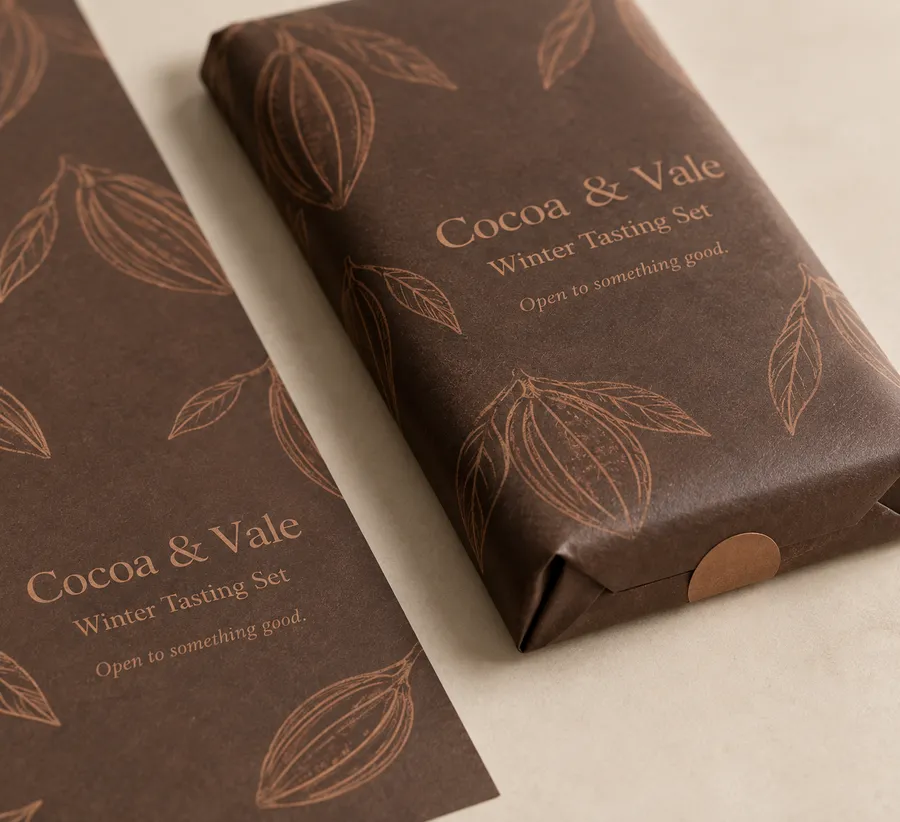
Sizing begins with the finished chocolate and the fold: packed length, width, height, weight, piece count, wrapper or cup, overlap, closure, and the face that should read first. Those details let the sheet, band, paperboard wrap, printed panels, and any outer box be considered around the actual handoff rather than an assumed stock footprint.
A repeatable sheet or band can keep the collection name and flavor face consistent on a shelf while staff replenish the same format.
Coordinated wraps can identify variants and keep a defined count legible before the pieces are placed in a tray or outer box.
A compact one-up wrap can carry an event name, greeting, or collection message around one or two chocolates.
The printed wrap can carry the collection story inside an outer shipper, with the delivery route and visible surfaces included in the brief.
Artwork is mapped to the folded wrap so the collection name, flavor, front panel, overlap, and finish remain intentional after the paper is closed around the chocolate.
A useful brief connects the printed story to the chocolate geometry, fold, and handoff so the paper is reviewed as a repeatable package rather than a loose decorative sheet.
Share finished length, width, height, weight, piece count, orientation, wrapper or cup, and the tallest point.
Explain sheet, roll, band, die-cut, overlap, fold direction, sticker, ribbon, seal, or whether the paper sits inside a box.
Identify the brand, collection, flavor or variant names, panel order, repeat or one-up layout, artwork status, and preferred finish direction.
The quote process is clearer when the chocolate is described as a packed product with a defined fold, artwork face, closure, and handoff.
Provide packed dimensions, weight, piece count, shape, wrapper or cup, orientation, tallest point, and any overlap or headspace requirement.
Explain whether the paper is a sheet, roll, band, die-cut wrap, inner liner, or part of an outer presentation box.
Discuss the paper or paperboard direction, repeat or one-up artwork, fold, seal, and visible front panel.
Identify the collection name, flavor wording, brand artwork, panel priorities, and preferred foil, lamination, spot UV, or embossing direction.
Check the cut, fold, overlap, closure, readable panels, and finish coverage against the packed chocolate.
Need help with structure, materials, or production planning? See how we manufacture custom packaging.
A sample kit carries a $44.99 USD shipping charge credited toward your first order, useful when you need to review paper feel, printed surface, fold position, seal area, and the opening sequence before approving a chocolate wrapping paper run.
Shipping charge: $44.99. Credited toward your first order.
Request a Sample KitFind clear answers about fit, materials, and ordering below.
Measure the completed chocolate or packed piece, including length, width, height, cup or wrapper, overlap, and any raised decoration. Include packed weight, orientation, piece count, and a simple flat-and-fold sketch when the arrangement changes the visible panels.
A sheet or band suits a flexible wrap around a bar, favor, or varied piece, while a folding carton adds connected panels and a defined outer structure. The choice depends on chocolate profile, count, fold, closure, storage, and handling.
A wrap alone does not replace an insert when pieces need separation or a defined tray. Share the outer box, cup, divider, or tray relationship so the sheet, band, and internal support can be reviewed together.
SBS paperboard, kraft paperboard, and corrugated board are the category material directions when a paperboard wrap or outer structure is involved. Foil stamping, matte lamination, gloss lamination, spot UV, and embossing/debossing are finish directions, with the selected combination reviewed against artwork and the folded package.
The standard minimum order is 50 units. Include quantity, packed dimensions, chocolate count, intended use, artwork status, and preferred sheet, band, or paperboard format in the quote request so the wrap can be scoped around the actual order.
The approved standard estimate is from 7 business days after digital proof approval. Free US shipping is included on the standard fulfillment path, and dieline or proof review is included at no extra charge.
Orders start at 50 units and scale up to 500,000 for bulk runs, with pricing from $0.19 per unit on larger quantities. Standard production is from 7 business days after digital proof approval.
Compare nearby products and request the format that best fits your next run.
Available product
Available product
Available product
Available product
Plan the chocolate wrap
Send the packed chocolate details, intended handoff, quantity, artwork status, preferred sheet or band format, material direction, and finish preference so Easy Box Packaging can review the package as one quote-ready specification.
Add your product details to see a quote summary.