Single-device retail pack
A folding carton or sleeve can present one assembled disposable pen with a calm front panel for a counter or shelf handoff.


Tall navy discreet disposable vape carton with silver foil mark and slim pen
Vape Cart Packaging
Disposable vape discreet packaging is a compact printed carton or sleeve planned around the assembled pen, cap, count, and handoff. Share the finished device dimensions, insert or divider needs, readable information panels, artwork, and delivery route so a low-profile pack can be reviewed for retail handling or shipment without implying universal privacy, compliance, or child-resistance performance.
Last updated
Working quote
Product brief
Disposable vape discreet packaging works best when discretion is treated as a packaging brief, not as an unsupported promise. Start with the assembled device that will actually be packed: record the overall length, widest diameter, mouthpiece or cap shape, approximate weight, and whether a label or protective wrap remains in place. A compact folding carton, paperboard sleeve, or fitted presentation pack can then be reviewed around the product, the number of units, and the way the package moves from fulfillment to the customer. A plain exterior, restrained graphics, and a clear opening route may support a low-profile presentation, but the final result depends on the construction and route selected.
The carton should not be sized from the phrase disposable vape alone. Two pens with similar nominal profiles can differ at the shoulder, mouthpiece, button, cap, or widest point. Send a sample or accurate dimensions before the dieline is treated as final. For a single device, a narrow tuck-end carton may provide a defined cavity and an uninterrupted front panel. A sleeve can keep the outer artwork simple while a tray or inner paperboard support holds the pen. For 2 or more units, a divider or fitted insert may keep pieces separated and facing the intended direction. The right choice depends on count, clearance, weight, fragility, and the desired reveal when the pack opens.
A discreet pack still needs useful information. Reserve one calm, readable panel for the approved brand, product name, variant cue, and any variable field that the customer has supplied. Side or back panels can carry the approved copy, batch space, barcode area, handling notes, or other destination-market information. Keep the visual hierarchy legible at the actual carton scale; a crowded front panel can become difficult to scan once scores, flaps, and folds are included. If the device should remain mostly covered until opening, show that intent in the brief and proof rather than assuming a sleeve will provide it automatically.
The customer remains responsible for confirming warnings, age language, ingredients, batch details, and other requirements for the market where the product is sold. EBP can review panel placement and printed coverage, but child-resistance, tamper evidence, odor control, barrier performance, and regulatory approval are product-specific checks. A discreet exterior should not be described as a guarantee of private delivery or concealment through every carrier. Describe the intended route, counter display, mailer, case pack, or direct handoff, so the carton and any outer shipper can be considered together.
SBS Paperboard gives the small carton a smooth printed face for a quiet color field, fine type, or selective mark. Kraft Paperboard can support a more natural paper character when that is part of the visual direction. Corrugated Board is a direction for an outer shipping carton or case pack rather than an assumption for every individual pen carton. A tuck-end closure can make the opening sequence clear, while a sleeve can leave an inner tray visible. If the package will travel in a mailer, decide how the retail pack sits inside that mailer and whether an outer case pack is needed; do not present the individual carton as transit protection unless the complete route has been reviewed.
A finish should reinforce the low-profile design rather than add noise. Matte Lamination can reduce glare across a reading panel, while Gloss Lamination changes how the printed field catches light. Spot UV, Foil Stamping, or Embossing/Debossing can mark a small logo or motif when the artwork supports the treatment. Keep foil and raised detail away from scores, tuck flaps, and small copy until the proof confirms placement. The pictured print is an example of artwork placement. Replace the sample print layout with approved customer artwork before production.
A useful quote includes the assembled length, diameter, mouthpiece or cap, widest point, unit count, orientation, approximate weight, insert or divider idea, opening preference, approved information, artwork status, material direction, finish, and shipping route. The standard fulfillment path starts at 50 units, with production from 7 business days after digital proof approval. Dieline and proof review are included, and free US shipping is an approved service fact. Pricing remains quote-only because the device, construction, artwork, finish, and quantity change the specification.
Before approval, compare the digital proof with the real device and the intended handoff. Check that the pen sits in the planned orientation, that the tuck flap or sleeve opens as expected, and that the discreet exterior leaves the required panels readable. Confirm whether one unit or 2 or more units need a divider, whether an information card changes the occupied space, and whether a mailing carton or case pack is part of the route. Ask for a sample kit when paperboard feel, fold definition, insert direction, or finish needs to be judged in hand; the approved program carries a $44.99 USD shipping charge credited toward the first order.
The result is a compact packaging direction that can be checked against the assembled disposable vape, not a generic promise about privacy. Send the measurements and approved copy so the carton, sleeve, insert, and outer route can be discussed as one system.
Proof points
The digital proof should show the assembled pack, not only a flat artwork file. Compare the device fit, opening, information panels, insert direction, exterior tone, and finish placement with the supplied brief.
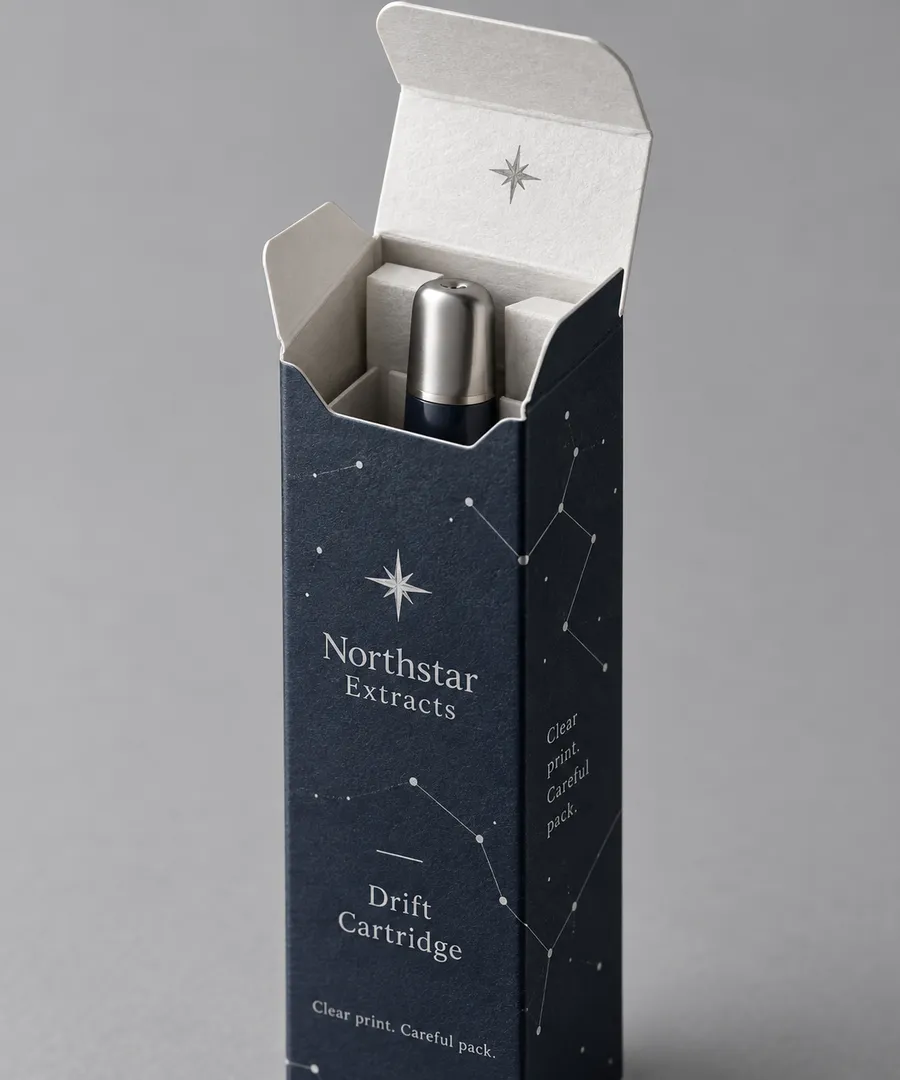
The package should keep the assembled device in the intended orientation, present a calm and readable exterior, and open in a way that suits the handoff. Start with the finished pen, count, clearance, approved information, and delivery route so the carton, sleeve, or insert is reviewed around a real use case.
A folding carton or sleeve can present one assembled disposable pen with a calm front panel for a counter or shelf handoff.
A printed inner carton can sit inside a mailer when the customer wants a low-profile exterior and the complete delivery route is planned together.
A divider or fitted insert can organize 2 or more devices when the unit count, spacing, orientation, and desired reveal are set before the dieline.
Individual cartons can be arranged in an outer case pack when the fulfillment team needs repeatable handling without treating the retail carton as transit protection.
Map artwork on the assembled pack so the product name, approved information, and restrained finish accents stay correctly oriented across the opening, side panels, tuck flaps, and back panel.
The printed exterior and interior support are considered together. Depending on geometry, weight, fragility, orientation, clearance, count, and reveal, support may be integrated into the paperboard structure or supplied as a separate insert or divider.
A narrow tuck-end carton or sleeve can be reviewed around the assembled disposable pen, cap, mouthpiece, and the clearance needed for a controlled removal.
A divider or fitted paperboard insert can separate 2 or more devices when the count, spacing, orientation, and desired reveal are known before sizing.
Corrugated Board can be considered for an outer case pack when individual printed cartons will travel together through fulfillment or delivery.
A useful quote starts with the assembled device and the level of privacy or low-profile presentation the pack is intended to support. The following information turns that description into a carton, sleeve, or insert direction that can be checked before production.
Provide length, diameter, mouthpiece or cap shape, widest points, approximate weight, unit count, orientation, and any wrap that remains inside.
State whether the pack is for a shelf, counter, mailer, case pack, or direct handoff and what should be visible before opening.
Show the arrangement, divider, insert, information card, or protective component that changes the occupied space.
Provide the brand, product, batch, warning, age, barcode, and destination-market copy for the printed panels.
Share any preference for SBS Paperboard, Kraft Paperboard, Corrugated Board for an outer carton, or the listed print finishes.
Need help with structure, materials, or production planning? See how we manufacture custom packaging.
A sample kit carries a $44.99 USD shipping charge credited toward your first order, useful when you need to compare paperboard feel, fold definition, insert direction, and finish treatment before approving discreet disposable vape packaging.
Shipping charge: $44.99. Credited toward your first order.
Request a Sample KitFind clear answers about fit, materials, and ordering below.
Send the assembled length, diameter, mouthpiece or cap shape, widest points, approximate weight, unit count, orientation, and any sleeve, card, or insert that will remain inside. For multiple units, show the actual spacing and arrangement.
A restrained exterior and covered device can support the intended presentation, but no carton guarantees privacy through every carrier, inspection, or delivery route. Describe the actual handoff so the structure and outer shipper can be reviewed together.
Not automatically. Support depends on geometry, weight, fragility, orientation, clearance, count, and the desired reveal. It may be integrated into the paperboard structure or supplied as a separate insert or divider after the real arrangement is reviewed.
Yes, the printed panels can be laid out for approved customer-supplied information. The customer must provide the wording and confirm the labeling, warning, age, and destination-market requirements that apply to the product.
SBS Paperboard and Kraft Paperboard are directions for the individual carton or sleeve. Corrugated Board can be considered for an outer shipping carton or case pack. Matte Lamination, Gloss Lamination, Spot UV, Foil Stamping, and Embossing/Debossing can be reviewed for selected artwork.
The standard fulfillment path starts at 50 units. Production begins from 7 business days after digital proof approval, with free US shipping and dieline and proof review at no extra charge. Your final unit price is confirmed in a quote because the device, construction, artwork, finish, and quantity determine the specification.
Orders start at 50 units and scale up to 500,000 for bulk runs, with pricing from $0.19 per unit on larger quantities. Standard production is from 7 business days after digital proof approval.
Compare nearby products and request the format that best fits your next run.

Available product

Available product

Available product

Available product
Plan the low-profile pack
Send the device dimensions, unit count, handoff, opening preference, interior support idea, approved information, artwork status, material direction, finish, and delivery route. Easy Box Packaging can then review the carton or sleeve as one quote-ready specification.
Add your product details to see a quote summary.