Single-cartridge retail unit
A compact folding carton can identify one cartridge or pen with a front-facing brand panel and a defined cavity.


Printed midnight-blue vape pen carton with Northstar Extracts mockup and a fictional pen shown for scale.
Vape Cart Packaging
Plan wholesale vape pen packaging around the filled device, cartridge count, insert, print panels, and delivery route. Easy Box Packaging can develop a compact folding carton or sleeve with a clear printed hierarchy, while compliance text and any child-resistance or tamper-evidence requirement remain product-specific checks.
Last updated
Working quote
Product brief
Wholesale vape pen packaging works best when the physical device leads the brief. Start with the assembled pen or cartridge: record its length, widest diameter, mouthpiece or cap shape, and the way it will sit in the carton. A single retail unit may need a narrow folding carton, while a multi-unit presentation can need a divider or fitted insert. The visible pack should be sized from the finished item, not from a generic category label.
The first decision is the handoff. A carton for a dispensary counter has a different job from a pack placed inside a mailer or case pack. Explain whether the customer will see one front panel, rotate the carton to read side information, or open a tuck top to remove the pen. That route affects panel hierarchy, clearance, and whether the pack needs internal support. If a sleeve is being considered, describe what holds the device in place and how it will be removed without pulling against a printed edge.
Measure the packed product at 1 complete orientation, including a cap, mouthpiece, protective wrap, or card that remains inside. For a 1-cartridge presentation, a simple cavity may be sufficient; for 2 or more pieces, an insert or divider can keep the devices separated and facing the intended direction. Those are planning examples, not a promise of one stock cavity. The quote should show the actual count and the clearance needed around the widest point before a dieline is treated as final.
A fitted paperboard insert can create a defined position for the pen, cartridge, or information card. The insert direction depends on product geometry, weight, filling method, and whether the pack is opened once or accessed repeatedly. If the unit will travel in an outer shipper, consider the complete system rather than describing the retail carton alone as transit protection. Easy Box Packaging can review the carton, insert, and outer route together when the brief includes those details.
Use the largest uninterrupted panel for the approved brand mark and product name, then reserve side and back panels for the information the buyer has confirmed for the destination market. A small pack usually has 3 useful reading zones: the front for identification, a side for a short product cue or variable field, and the back for required copy and handling information. This is an artwork-planning framework, not regulatory advice. The buyer remains responsible for confirming warnings, ingredients, batch details, age language, and other market requirements.
Keep the hierarchy readable at the carton's actual scale. A dense front panel can become difficult to scan once folds and tuck flaps are considered. Supply the approved logo, product name, variant or strain cue, required copy, color references, barcode space, and any blank area needed for a label. If variable information will be applied after printing, mark that panel before proof review.
SBS Paperboard is a smooth printed direction for a clean retail face, while Kraft Paperboard can support a more natural paper character. Corrugated Board belongs in the conversation for an outer shipping carton or case pack rather than being assumed for every small retail unit. The listed materials are category directions; the final board and construction should be confirmed for the packed device, count, storage, and handling route.
Matte Lamination can reduce glare across a dense information panel, while Gloss Lamination changes the reflectivity and color impression. Spot UV, Foil Stamping, or Embossing/Debossing can be reserved for a logo, product name, or small motif where the effect is easy to see. Finish placement should follow the artwork and folds. It should not be used to imply a barrier, safety certification, or universal compliance outcome.
A useful request includes the filled device dimensions, packed weight, count per carton, orientation, insert or divider idea, artwork status, print coverage, preferred board direction, finish direction, quantity, and delivery destination. Also state whether the carton will be shelf-facing, handed over, placed in a mailer, or packed into a case. The standard minimum is 50 units, and the approved production estimate is from 7 business days after digital proof approval. Pricing remains quote-only because the footprint, count, insert, board, finish, and quantity determine the final specification.
Easy Box Packaging includes free US shipping on the standard fulfillment path and dieline and proof review at no extra charge. Those are commercial program facts; they do not replace a product-specific review of fit or destination-market labeling. A sample kit can be requested when the team needs to compare paper character or finish treatment before approving a larger run; the sample-kit shipping charge is $44.99 USD and is credited toward the first order.
The proof should make the opening, device position, printed seam, and information hierarchy visible together. Check the front panel at the viewing distance expected in the store, then inspect the side and back panels after the carton is folded. Confirm that a 1-unit or multi-unit arrangement matches the approved brief, that the insert does not hide required copy, and that the tuck or sleeve opening works with the actual mouthpiece or cap. If the product, count, or destination changes, revisit the structure and artwork instead of assuming the previous dieline still applies.
Vape pen packaging is a focused packaging problem: fit the real device, give the printed information a readable order, and confirm the route before choosing the final construction. Send the product details and artwork status to Easy Box Packaging for a quote that keeps the carton, insert, finish, and commercial terms tied to the pack you intend to sell.
Proof points
Review the folded carton or sleeve with the real product arrangement so the opening, fit, print, and intended handling route can be judged together.
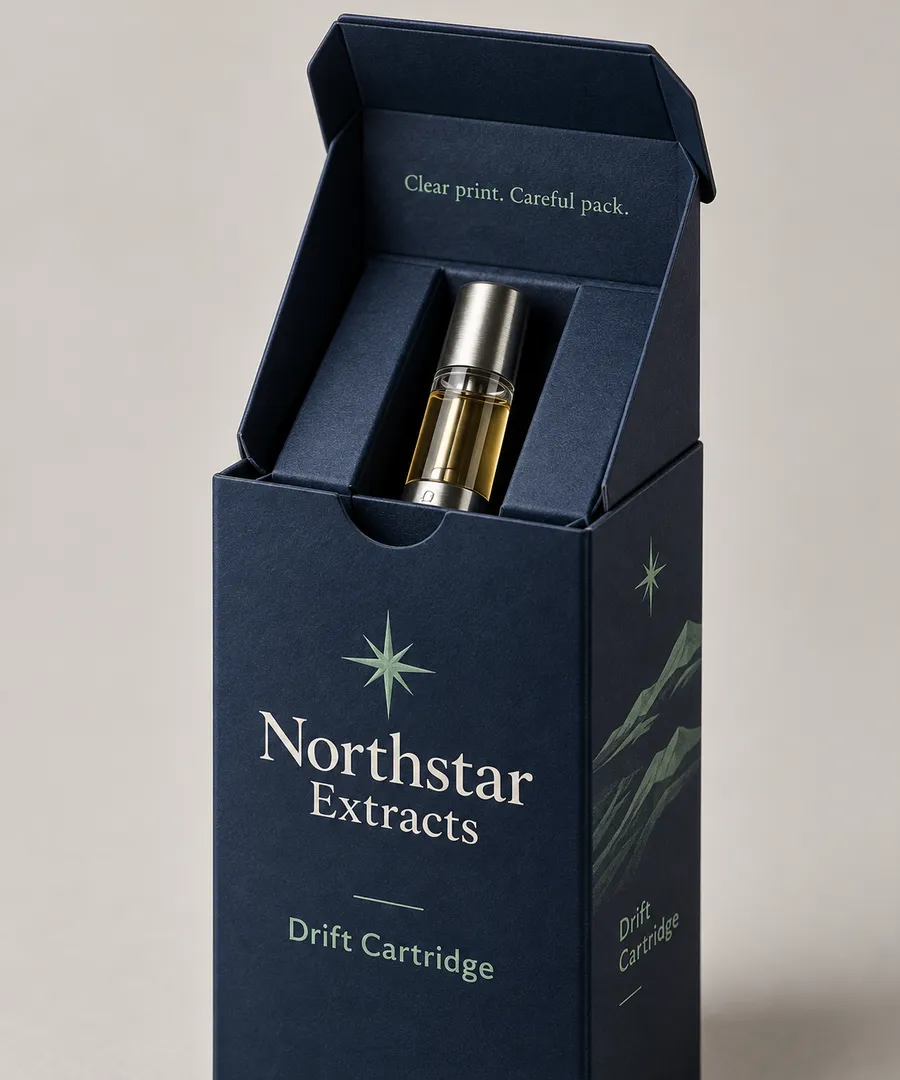
The useful starting point is the assembled device, its count, and the handoff route. Share those details before choosing a folding carton, sleeve, insert, board direction, or finish so the printed pack is reviewed as a complete object.
A compact folding carton can identify one cartridge or pen with a front-facing brand panel and a defined cavity.
A printed sleeve can frame a similarly shaped device when the retention method and removal direction are clear.
Two or more devices can be arranged with a divider or fitted insert when count, orientation, and panel access are specified.
A Corrugated Board outer carton can be considered for moving individual retail packs through a defined wholesale route.
Use the front panel for fast identification, then assign side and back space to approved variable information and destination-market copy before adding decorative treatment.
A focused brief lets the review connect fit, information panels, artwork, and the delivery route without treating a generic stock size as a final answer.
Provide the filled pen or cartridge length, widest diameter, mouthpiece or cap shape, weight, count, orientation, and any wrap that remains inside.
Describe whether the pack needs a shared cavity, fitted paperboard insert, divider, information card, or a simple sleeve around the device.
Mark the brand, product name, variant cue, variable fields, required copy, barcode space, and any side or back panel that must stay clear.
Start with the filled product and route, then review the assembled pack before approving the commercial specification.
Record length, widest diameter, mouthpiece or cap, weight, count, orientation, and any wrap or card that remains inside.
Explain whether the pack is shelf-facing, handed over, placed in a mailer, or moved in an outer case pack.
Send the approved brand assets, product name, required copy, variable fields, print coverage, board direction, and finish preference.
Check the opening, insert, panel hierarchy, and destination-market text on the proof before confirming quantity and production.
Need help with structure, materials, or production planning? See how we manufacture custom packaging.
A sample kit can help the team inspect paper character, surface sheen, print contrast, and fold behavior before approving the product-specific proof. Sample-kit shipping is $44.99 USD and is credited toward the first order.
Shipping charge: $44.99. Credited toward your first order.
Request a Sample KitFind clear answers about fit, materials, and ordering below.
Share the filled device length, widest diameter, mouthpiece or cap shape, weight, count per carton, orientation, and any wrap or insert that remains inside. Also describe the retail or fulfillment route.
Yes, an insert or divider can be considered when the device geometry, count, and removal direction are clear. The final support layout should be reviewed with the assembled product and artwork panels.
The category directions include SBS Paperboard, Kraft Paperboard, and Corrugated Board for an outer case pack, along with Matte Lamination, Gloss Lamination, Spot UV, Foil Stamping, and Embossing/Debossing. Suitability depends on the selected construction.
No. Easy Box Packaging can develop the printed structure, but the buyer must confirm all applicable warning, labeling, age, batch, and destination-market requirements before production.
The verified standard minimum is 50 units. Production is from 7 business days after digital proof approval; your final unit price is confirmed in a quote because the final carton, insert, board, finish, and quantity set the unit cost.
Orders start at 50 units and scale up to 500,000 for bulk runs, with pricing from $0.19 per unit on larger quantities. Standard production is from 7 business days after digital proof approval.
Common uses include single-cartridge retail unit, disposable pen sleeve, multi-unit presentation, and fulfillment case pack. The final specification is set by the packed product and how it will be handled.
Compare nearby products and request the format that best fits your next run.

Available product

Available product

Available product

Available product
Ready to scope the pack?
Tell Easy Box Packaging what sits inside, how many units belong in each carton, which panels carry required information, and where the pack will travel. The quote can then stay tied to the actual fit, insert, board, finish, and quantity.
Add your product details to see a quote summary.