
Jump to section9 sections
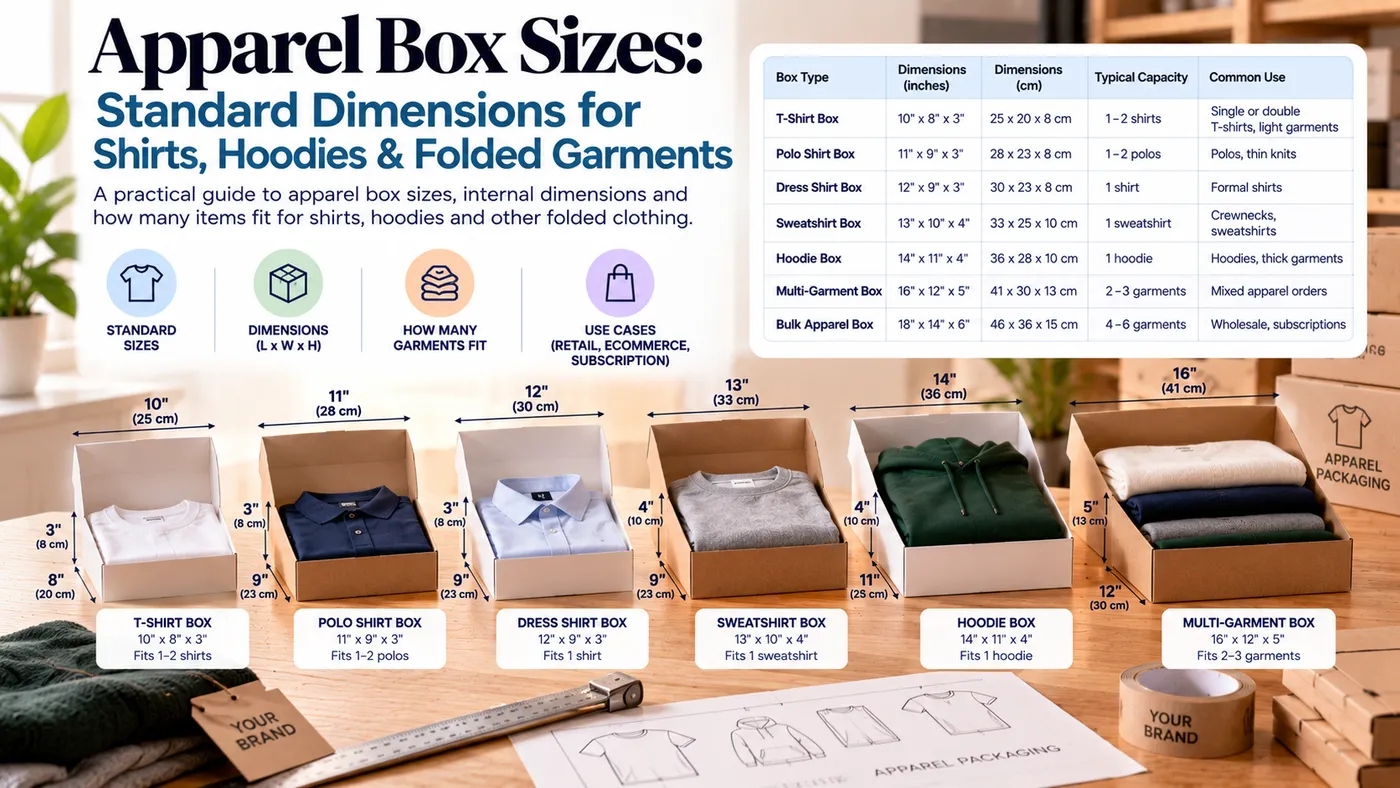
Quick answer: A folded T-shirt usually fits an apparel box near 10"–11.5" × 7"–8.5" × 1.25"–1.6". A sweater needs roughly 14"–15" × 9.5" × 2", and a hoodie about 15" × 9.5" × 3". Jeans typically take 17" × 11" × 2.5". Apparel box sizes shift with the fold, so read every figure as a range.
*Last updated: October 2026.*
Apparel box sizes aren't set by any standards body. Suppliers cluster around a handful of stock sizes, and the chart below shows where they land. Depth is the number that moves most.
Apparel Box Size Chart by Garment
Garment type | Fold method | Box L×W×H (in) | Box (cm) |
|---|---|---|---|
T-shirt | Standard fold | 10–11.5 × 7–8.5 × 1.25–1.6 | 25.4–29.2 × 17.8–21.6 × 3.2–4.1 |
Polo shirt | Standard fold | 11.5–14 × 8.5–9.5 × 1.6–2 | 29.2–35.6 × 21.6–24.1 × 4.1–5.1 |
Dress shirt or blouse | Envelope fold | 11–11.5 × 8.5 × 1.5–1.6 | 27.9–29.2 × 21.6 × 3.8–4.1 |
Lightweight sweater | Standard fold | 14–15 × 9.5 × 2 | 35.6–38.1 × 24.1 × 5.1 |
Hoodie or fleece | Standard fold | 15–19 × 9.5–12 × 3 | 38.1–48.3 × 24.1–30.5 × 7.6 |
Jeans or trousers | Halves, then thirds | 17 × 11 × 2.5 | 43.2 × 27.9 × 6.4 |
Jacket, coat or robe | Flat fold | 19–24 × 12–14 × 3–4 | 48.3–61 × 30.5–35.6 × 7.6–10.2 |
Kids tee or baby set | Standard fold | 10–11.5 × 7–8.5 × 1.25–1.6 | 25.4–29.2 × 17.8–21.6 × 3.2–4.1 |
These are retail two-piece boxes, measured on the outside. Your folded garment needs to be smaller than the interior.
Key takeaway: Pick your box by folded thickness first, then by footprint. A box that's half an inch too shallow won't close cleanly.
Why Apparel Box Sizes Aren't Standardized
Shoes have a rough size logic. Apparel doesn't. A medium T-shirt in one brand's cut folds to a different footprint than another's. Fabric weight changes everything, too. A cotton tee compresses to a flat, springy stack. A fleece hoodie stays puffy no matter how hard you press it.
Suppliers solve this by stocking a few dependable footprints and varying the depth. You'll see 11.5" × 8.5" for shirts, 15" × 9.5" for sweaters, and 17" × 11" for heavier pieces. Those cluster points repeat across catalogs, which is why I treat them as the closest thing to a standard.
My opinion: if your fold is consistent, one footprint can cover three or four garment sizes. Fold discipline matters more than box variety.
The Three Folding Methods
The fold decides the footprint before the box does. Here's how each method changes what you need.
Method | Folded footprint | Depth effect | Best for |
|---|---|---|---|
Standard fold | Rectangle, about 10–12 in long | Moderate | Tees, polos, sweaters |
Roll | Narrow tube, 3–5 in wide | Higher, but shorter footprint | Soft knits, travel kits |
Flat or envelope fold | Large flat rectangle | Lowest | Dress shirts, blouses, linens |
A standard fold gives you the predictable stack that most stock boxes assume. Rolling compresses soft knits and shrinks the footprint, but it adds depth and can leave creases in structured fabric. Flat folds keep collars crisp. The trade-off is a bigger footprint and a thinner box.
Narrow stock boxes around 11.5" × 5.5" × 1.5" exist, and they suit tightly folded or rolled pieces. Confirm with a sample before ordering a full run.
How to Measure a Folded Garment
Don't measure the box first. Fold the garment the way a customer will see it, then work outward.
1. Lay the garment flat and fold it with your real method. Press lightly, the way tissue and a lid would. 2. Measure the folded length and width with a rigid ruler, not a soft sewing tape. 3. Stack the fold and measure thickness at its thickest point, usually the collar or hem. 4. Add about 0.25" to 0.5" per side for length and width, and 0.25" for depth.
Run your hand across the stack. If the fabric springs back, add depth. A cotton tee feels dense and flat. A brushed fleece feels like a loaf of bread. I've seen brands size a box from a pressed sample, then watch fifty fluffier garments refuse to close the lid.
Once you have a footprint, compare it against the chart. If it falls between stock sizes, that's your cue for a custom cut. For general measuring rules across product types, the box size guide covers the basics.
Polybag vs Box for Apparel Shipping
Retail boxes sell the garment. They aren't built to travel alone. A carrier sees only the outer package. You'll choose a polybag, a mailer box, or a retail box inside either.
Polybags win on weight and cost. A flat poly mailer won't add depth, so it keeps dimensional weight low. Our poly mailer sizes chart shows which dimensions fit which folded garment. The downside is zero crush protection and a plain unboxing.
A mailer box costs more per unit but protects the fold. Carton-style mailers also give you printed surfaces inside and out. See our mailer box sizes guide for the exact interior dimensions. For a printed option, check our custom mailer boxes.
Supplier guidance lands in similar territory. A single shirt ships in roughly 10" × 8" × 2", and a hoodie or two-piece set in about 12" × 9" × 3". Carriers also bill on dimensional weight, so a half-empty box costs you. FedEx explains how dimensional weight pricing works. Verify current rules with your carrier before you commit to a size.
Apparel Box Sizes by Use
Retail gift. This is the classic shirt box with a lid. Keep the depth near 1.5" to 2.5" so the fold reads flat on a shelf. It should look like a gift when someone lifts it. If you're also selling accessories, our gift box sizes chart covers add-ons.
Ecommerce shipping. Skip the presentation depth. Go snug. Fit the garment inside a mailer or poly bag, and keep the retail box only if your brand needs it. Many shippers put a retail box inside a slightly larger mailer, but I think that's overkill for low-value garments.
Subscription. Boxes for a curated capsule of items usually need more depth. Plan for tissue, a card, and two or three folded pieces. A deeper, lighter box beats a tall one stuffed past capacity.
For printed retail packaging, take a look at our retail product boxes.
Custom Apparel Box Sizes
Stock sizes are the starting point. They don't cover every fold, every fabric weight, or every brand's cut. If your garment lands between two stock sizes, you'll either waste space or crush the fabric.
That's where EBP comes in. We custom-cut boxes to your exact folded dimensions, and many products start from 50 units. Standard production runs about 7 business days after proof approval, and rush orders can start from about 4 days. Pricing is quote-based, so send us your folded dimensions and we'll quote from there.
Frequently Asked Questions
What size box fits a folded T-shirt? A folded T-shirt fits a box of roughly 10" to 11.5" long, 7" to 8.5" wide and 1.25" to 1.6" deep. Cotton weight and fold style can shift that by half an inch.
What size box fits a hoodie? A hoodie typically needs a box around 15" × 9.5" × 3", with heavier fleece moving toward 19" × 12" × 3". Depth is the limiting number, because fleece springs back.
What is the standard shirt box size? The most common shirt box is about 11.5" × 8.5" × 1.6" for a dress shirt. Larger sweater boxes run 14" to 15" long by 9.5" wide.
What box size is best for jeans? Jeans usually fit a 17" × 11" × 2.5" box when folded in halves and thirds. Thicker denim may need an extra half inch of depth.
How deep should a clothing box be? Retail clothing boxes are usually 1.25" to 3" deep, depending on fabric bulk. Anything over 2.5" starts to look bulky on a shelf.
Should I roll or fold clothes for a box? Folding is the safer default, since it creates a flat, predictable stack. Rolling saves footprint on soft knits but can crease structured fabric.
Can I ship clothes in a retail apparel box? You can, but a retail apparel box isn't built for carrier handling. Put it inside a mailer or poly bag for shipping.
Do apparel boxes come in custom sizes? Yes. Custom apparel boxes can be cut to your folded dimensions, and many formats start from 50 units. Send your folded measurements for a quote.
Apparel Box Sizes: The Bottom Line
Apparel box sizes depend on fold, fabric weight and use. Use the chart as a starting point, measure your own folded garment, and size depth first. If your product falls between stock sizes, a custom cut costs less than a rattling or crushed box.
Product doesn't fit a standard size? We custom-cut every box to spec — get a free quote.