
Jump to section12 sections
- Quick answer
- Corrugated flute guide: thickness and flutes per foot
- Should I use E flute or B flute for a mailer box?
- Which corrugated flute is strongest?
- Which flute prints best?
- Best corrugated flute for ecommerce shipping
- Product weight and fragility: how to choose
- Mailer boxes vs shipping cartons
- Retail presentation: when thin flutes win
- The thickness trap most brands miss
- What to send your packaging manufacturer
- Key takeaway
This corrugated flute guide gives a plain answer. Use E flute for a light, print-led mailer. Use B flute when the box is your only protection. C flute fits shipping cartons, F flute fits small retail cartons, and A flute is rare. Flute height sets cushioning and print smoothness. The board's ECT rating and liners set stacking strength.
Quick answer
- E or B for a mailer: E flute for light, non-fragile, print-led orders. B flute for heavier, fragile, or rattly products.
- Strongest: no letter wins alone. Wall count and ECT rating decide stacking strength, and double wall beats single wall.
- Best print: F flute, then E flute, then B flute. Liner choice matters as much as the flute letter.
- Ecommerce shipping: B or C flute single wall is the usual starting point.
- Retail presentation: E and F flute give sharp folds and smooth print.
Corrugated flute guide: thickness and flutes per foot
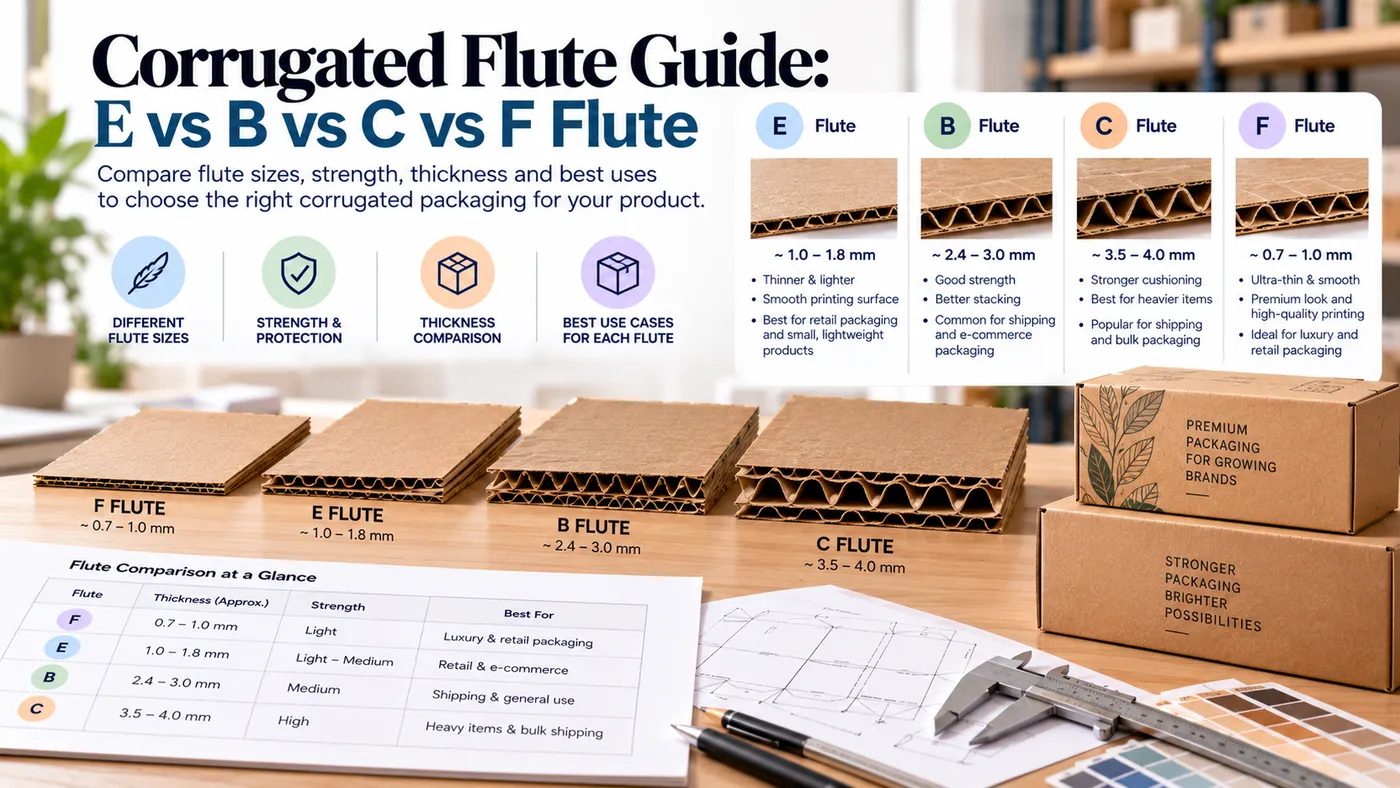
Flutes are the waves between the two flat liners. The Fibre Box Association gives approximate flutes per foot. Thickness figures below are typical single-wall board values from Packaging Corporation of America and supplier guides. Mills differ by a few tenths of a millimeter.
Flute | Approx. thickness | Flutes per foot | Best for | Print surface | Relative protection |
|---|---|---|---|---|---|
F | 0.8–1.0 mm | ~125 | Small retail cartons | Smoothest | Light |
E | ~1.5 mm | ~90 | Retail boxes, light mailers | Very smooth | Medium-light |
B | ~3 mm | ~47 | Ecommerce mailers, retail displays | Good | Medium |
C | ~4 mm | ~38 | Shipping cartons | Coarser | Higher |
A | ~5 mm | ~33 | Cushioning, rarely used now | Coarsest | Highest cushion |
Source: Fibre Box Association for flutes per foot, and Packaging Corporation of America for A and F height. Treat every number as approximate and ask for a measured sample. Our corrugated flute types glossary post covers the basics of each letter. Our packaging glossary covers the rest of the terms.
Should I use E flute or B flute for a mailer box?
For the headline call in this corrugated flute guide, choose E flute for a light, stable product that cannot shatter. Think cosmetics tubes, folded apparel, candles in tins, or a subscription box with paper goods. The thinner board folds sharper and prints cleaner.
Choose B flute if the mailer is the only thing between your product and the carrier. Think glass jars, heavy sets, or anything that rattles. The extra board gives more cushion and takes more punishment.
My rule: when in doubt, go B. A pretty box that arrives crushed costs more than a slightly rougher print.
A middle option exists. An EB double-wall board puts E flute outside for print and B flute underneath for protection. It costs more, so use it only when you need both. Our custom corrugated mailer boxes are planned around the packed order. Tell us the loaded weight and we'll review board direction in your quote.
Which corrugated flute is strongest?
There's no single winner. The Fibre Box Association says larger flutes generally give more cushioning and vertical compression strength. But ECT rates stacking strength. Liners and medium weight move that number as much as the letter does.
Here's how I'd read it:
- Most cushion: A flute, though it's now uncommon.
- Standard shipping strength: C flute single wall.
- Strongest overall: double wall such as BC, roughly 6–7 mm thick.
- Lowest strength: F and E, which are built for retail, not rough transit.
Don't buy a flute letter. Buy an ECT rating for your product weight and ship route.
Which flute prints best?
Any corrugated flute guide will tell you smaller flutes print best. F flute and E flute have a near-flat surface. Fine type and photos look closer to a folding carton. B flute prints well for most brands. C flute can show a faint washboard pattern under solid colors.
One more variable matters. Kraft liner is brown, and brown dulls color. Run a thumbnail across a C flute carton and you can feel the ridges under the print. A white-top liner on the same flute often fixes muddy print without changing structure. Ask for natural or white liner in your quote.
Best corrugated flute for ecommerce shipping
For most parcels, our corrugated flute guide starts with B flute or C flute single wall. B flute is thinner, so the box ships smaller. C flute adds cushion for heavier or more fragile orders.
Thickness affects your carrier bill. Thicker board raises external dimensions, and carriers price by dimensional weight. Our guide to why corrugated wins for ecommerce covers the cost side. Our shipping box sizes guide covers carton dimensions.
Product weight and fragility: how to choose
This corrugated flute guide matches flute to weight, fragility, and route, in that order.
- Light and sturdy (apparel, paper goods, tins): E flute mailer.
- Light but print-critical (cosmetics, gift sets): E flute with a white-top liner and an insert.
- Medium weight or breakable (candle jars, bottles): B flute, plus an insert that stops movement.
- Heavy or very fragile: C flute or double wall, or a B flute mailer inside a shipper.
- Retail shelf only (bakery, coffee cartons, small boxes): E or F flute.
Weights vary by product, so test a sample before a full run. Our packaging samples guide explains what to check in hand.
Mailer boxes vs shipping cartons
Every corrugated flute guide should separate these two formats. A mailer is a one-piece folded box that opens like a lid. It's built to be seen, so thinner flutes make sense. A shipping carton, usually a slotted box, is built to be stacked and thrown around. It leans on C or B flute and a higher ECT.
Our mailer box sizes guide helps with fit. If your mailer ships inside another carton, E flute is usually enough. The outer box does the protecting.
Retail presentation: when thin flutes win
A corrugated flute guide should cover the shelf, not only the parcel. The Fibre Box Association says E and F flutes add structure to retail packaging versus paperboard folding cartons. They also take die-cut windows and tight folds well. That suits bakery boxes, coffee cartons, and shelf gift packaging.
The trade-off is real. Thin flutes cushion less. Don't pick them for a product that must survive a parcel network alone.
The thickness trap most brands miss
Here's what a typical corrugated flute guide skips. Board thickness eats interior space. B flute is roughly 1.5 mm thicker per wall than E flute. Two walls cost about 3 mm per axis, an eighth of an inch.
A box sized for an E flute product can feel tight in B flute. I've seen brands switch flutes late and then find the lid won't close easily. Always specify inside dimensions, then confirm the flute. Our corrugated boxes range is built from your product size. Our manufacturing page shows how we handle dielines and proofs.
What to send your packaging manufacturer
- Product dimensions and loaded weight, including inserts
- Product type and how fragile it is
- Quantity and format (mailer or shipping carton)
- Artwork status and print coverage, inside and outside
- Board preference: flute, kraft or white, single or double wall
- Finishing needs such as matte lamination or spot UV
- Insert requirements
- Shipping route and destination
- Required date
Key takeaway
E flute suits light, print-led mailers, and B flute suits products the box must protect. Confirm the ECT rating, not just the letter, and use this corrugated flute guide as your shortcut.
Flute thickness and strength figures are approximate and vary by mill and liner. Test samples with your real product before production.