
Jump to section8 sections
- What Each Custom Packaging Sample Actually Proves
- When Each Custom Packaging Sample Is Worth It
- The Typical Order of Samples Before Production
- How a Custom Packaging Sample Affects Your Timeline
- How to Review a Custom Packaging Sample
- Common Custom Packaging Sample Mistakes
- FAQ
- Conclusion: Pick the Right Custom Packaging Sample, Not the Most Samples
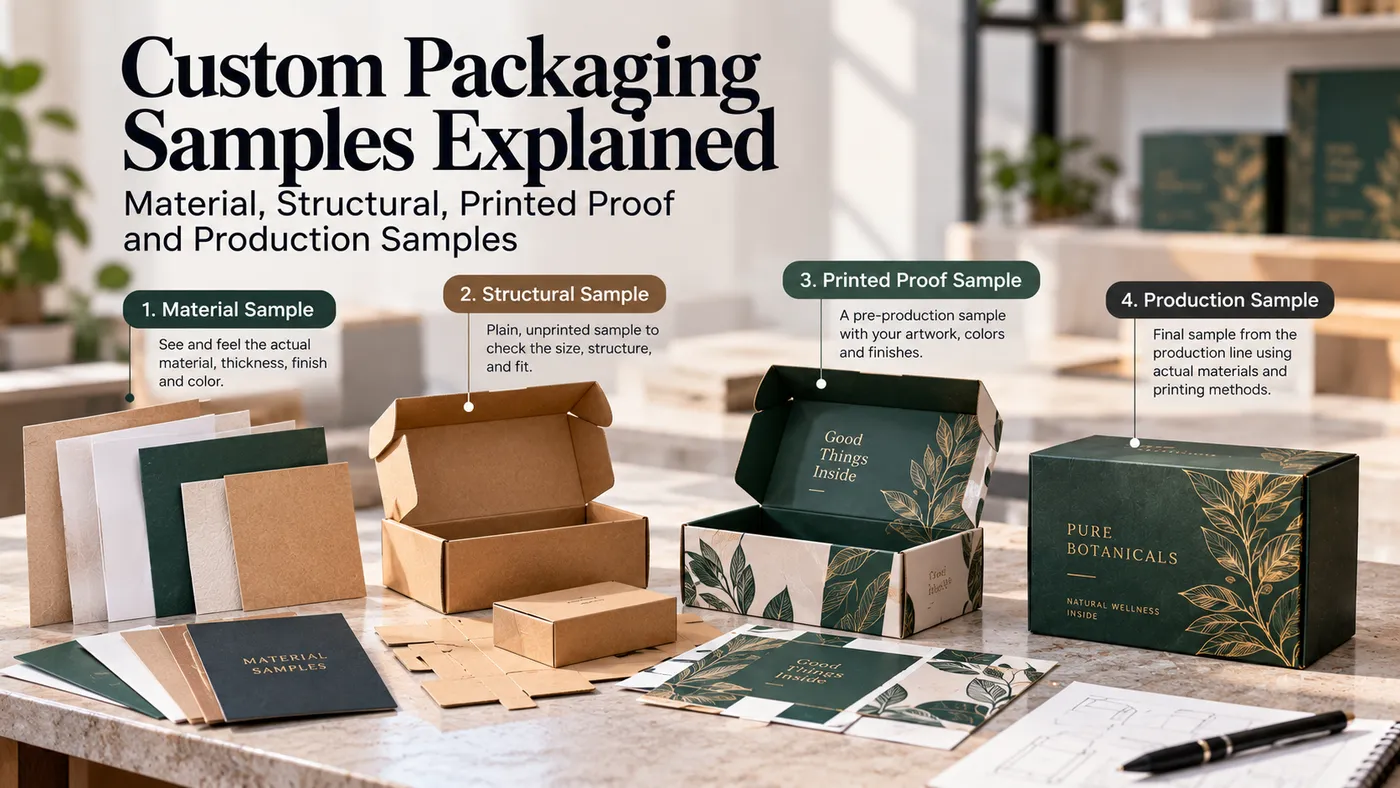
Quick answer: A custom packaging sample is a physical or digital check before you commit to a full run. A material sample shows the board. A structural sample shows fit. A printed proof shows color and layout. A production sample confirms the finished result. Each proves something different, and none proves everything.
*Last updated: October 2026.*
A custom packaging sample isn't one thing. Four different checks share the name, and each answers a different question. The table below shows what each one confirms and what it leaves open.
Sample type | What it confirms | What it doesn't confirm | Best time to use |
|---|---|---|---|
Material or board sample | Board feel, thickness, finish, surface texture | Fit, structure, how your artwork prints | Early, while choosing materials |
Structural (white) sample | Fit, closure, folds, how the box opens | Color, print quality, finish | After dimensions are set, before artwork |
Printed proof (digital or hard proof) | Layout, copy, color reference, artwork placement | Fit, board feel, how the box holds up | Once artwork is nearly final |
Pre-production or production sample | The finished box as it will be made | Anything that changes after you approve it | Last step, before the full run |
Key takeaway: Match the sample to the risk. If you're unsure about fit, get a structural sample. If you're unsure about color, get a proof. Don't pay for four checks when two cover your risk.
What Each Custom Packaging Sample Actually Proves
Think of each sample as a single question with a single answer. The trouble starts when people expect one sample to answer every question.
A material sample answers "How will this feel?" You hold the board. You flex it. You check the finish with your thumb. It tells you nothing about whether your product fits.
A structural sample answers "Will it work?" It's usually plain, often white, and unprinted. You drop your real product in, close the lid, and watch how the box behaves. This is a structural sample packaging check, and it catches the costly mistakes.
A printed proof answers "Does it look right?" A digital proof is a file view of your artwork on the flat layout. A hard proof is printed on paper. Both help you check copy, logo placement, and color references. Neither shows you how the finished board feels.
A pre-production sample answers "Is this what I'm getting?" It's the closest thing to the final box. It's also the last chance to catch a problem.
Our guide on how to get custom packaging made says it plainly. A digital proof can show layout, but it can't confirm how your product fits or how the finished material feels. That's the gap physical samples fill.
When Each Custom Packaging Sample Is Worth It
Not every job needs every sample. The right mix depends on whether this is a first order or a reorder, and on the format.
First order or reorder. On a first order, I'd lean toward a structural sample every time. You haven't seen your product in that box yet. On a reorder with no changes, you've already got a good reference. A fresh sample is rarely worth the wait.
Rigid boxes. Rigid construction is hard to judge from a drawing. The wrapped board, the lid fit, and the base depth all matter. A custom box sample is most valuable here. Browse our rigid boxes to see the formats we make.
Mailer boxes. Mailers live or die on fit and closure. A structural sample shows whether the lid stays shut and whether your product slides around. Check our mailer boxes for the structures available.
Pouches. Flexible formats behave differently. Fill weight, seal strength, and how the pouch stands up matter more than folds. A material sample plus a filled test is often the most useful check.
Here's my honest opinion. Skip the printed hard proof if your artwork is simple and your color match isn't critical. A digital proof is usually enough. Save the money for a structural check.
The Typical Order of Samples Before Production
Most jobs follow the same rough sequence. You can skip steps, but the order rarely changes.
1. Material sample. Pick the board and finish direction. 2. Structural sample. Confirm size, fit, and closure with your real product. 3. Printed proof. Check artwork, copy, and color against your brand. 4. Pre-production sample. Review the near-final result, if your job calls for one. 5. Approval. You sign off, and production starts.
Think of it as narrowing down. Early samples settle big questions. Later ones settle small ones. If the structure is wrong, fix it before you pay to print on it.
A custom packaging sample at step two is cheap insurance. A custom packaging sample at step four is a final check. Mixing up the order is how people end up redoing artwork on a box that doesn't fit.
If you want to compare materials and finishes side by side, our Sample Kit is built for that. It's listed as a physical kit for comparing materials, print treatments, finishes, and construction before a production order. Check the page for current terms.
How a Custom Packaging Sample Affects Your Timeline
Sampling adds time. That's the honest trade-off. The more rounds you do, the later your launch.
Here's how it fits with our approved production facts. Standard production is 7 business days after approval. Rush production starts from about 4 days. Those clocks start after you approve the final specification.
Sampling and approvals happen before that. They're separate. A slow approval round doesn't change the production time. It pushes the start of it.
So plan backward from your launch date. Count production, add shipping, then add your sampling rounds. Our guide on custom packaging lead times covers how to build that schedule.
If you've got a fixed event date, say so early. Share it before the quote is final so we can tell you whether the schedule is workable.
How to Review a Custom Packaging Sample
Don't just glance at it and say yes. Run the sample through a real test. Use this checklist.
- Fit. Put your actual product inside, with any wrap, cap, or insert. Is there rattle? Is it too tight to remove? - Closure. Open and shut it ten times. Does the lid stay closed? Does the tuck hold? - Board feel. Press the sides. Does it dent easily? Does it feel right for your price point? - Color against brand. Hold it next to your logo files or an existing product. Judge it in daylight, not just under office lights. - Finishing. Check edges, corners, and any coating. Look for scuffs and uneven spots. - Drop test. For shipping boxes, pack it and drop it from waist height. Open it and check the product.
Use your normal packing steps when you test. A sample that works for one careful person may fail on a busy packing line.
Write down what you find. Mark problems on the proof and ask for a corrected version. Don't approve based on an assumption.
Common Custom Packaging Sample Mistakes
I've seen the same few errors again and again.
Testing with a stand-in product. A similar item isn't your item. Test the real thing, with its cap and wrap.
Judging color from a screen. Monitors lie. A digital proof is a layout check. Use a physical reference when color matters.
Skipping the structural check to save time. This is the one that bites. A wrong fit found after printing means a reprint.
Approving without reading the notes. Confirm what the sample represents. Is it the final board? The final finish? Ask.
Assuming a sample guarantees the run. It shows what's possible. Approve the written specification, and keep the approved proof with your quote.
Also ask whether sampling is listed separately in your quote. Setup, tooling, sampling, and freight can all be line items. Compare quotes on the same basis.
FAQ
What is a custom packaging sample? It's a physical or digital version of your packaging made before the full run. It lets you check material, fit, color, or finish. Different sample types check different things.
What's the difference between a structural sample and a printed proof? A structural sample tests shape, fit, and closure, usually without print. A printed proof tests artwork, copy, and color placement. One checks the box, the other checks the design.
Do I need a physical sample before ordering? Not always, but it's smart when fit, board feel, or the opening sequence matters. A digital proof can't confirm how your product fits or how the material feels.
What is a white sample? It's an unprinted structural sample, usually in plain board. It shows the shape and fit of the box without artwork. It doesn't show print or color.
Is a digital proof enough? A digital proof is enough for layout and copy checks. It isn't enough for fit, board feel, or exact color. Pair it with a physical sample if those matter.
How many sample rounds should I plan for? Many jobs need one or two. A first order with a new structure may need more. Each round adds time before production starts, so plan backward from your date.
Does a custom packaging sample change my production time? No. Standard production is 7 business days after approval, with rush from about 4 days. Sampling happens before approval, so it moves your start date, not the production clock.
How do I find out about sample options and costs? Sample options depend on the format and specification. Your quote confirms what's available for your job, including whether sampling is listed separately.
Conclusion: Pick the Right Custom Packaging Sample, Not the Most Samples
The best custom packaging sample is the one that answers your biggest open question. If that's fit, test fit. If it's color, check a proof. If it's feel, hold the board.
More samples don't mean less risk. They mean more time. Pick checks that match your real risks. Review each with your actual product. Approve only what you've tested.
My view is simple. A structural check on a first order is almost always worth it. Everything else depends on the job.
Want a sample before you commit? Get a free quote. We'll confirm the sample options and timeline with your quote.