
Jump to section8 sections
- What the 7 Business Days Does and Doesn't Cover
- The Stages Behind Custom Packaging Lead Time
- What Adds Time by Packaging Type
- Standard vs Rush Custom Packaging
- How to Shorten Your Custom Packaging Lead Time
- A Realistic Planning Example
- Frequently Asked Questions
- Plan Your Custom Packaging Lead Time Early
Quick answer: Standard production at Easy Box Packaging takes 7 business days once artwork and specs are approved. Rush custom packaging starts from about 4 days. Shipping transit is separate and depends on carrier and destination. Complex structures, specialty finishes, and slow artwork approval can add time. Your quote confirms the exact schedule.
*Last updated: October 2026.*
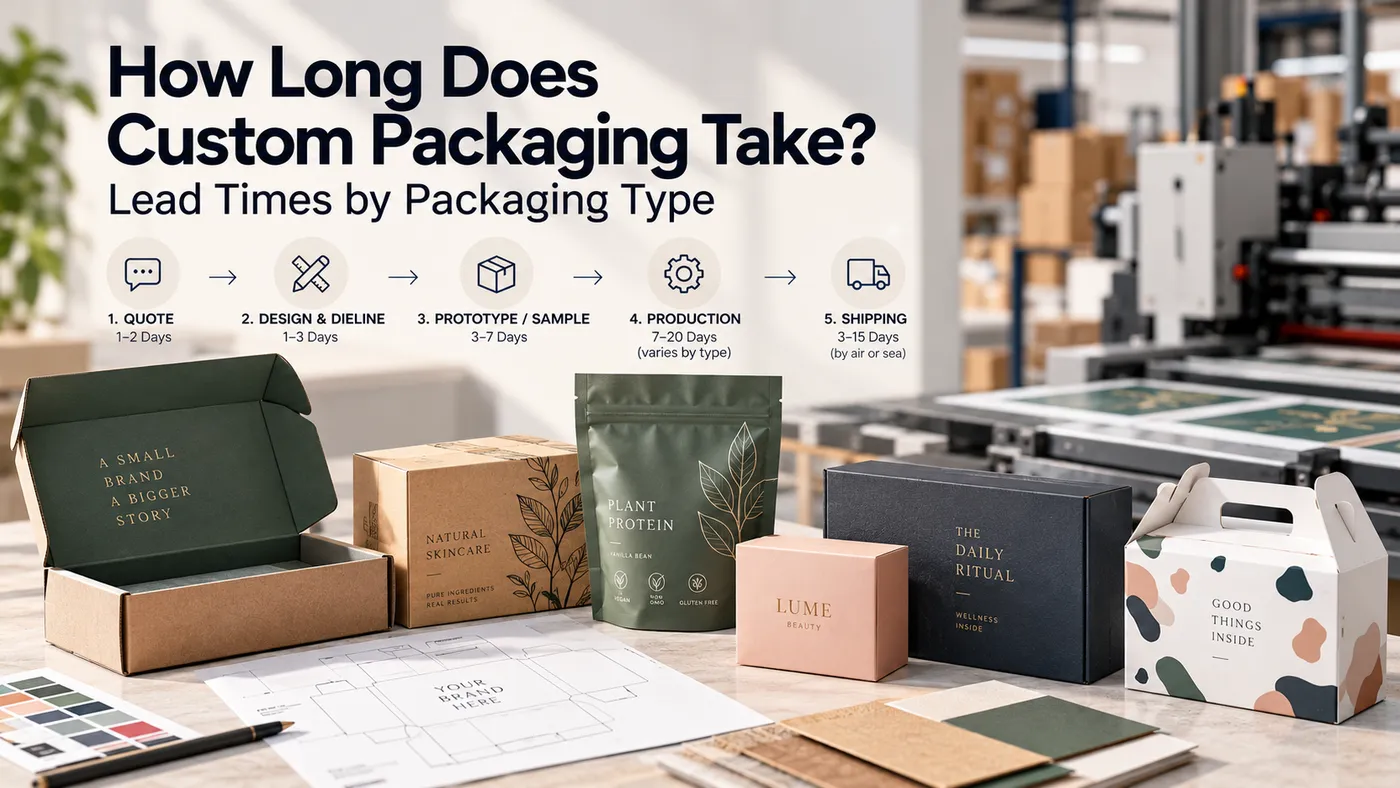
Custom packaging lead time is the total time from your first spec to boxes in your hands. Production is only one slice of it. The table below shows each stage and what can slow it down.
Stage | What happens | What can slow it |
|---|---|---|
Discovery and specification | You share product size, quantity, and material goals. | Missing dimensions or an undecided quantity. |
Structure and sampling | The box structure is built and tested on your product. | Several sample rounds or late structure changes. |
Artwork and pre-press approval | Your artwork is checked and approved for print. | Wrong file setup or slow sign-off. |
Manufacturing | Printing, converting, finishing, folding, gluing, and assembly. | Foil, embossing, spot UV, or hand assembly. |
Quality control | Finished boxes are inspected against the approved spec. | Rework if a spec was unclear. |
Packing and dispatch | Boxes are packed and handed to the carrier. | Carrier schedules and destination. |
Key takeaway: The 7 business days covers standard production after approval. Your calendar time is longer because it also includes sampling, approvals, and shipping.
What the 7 Business Days Does and Doesn't Cover
The 7 business day figure is a production baseline. It starts once artwork and specs are approved. It doesn't include sampling time, proof rounds, or shipping transit.
That split matters. Most people hear "7 days" and expect boxes on the dock in a week. I've seen plenty of projects slip because nobody counted the approval days before production started.
Our site also says timing varies by product, quantity, materials, and finishing. We think that's the honest way to put it. Any supplier who quotes one fixed number for every box type is guessing.
The Stages Behind Custom Packaging Lead Time
You can see our full process on the manufacturing page. Here's how each stage affects the clock.
Discovery and specification. This stage is fast when you know your product's exact size. Measure it twice. A box that's off by a few millimeters means a new sample.
Structure and sampling. We build the structure and test the fit. A sample you can hold tells you more than any render. You can feel the board weight and see how the lid closes. Ordering a sample kit early lets you pick a board and finish before you commit.
Artwork and pre-press approval. This is where many delays hide. Files that aren't print-ready bounce back and forth. One clear approver speeds this up.
Manufacturing. Printing, converting, finishing, folding, gluing, and assembly happen here. Simple one-color jobs move fast. Layered finishes take longer.
Quality control and dispatch. Every order is checked before it's packed. Then carrier transit starts. That part sits outside our production count.
What Adds Time by Packaging Type
We don't publish a different day count for each format. The 7 business day and rush figures are the production baseline. The exact schedule is confirmed in your quote. This table shows what tends to add time to each format.
Format | What adds time | Planning note |
|---|---|---|
Hand assembly, wrapped finishes, inserts, specialty finishes | Plan the most buffer here. Sample first. | |
Large sizes, multi-color print, material availability | Plain kraft jobs usually move fastest. | |
Full-coverage print, custom inserts | Lock your dimensions before artwork. | |
Window cutouts, foil, embossing, spot UV | Each added finish adds a production step. |
Rigid boxes deserve a special mention. Hand assembly is slower than machine folding. If you're deciding between formats, our guide on rigid boxes vs folding cartons covers the trade-offs. Quantity matters too. Our MOQ by format guide explains why many products start from 50 units.
Standard vs Rush Custom Packaging
Standard production is 7 business days. Rush custom packaging starts from about 4 days. Rush isn't a switch you flip on every job.
Rush availability depends on the project. A simple structure with approved artwork is a better rush candidate. A hand-assembled rigid box with foil is not. Our team confirms what's possible in the quote. A rush job shortens production, but your custom packaging lead time still includes approvals and shipping.
There are trade-offs. Rush means less room for sample changes. It also leaves little time to fix an artwork error. If you need fast custom boxes, finalize your dimensions and artwork first. Then ask for the rush schedule.
My opinion: rush is worth it for a launch date, not for poor planning. Spend that effort on approvals instead.
How to Shorten Your Custom Packaging Lead Time
Many delays come from decisions, not machines. A shorter custom packaging lead time usually starts with faster choices on your side. These habits protect your schedule.
- Approve artwork once. Send print-ready files and name one approver. - Confirm final dimensions. Measure your product with its inner packaging included. - Sample early. Test the fit before you commit to a full run. - Decide finishes up front. Foil, embossing, and spot UV each add a step. - Keep the structure simple. A standard style beats a custom one when time is tight.
Our guide on how to get custom packaging made walks through the order process step by step.
A Realistic Planning Example
Here's a simple example. The numbers are assumptions, not a promise. Your quote sets the real schedule.
Say your artwork is approved on a Monday. Seven business days of standard production runs through the following Tuesday. Add carrier transit after that. If transit takes 3 business days, boxes arrive the Friday after.
Now add the steps before approval. Allow time for a sample and for one round of artwork changes. If those take 5 business days, your total from first spec is about 15 business days. That's three work weeks.
Work backward from your launch date. Add a week of buffer. That buffer is cheap insurance.
Frequently Asked Questions
How long does custom packaging take? Standard production takes 7 business days after artwork and specs are approved. Sampling, approvals, and shipping add to that.
What is the fastest custom packaging lead time? Rush production starts from about 4 days. Availability depends on the project, and your quote confirms it.
Does the 7 business days include shipping? No. The 7 business days covers production only. Shipping transit depends on carrier and destination.
Does the lead time include proofing and sampling? No. Production time starts after artwork and specs are approved. Sample and proof rounds happen before that.
Which custom packaging takes longest? Hand-assembled rigid boxes with specialty finishes tend to take longest. Foil, embossing, and inserts each add a step.
Can I get rush custom packaging on any box? No. Rush depends on structure, finish, and quantity. Simple structures with approved artwork are the best candidates.
What causes the most delays in custom packaging? Slow artwork approval is one of the most common delays. Files that need fixing add a full round before printing can start.
How can I get an exact timeline for my order? Request a quote with your box type, quantity, and finish. We confirm the production schedule in the quote.
Plan Your Custom Packaging Lead Time Early
Custom packaging lead time is easier to manage when you know the stages. Approve artwork once, sample early, and keep finishes simple. Those three habits often save more time than rushing.
Need to know the timeline for your product? Get a free quote. We'll confirm the schedule in your quote.