
Jump to section11 sections
- Quick answer
- Why custom packaging price breaks happen
- What does not drop at higher quantities
- Digital vs offset: how the economics differ
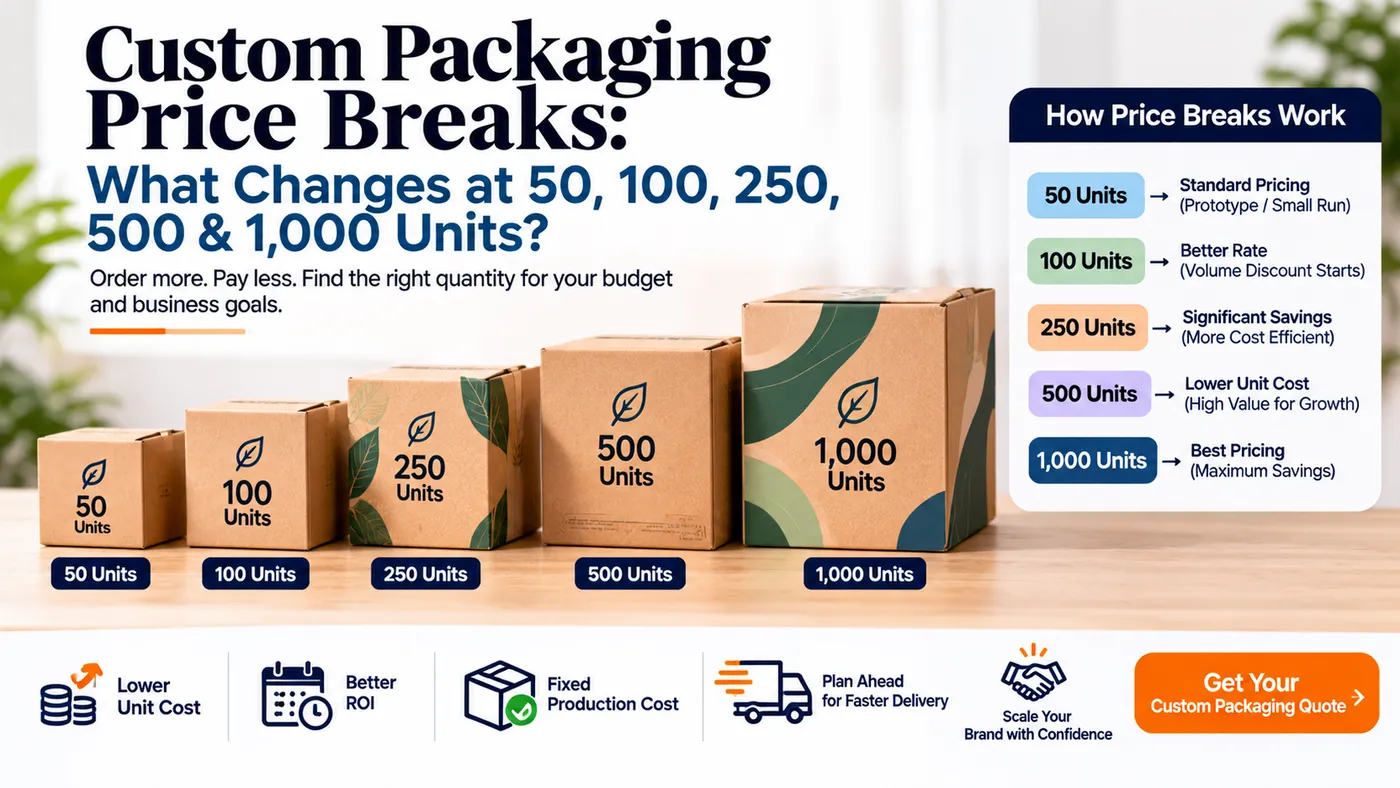
- Custom packaging price breaks by quantity: 50, 100, 250, 500 and 1,000
- An illustrative example of custom packaging price breaks (not EBP pricing)
- When to switch printing methods
- How to read price breaks on your quote
- Should startups order more to get a lower unit cost?
- What to send your packaging manufacturer
- Key takeaway
Custom packaging price breaks happen because setup costs stay fixed while quantity grows. Per-unit cost usually falls fastest between 50 and 250 units, then flattens as material and labor take over. Digital printing flattens the curve. Offset steepens it. Exact break points depend on structure, material, print method and finish. Ask for several quantity tiers on one quote.
Quick answer
- Setup work costs the same at 50 units or 1,000. Each box carries less of it as quantity rises.
- The steepest drop in per-unit cost usually comes early, from 50 to 250 units.
- Material, assembly, inserts and freight scale with every box, so they never disappear.
- Digital printing has little setup. Offset has more, but a lower cost per box at volume.
- There's no universal break point. Your quote shows it.
Why custom packaging price breaks happen
Every custom job has costs you pay once and costs you pay per box. Custom packaging price breaks come from spreading the first kind across more boxes. For a plain-language definition of terms like dieline and makeready, see our packaging glossary. Typical one-time items:
- Dies and tooling. A cutting die turns flat sheets into your dieline shape. It's made once per structure.
- Plates or print setup. Offset needs plates. Digital needs file prep instead.
- Proofs and prepress. Artwork checks and print proofs take the same time at any quantity.
- Makeready waste. Peer-reviewed research on sheetfed offset finds paper is always wasted in press setup. Setup is typically the largest source of waste sheets.
- Finishing setup. Foil, embossing and spot UV each need their own tooling or pass.
- Material yield. Board comes in sheets. Small runs often waste more of each sheet.
Our manufacturing page shows where each of these steps sits in production.
What does not drop at higher quantities
Some costs scale with every box. Custom packaging price breaks don't touch these:
- Board, paper and wrap per box
- Hand assembly on rigid boxes
- Inserts, trays and tissue
- Freight, which follows weight and cube
- Digital print cost per box, which stays roughly flat
I've watched founders order 1,000 boxes expecting half the price of 100. The setup shrank, but the board and labor didn't. The saving was real but smaller than they'd hoped.
Digital vs offset: how the economics differ
Digital and offset are the two print routes Easy Box Packaging quotes. Flexography also exists, mostly for high-volume corrugated, and it's outside this guide.
Digital has almost no setup, so your first box and your fiftieth cost close to the same. Offset has plate and makeready costs up front. Its cost per box falls faster as quantity grows. Our guides on offset vs digital printing and short-run vs long-run packaging cover the mechanics. This guide covers the buying decision: where custom packaging price breaks land and what to do about them.
Custom packaging price breaks by quantity: 50, 100, 250, 500 and 1,000
Cost bands below are relative, not prices. They mirror the planning language on the low-MOQ and wholesale pages from Easy Box Packaging.
Quantity | What typically changes | Per-unit cost band | Best fit | Watch-outs |
|---|---|---|---|---|
50 | Setup is spread over very few boxes | Highest | Launch tests, samples, PR kits | Low MOQ applies to eligible formats only |
100 | Setup share starts shrinking | High | First market launch | Often still digital-printed |
250 | Biggest early drop in setup share | Moderate | Growing demand, extra SKUs | Design must be settled |
500 | Offset may start to compete on some jobs | Moderate to lower | Proven products | Storage and cash tied up |
1,000 | Setup share is small | Lower | Repeat demand | Artwork changes strand stock |
Easy Box Packaging confirms that low MOQs start at 50 units on eligible formats. The final minimum depends on your specification.
An illustrative example of custom packaging price breaks (not EBP pricing)
Here's a hypothetical to show the shape. The numbers are invented. They are not quotes and not EBP pricing. Index 100 equals the 500-unit run in each row.
Hypothetical job | 50 | 100 | 250 | 500 | 1,000 |
|---|---|---|---|---|---|
Setup-heavy (offset-style) | 700 | 367 | 167 | 100 | 67 |
Low-setup (digital-style) | 167 | 130 | 107 | 100 | 96 |
The setup-heavy job drops steeply. The low-setup job barely moves. That's why digital suits tiny runs and offset rewards volume. Custom packaging price breaks look very different depending on the print route.
When to switch printing methods
The switch point is where custom packaging price breaks change shape. Switch when the plate cost, spread over your quantity, costs less than digital's extra cost per box. Three things move that point:
- Color count. More colors mean more plates and more setup.
- Finishes. Foil or embossing adds setup that digital doesn't avoid.
- Reorder pattern. Ask whether plates are stored for reorders.
A simple one-color job can switch sooner. A five-color job with foil switches much later. I've seen a plain one-color carton justify offset at a modest quantity. A foil-heavy box at the same quantity stayed on digital. Request the same quote in both methods and compare.
How to read price breaks on your quote
Ask for one-time costs and per-box costs as separate lines at every tier. That's the clearest way to see custom packaging price breaks on paper. Then compare the one-time lines. If they match across tiers, the price break is pure spreading. You can then predict the next tier yourself. If they change, a different print route or tooling step has kicked in. That's the moment to ask why.
Also ask what happens to the price if your artwork changes before the second order. A cheap tier loses its appeal when leftover boxes carry an old logo.
Should startups order more to get a lower unit cost?
Sometimes. The lower unit cost from custom packaging price breaks is real. So are the costs of holding stock. Weigh three risks.
- Cash flow. Boxes you haven't used are money sitting on a shelf.
- Storage. A flat stack of 500 mailers takes more shelf than most founders expect. It also needs dry, clean space.
- Reorder risk. A new logo, size or finish can strand leftover stock.
How this plays out by product:
- Candle jars and cosmetics: Sizes tend to stay stable, so 500 can be sensible after a test run.
- Apparel or subscription mailers: Mailer boxes with stable dimensions suit larger runs once demand is predictable.
- Gift sets and seasonal items: Keep runs short. The design expires with the season.
My opinion: order the first run small, even at a higher cost per box. Learning fit and artwork is worth more than the saving. Once a design survives two reorders, move up a tier.
What to send your packaging manufacturer
To make custom packaging price breaks visible, ask for several tiers on one quote.
- Product dimensions and packed weight
- Quantity tiers, for example 100, 250, 500 and 1,000
- Packaging format or reference
- Artwork status and number of colors
- Material preference
- Printing method, or a request to quote digital and offset
- Finishing, such as foil or embossing
- Inserts or trays
- Destination for freight
- Required date and expected reorder frequency
- Whether you want a physical sample kit first
Ask for one-time costs and per-box costs as separate lines. Easy Box Packaging confirms pricing, production method and timing against your approved specification.
Key takeaway
Custom packaging price breaks come from spreading fixed setup across more boxes. They flatten once material and labor dominate, so order the quantity your demand supports.
Illustrative figures are examples only. Request a quote for pricing on your specification.