
Jump to section12 sections
- Quick answer
- What ECT measures
- What BCT measures
- ECT vs BCT: which test matters for your situation
- How ECT turns into a BCT estimate
- Stacking loads, pallets and warehouse time
- Humidity
- Flute, board grade and box size
- Real ECT vs BCT examples
- Common ECT vs BCT mistakes
- What to send your packaging manufacturer
- Key takeaway
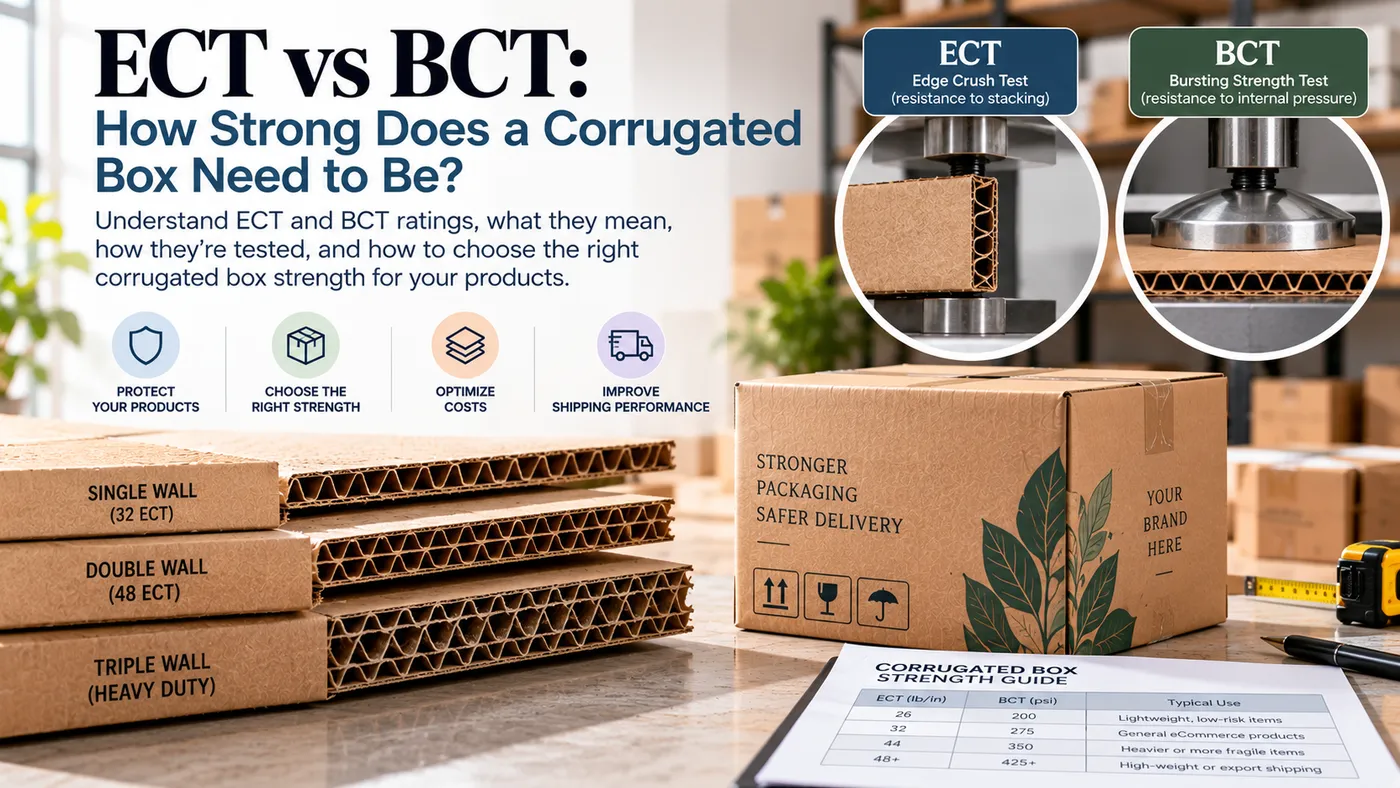
ECT vs BCT is material versus finished box. ECT (edge crush test) rates the corrugated board in pounds per inch of edge. BCT (box compression test) crushes a finished box top to bottom and reports pounds of force. Use ECT to set the board spec and meet carrier minimums. Use BCT to judge how much stacking load one real box can take.
Quick answer
- ECT vs BCT in one line: ECT measures the board. It's the number on the box maker's certificate and the one you compare between quotes.
- BCT measures the finished box. It reflects size, style, scores, cutouts, and glue.
- Shipping single parcels: ECT and a drop-safe design matter most.
- Stacking on pallets or in storage: BCT, plus a safety margin for time and humidity, matters most.
- No BCT is a safe stacking load. It's a lab peak, not a working limit.
What ECT measures
ECT is a short-column test. A small strip of board is stood on its edge, parallel to the flutes, and crushed. The result is force per inch of width, in lb/in. TAPPI T 811 is the standard edge crush method for corrugated board.
In ECT vs BCT terms, ECT belongs to the board, not the box. Liners, medium weight, and flute all feed into it. Our corrugated flute types post explains the flute side. Our packaging glossary defines the other terms.
Carriers use it too. The NMFTA says Item 222 of the National Motor Freight Classification sets minimum edge crush and burst values. They vary by box weight and size. The box manufacturer's certificate (BMC) stamped on the box confirms the box meets them. One Item 222 table, reproduced by iPack, lists 32 lb/in ECT for single-wall boxes up to 65 lb. Check the current tables, because size also counts.
What BCT measures
BCT puts the whole box between two platens and crushes it until it fails. ASTM D642 is the standard method for compressive resistance of shipping containers. It can test empty or filled boxes, and unit loads too.
Here's the detail most guides skip. ASTM D642 notes that fixed-platen machines tend to make a corrugated box fail at its strongest point. Swivel-platen machines make it fail at its weakest. Two labs can report different BCT numbers for the same box. Any ECT vs BCT comparison needs matching test conditions.
A related method, ASTM D4577, holds a constant load for a set time. That one mimics a stack sitting in a warehouse. You can read the scope on the ASTM D642 listing.
ECT vs BCT: which test matters for your situation
Scenario | Which test matters | What to ask the supplier |
|---|---|---|
Comparing two box quotes | ECT | "What's the ECT of the combined board, and is it on the BMC?" |
Single parcels, no stacking | ECT, plus drop-safe design | "Is the board spec carrier-compliant for my weight and size?" |
Palletized cartons, stacked 3+ high | BCT | "Can you test or estimate BCT for my exact box?" |
Warehouse storage for weeks | BCT under constant load | "Is there a constant-load result, or a humidity margin?" |
Heavy product, small footprint | Both | "Does a higher ECT or double wall fit my weight?" |
Retail mailer, light product | ECT, then a sample | "Can I test a sample packed with my product?" |
How ECT turns into a BCT estimate
The McKee formula links ECT vs BCT. It estimates BCT from board and box numbers. The simplified form is BCT = 5.87 × ECT × √(caliper × perimeter). ECT is in lb/in. Caliper is board thickness in inches. Perimeter is 2 × (length + width), also in inches.
Here's an illustration with assumed numbers, not EBP board data. Take a 12 × 9 × 6 inch box. Perimeter is 42 inches. Assume 32 lb/in ECT and 0.15 inch caliper. The square root of 0.15 × 42 is about 2.51. So 5.87 × 32 × 2.51 gives roughly 470 lb.
Treat that as an estimate. Westpak, a packaging lab, calls the simplified version a quick estimate for a regular slotted container. It shouldn't rate a real box. Georgia Tech's Roman Popil calls it easy but not accurate. The same formula appears in the Westpak BCT calculator.
The result is also a peak, not a working load. Westpak notes that BCT isn't stacking strength. Stacking strength is what a box survives through a full distribution cycle.
Stacking loads, pallets and warehouse time
Stacking load is the weight above your bottom box. Count the full boxes above it, each with contents. In the ECT vs BCT decision, this is where BCT earns its keep. Compare the load to BCT, with a margin.
Time matters because corrugated creeps. A box that survives a quick crush may sag under the same load over weeks. That's why ASTM D4577 exists. Ask your supplier what margin they apply for your storage period.
Pallet pattern matters too. Boxes stacked in aligned columns pass load through the corners. Corners carry roughly two-thirds of a box's compression load, according to the NMFTA. Overhang or misaligned columns waste that strength.
Humidity
Humidity is the quiet killer of any ECT vs BCT spec. The NMFTA reports that as relative humidity passes 95%, stacking strength can fall by more than 60%. It cites research in the Fibre Box Handbook. Liquid water is worse, with more than 90% strength loss on contact. Read the NMFTA humidity guidance for details.
I've seen cartons pass a spec on paper and fail on a humid dock. The board wasn't wrong. The route was. Map your worst-case humidity, then size the margin to it.
Flute, board grade and box size
Flute and board grade change ECT. Heavier liners and double wall raise it. Larger flutes generally add vertical compression strength, in general. See why corrugated wins for ecommerce for the trade-offs.
Box dimensions change BCT even at the same ECT. A bigger perimeter raises the estimate in the formula. The formula also assumes the panels can bulge. Georgia Tech's slides put that at a height of at least perimeter divided by seven. Cutouts, windows, and handles cut strength. If you're sizing a carton, start with our shipping box sizes guide. Our cardstock vs cardboard vs corrugated post covers the material basics.
Real ECT vs BCT examples
- Candle jars in a shipping carton: weight is the issue. Ask for ECT plus a drop test with the jars packed.
- Apparel subscription boxes: light and often stacked at a 3PL. Ask about BCT under stacking and humidity.
- Coffee bags on a pallet: stacking dominates. Ask for BCT and a pallet pattern.
- Cosmetics mailer: presentation matters. Ask for a sample, then test it.
For printed corrugated, see our custom printed corrugated boxes. For plain shipping cartons, see our corrugated boxes.
Common ECT vs BCT mistakes
- Comparing a BCT number to an ECT number. They're different units for different things.
- Treating BCT as a safe stacking load.
- Ignoring humidity, storage time, and pallet pattern.
- Choosing flute by letter instead of by ECT.
- Skipping a sample test on the real packed product.
Our packaging samples explained post covers how to test before you commit.
What to send your packaging manufacturer
- Product dimensions and packed weight
- Quantity per order and per pallet
- Box format: mailer, shipping carton, or die-cut
- Stack height and storage duration
- Destination, shipping route, and humidity exposure
- Material preference: kraft or white-top liner
- Artwork status, printing, and finishing needs
- Inserts or dividers
- Required date
See our manufacturing capabilities for what we can quote.
Key takeaway
Understanding ECT vs BCT isn't a contest: ECT specs the board, BCT checks the finished box. Choose by weight, stack height, storage time, and humidity, then test a real sample.
Test numbers here are general guidance. Your own packed product, route, and storage conditions decide the final spec.