Retail shelf presentation
Present a single product or a small row with the front lip, rear panel, and main brand cue oriented toward the shopper.

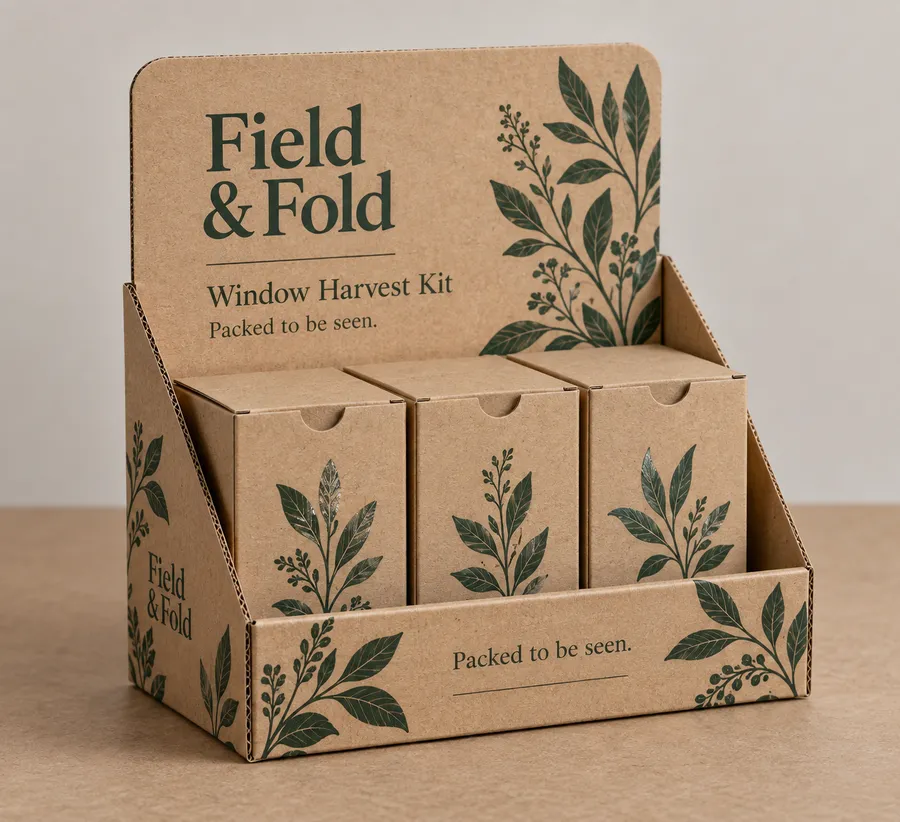
Open-front kraft corrugated display box holding upright cartons with a printed green rear panel
Corrugated Boxes
Custom corrugated display boxes organize products for a shelf, counter, event, or retail handoff while keeping the shopper-facing panel visible. Share the item dimensions, packed weight, display count, viewing angle, board direction, artwork, and delivery route so the open front, back panel, folds, and print coverage are reviewed as one structure.
Last updated
Working quote
Product brief
Custom corrugated display boxes combine a defined fluted-paperboard shell with a presentation-led opening. The goal is not simply to hold a product; it is to keep the product upright or arranged while the front lip, side panels, and branded back panel guide the shopper's view. A compact counter display creates a different brief from a wider shelf unit that will travel loaded to a store. Start by describing what the display must show, where it will sit, and how the filled unit reaches that setting.
A useful brief names the product's finished width, depth, and height, its packed weight, its orientation, and the number of items that share one display. Note whether every item faces forward, whether a label or feature must stay unobstructed, and whether the display is replenished one item at a time. Those details influence the front lip, the back panel height, the base footprint, and the amount of space needed for loading. Avoid choosing a stock size first and forcing the product into it; the display should be developed around the real packed arrangement.
An open-front corrugated display can use a shallow front lip and a taller rear panel, stepped shelves, a divider, or another folded arrangement that suits the product count. The front should keep the intended product view clear, while the base and rear panel give the unit a defined footprint. If a display will be carried to a counter, the opening sequence and loading method matter. If it will travel through parcel handling, explain whether it ships flat for assembly or travels already loaded so the structural conversation reflects the actual route.
Corrugated Board is the central material direction for this category because the fluted construction can create a shaped retail shell. Kraft Paperboard or SBS Paperboard may be discussed for a particular surface or presentation requirement, subject to the final structure and production review. This page does not assign an unsupported flute grade, gsm, edge-crush value, or fixed thickness. Material selection should follow the packed product, the number of facings, the display footprint, and the handling conditions rather than the word “display” alone.
Internal support depends on several inputs together: product geometry, weight, fragility, orientation, the outer display structure, the desired reveal, and whether the unit is shipped loaded or assembled at its destination. Support may be integrated into the corrugated folds, created with a divider, or reviewed as a separate insert. Describe the contact points and loading path so the quote can address a real arrangement instead of assuming that every product needs the same support.
A display has several visual planes, but the main front or back panel usually carries the first brand and product cue. Provide the dieline if available, identify the face that should read from the shopper's position, and keep important copy clear of folds, cut edges, dividers, and the open display area. Side panels can carry supporting information while a lower lip can repeat a short product name or directional message. A digital proof should show the assembled hierarchy, not just a flat sheet of artwork.
Matte Lamination and Gloss Lamination can be considered for different surface appearances. Spot UV can highlight a selected mark, while Embossing/Debossing or Foil Stamping can give one brand detail a tactile or metallic role when the board, artwork scale, and production method support it. These are finish directions, not universal performance promises. Review each effect against fold lines, exposed edges, the product view, and the amount of handling the display will receive.
A display that stays on a shelf has a different practical brief from one that is packed into a master carton and shipped to a retailer. Tell us whether products are loaded before dispatch, whether the display is assembled at the destination, and how many units are handled together. Include storage orientation and any replenishment routine that could change access to the front row. Those details help the construction, opening, and artwork remain useful after the display leaves the packing bench.
The standard fulfillment path starts at 50 units. Production is from 7 business days after digital proof approval, and Free US shipping applies on that standard path. Dieline and proof review are included at no extra charge, so the review can cover the open front, rear panel, printed hierarchy, folds, and packed product together. Quote requests are answered within 24 hours, typically the same business day. A sample kit carries a $44.99 USD shipping charge credited toward the first order when you want to compare board feel, print, and finish direction before a run.
For a quote, send the product name, finished product dimensions, packed weight, item count per display, orientation, preferred viewing face, target shelf or counter setting, and whether the unit travels loaded. Add the intended board direction, Corrugated Board, Kraft Paperboard, or SBS Paperboard, if you have a starting preference. Share artwork status, panel priorities, code placement, finish direction, and any divider, stepped shelf, front lip, or back-panel request.
That information gives Easy Box Packaging a clear basis for discussing the structure, print coverage, and handling path. The 50-unit starting point does not determine the display footprint or material by itself, and no unsupported price should be assumed before the individual configuration is reviewed. When the product arrangement, retail view, delivery route, and artwork are described together, the resulting custom corrugated display box can be evaluated as an assembled retail tool rather than a generic carton with graphics added later.
Proof points
The useful proof is a check of the finished display relationship, not a flat artwork review alone.
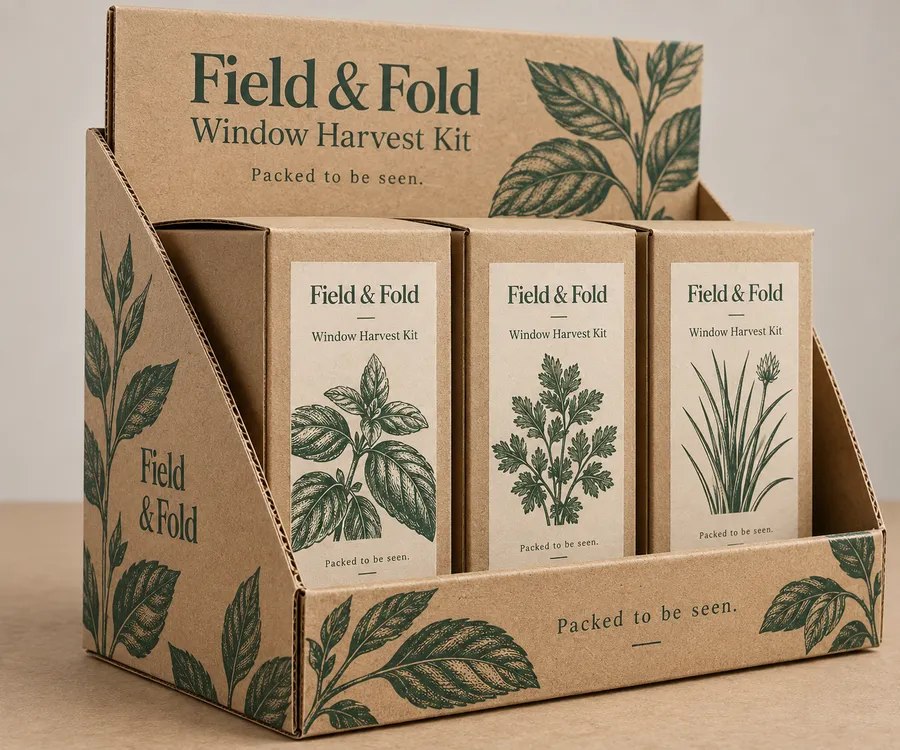
The open front, base, rear panel, dividers, and printed surfaces are reviewed with product dimensions, count per display, viewing angle, and route to retail. That keeps the presentation readable while giving the corrugated structure a practical loading and handling brief.
Present a single product or a small row with the front lip, rear panel, and main brand cue oriented toward the shopper.
Keep compact products visible and replenishable where the display footprint and front opening need to work in a tighter setting.
Discuss Corrugated Board and loading sequence when a filled display must travel to a store before it reaches the shelf.
Arrange a short-run product set with a branded back panel and open view when the display will be set up for a handoff or campaign.
Put the principal product and brand cue on the shopper-facing panel, then use side, rear, and lower panels for supporting information. Keep essential artwork clear of folds, edges, dividers, and the open display area.
A focused brief connects the corrugated structure to the product and the place where shoppers will see it.
Provide item dimensions, packed weight, orientation, count per display, and the feature that must remain visible.
Identify the shelf or counter position and the panel or front row that should face the shopper.
Explain whether the display travels loaded, ships flat, or is assembled and filled at its destination.
A clear sequence keeps the product arrangement, shopper-facing view, corrugated structure, and artwork aligned before the run begins.
Send dimensions, packed weight, orientation, item count, fragility, and the feature that must face the shopper.
Identify the shelf, counter, event, or retail handoff and whether the display travels loaded or ships flat.
Share a board preference, panel hierarchy, artwork status, code placement, and any finish, divider, front-lip, or back-panel request.
Check the assembled view, product access, folds, open area, printed hierarchy, and selected finish areas together before approval.
After proof approval, production starts from 7 business days and the standard fulfillment path includes Free US shipping.
Need help with structure, materials, or production planning? See how we manufacture custom packaging.
A sample kit carries a $44.99 USD shipping charge credited toward your first order, giving you a way to review board feel, printed panels, and finish direction before committing to a production run.
Shipping charge: $44.99. Credited toward your first order.
Request a Sample KitFind clear answers about fit, materials, and ordering below.
Provide each product's finished width, depth, and height, packed weight, orientation, item count, and any feature that must remain visible. Also note the intended shelf or counter position and whether the display travels loaded.
The shipping format can be discussed with the display geometry and loading method. Explain whether the unit is assembled and filled before dispatch or shipped flat for assembly at the destination.
Corrugated Board is the central material direction, with Kraft Paperboard or SBS Paperboard reviewed for a particular surface or presentation need. Matte Lamination, Gloss Lamination, Spot UV, Embossing/Debossing, and Foil Stamping are finish directions subject to artwork and production review.
Prioritize the panel facing the shopper, then use rear, side, and lower panels for supporting information. Keep key copy clear of folds, edges, dividers, and the open display area, and review the assembled hierarchy in the digital proof.
The standard fulfillment path starts at 50 units. The final quote still depends on the product arrangement, display footprint, board direction, artwork, finish, and handling route.
The approved standard estimate is from 7 business days after digital proof approval. Dieline and proof review are included at no extra charge, and the final schedule follows the confirmed configuration.
Orders start at 50 units and scale up to 500,000 for bulk runs, with pricing from $0.26 per unit on larger quantities. Standard production is from 7 business days after digital proof approval.
Compare nearby products and request the format that best fits your next run.
Available product
Available product
Available product
Available product
Custom corrugated display packaging
Send the packed product details, intended viewing face, display count, material direction, artwork status, quantity, and route to retail for a project-specific review.
Add your product details to see a quote summary.