
Jump to section7 sections
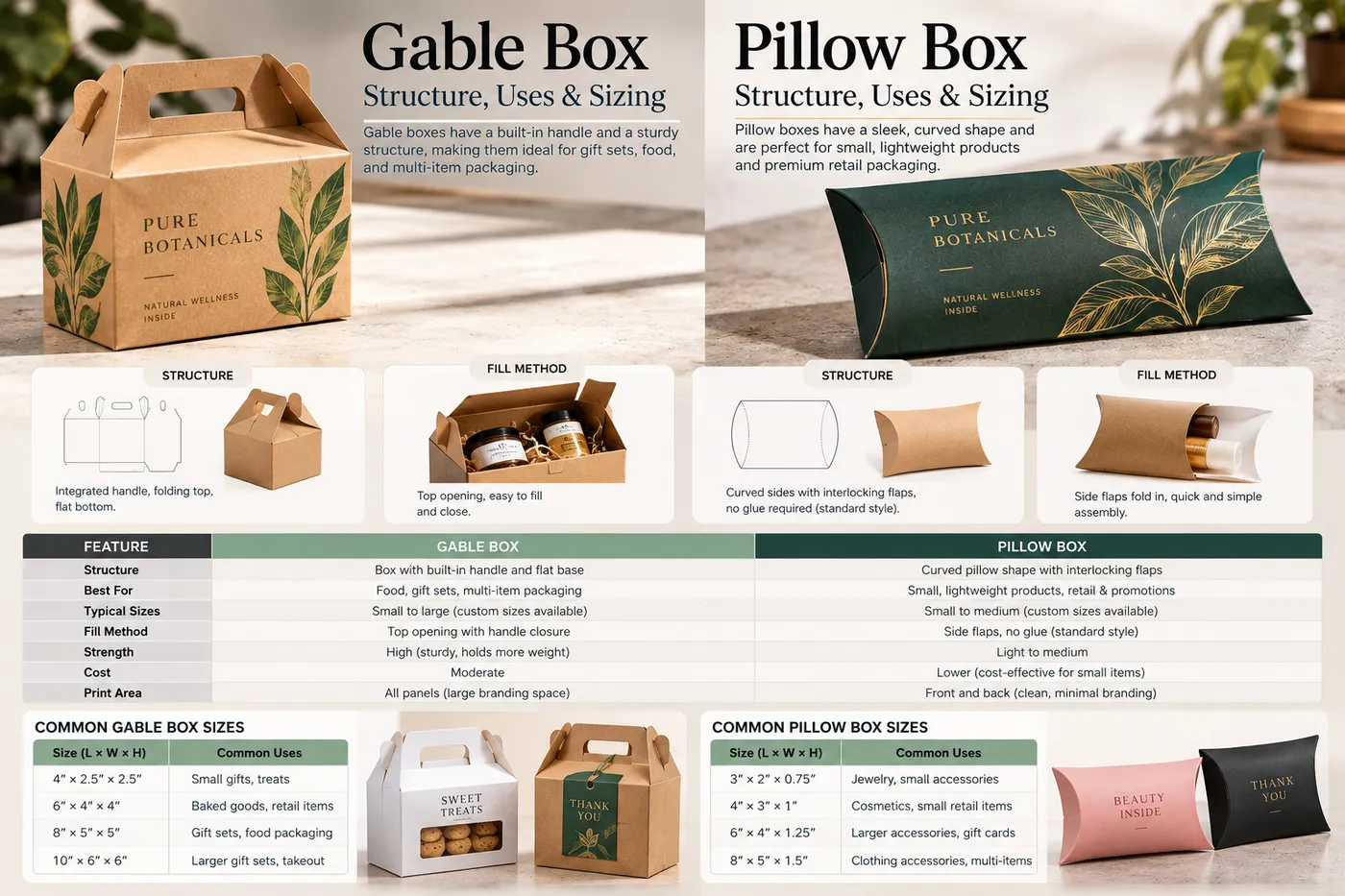
A gable box is a rectangular carton with a triangular gable handle built into the top. It folds flat for shipping. It pops up with a handle, like a miniature milk carton. It's common for baked goods and gift packaging. A pillow box has a curved body with folded ends that tuck in, with no separate base. It gives a gift-bag silhouette. Brands use it for smaller items like jewelry or party favors.
This guide covers both shapes in plain terms. We'll walk through how each one folds and locks. We'll also compare sizing, fill method, and cost. For the full list of structural terms this pair belongs to, see our packaging glossary.
What is a gable box?
A gable box starts as a flat die-cut blank. Picture two long side panels and two shorter end panels, each with angled top flaps. Fold the sides up. Fold the angled flaps inward. They meet at a peak. That peak forms the triangular gable, with a pre-punched slot for a handle to pass through.
The trade name here is "gable top carton," or simply "gable box." The plain-English version is simpler. It's a milk-carton shape. Anyone who's held a half-pint milk carton already knows the fold pattern by feel, even without a diagram.
Assembly needs no glue on most gable box styles. The side flaps interlock with slotted tabs. The gable peak locks itself shut once folded correctly. That's a real time-saver for anyone packing orders by hand, especially at volume.
Gable boxes ship flat. A stack of 50 takes up barely more room than a ream of paper. That's a meaningful win for brands storing packaging on-site between orders. Shelf and closet space is often tight in a small studio or storefront. This shape shows up constantly in bakery packaging. Cake box lines use it for exactly that reason: flat storage, a fast fold, and a built-in carry handle.
The handle itself carries real weight in daily use, not just decoration. A properly scored gable peak holds a filled box of cookies without tearing at the fold. The same holds for a small gift set. That's true only when the paperboard weight matches the product load. A heavier filling calls for a heavier board, or a reinforced gable peak. I've seen a bakery client learn this the hard way — a run of gable boxes sized for light pastries tore at the handle once loaded with a heavier gift assortment. Bumping up the board weight on the reorder fixed it completely.
What is a pillow box?
A pillow box is a single curved die-cut shape, and it's built very differently from a gable box. There's no separate base and no separate lid. The whole box is one piece of folded paperboard. Think of a pillow or a cushion — hence the name. Two folded, tucked-in ends replace the flat panels a gable or tuck-style box would use.
The fold-and-tuck assembly is simple. Fold the flat blank around a curved die-cut line. The two ends curl inward. They tuck into slits cut near each edge. No glue, no tape, no separate closure mechanism is needed. Just paperboard, folded against its own grain.
That curved body is also the pillow box's one real constraint. The curve pulls inward at both ends. Artwork or text placed too close to either end distorts once the curve forms. It can even get cropped off entirely at the fold line. Competitor glossaries rarely mention this gap. It matters once a brand submits print-ready files and the proof comes back warped at the edges. This shape is a staple of gift box lines for jewelry, favors, and small retail add-ons. That soft silhouette does real presentation work on its own, without a gable box's bulk.
Typical sizes and fill method
Gable boxes commonly run from small single-serving bakery sizes up to larger party-size containers. A typical small gable box measures about 4 x 4 x 4 inches. A larger gift or party version can reach 10 x 10 x 10 inches or more. Fill happens from the top, before the gable peak locks shut. It's similar to loading a takeout container by hand.
Pillow boxes run smaller overall. Most fall between 3 x 2 inches and 6 x 4 inches. That range suits jewelry, favors, soap bars, or small accessories well. Fill happens by sliding the product in. This happens before folding the second tucked end shut, so there's no top-loading motion at all.
Minimum order quantities and custom printing
Both shapes are available in custom print runs, not just plain kraft or white stock. A gable box's flat panels take full-color printing well across most of the surface. Only the handle slot and fold lines need designing around. A pillow box can also carry full custom printing. The design has to account for the curve pulling artwork inward at both tucked ends, as covered above.
Minimum order quantities vary by supplier and print complexity. Both the gable box and the pillow box are commonly available at low MOQs for small or growing brands. Better per-unit pricing opens up at higher volumes. Request a custom quote to get exact numbers for a specific size, stock, and print run.
Comparing gable boxes and pillow boxes
Gable box | Pillow box | |
|---|---|---|
Structure | Flat panels + triangular peak + handle slot | Single curved piece, folded and tucked at both ends |
Typical size range | 4x4x4 in to 10x10x10 in | 3x2 in to 6x4 in |
Fill method | Top-load before peak locks | Slide in before second end tucks |
Best product fit | Baked goods, party favors, gift sets | Jewelry, soap, small accessories |
Relative cost per unit | Moderate (more die-cut panels) | Lower (single-piece die cut) |
Printable area | Full panel faces, handle area excluded | Reduced near curved, tucked ends |
Other specialty box shapes
A few other die-cut shapes show up in the same "specialty structure" category as gable and pillow boxes. Hexagonal boxes use six angled panels instead of four. That gives a distinctive silhouette for candles or cosmetics. Triangular boxes fold into a three-sided prism. They're often used for single-slice cake or novelty retail items. Windowed boxes add a die-cut opening. It's usually covered with clear film, to show the product without opening the box. Any of the shapes above can add a window as an option.
All of these shapes, along with the gable box and the pillow box, rely on the same underlying die-cutting process. For more on how that cutting step works, see our guide to die cutting.
Which structure to choose
Choose a gable box when the product needs real volume and a built-in carry handle. That covers baked goods, multi-item gift sets, or anything a customer might carry by hand from a counter. Choose a pillow box when the product is small and light. It benefits more from a soft, gift-ready presentation than from a rigid container.
According to PMMI, the Association for Packaging and Processing Technologies, structural packaging choices are shaped by shelf presentation needs. Fill-line compatibility matters just as much. That's a reminder that structure isn't just a look. It's a production decision too, especially once order volume grows past hand-packing.
A box insert adds extra protection inside either shape. It keeps contents from shifting in transit. That matters most for pillow boxes. They tend to hold loose or delicate items like jewelry, where a little padding goes a long way.
Gable and pillow boxes aren't the only fold-and-lock structures worth knowing. The straight tuck vs reverse tuck comparison covers a different, more common closure family. It shares some of the same locking-tab logic described above.
One limitation worth noting: exact size breakpoints and minimum order quantities vary by supplier and paperboard weight. Request a custom quote for exact pricing and sizing on your specific run.