
Jump to section12 sections
- Quick answer
- The healthcare packaging kits spectrum
- Supplement and nutraceutical kits
- OTC medication kits
- Wellness and healthcare gift kits
- Veterinary supplement kits
- Diagnostic test kits
- Medical device secondary packaging
- Clinical trial IMP supply kits
- Choosing the right structure across the spectrum
- What to send your packaging manufacturer
- Key takeaway
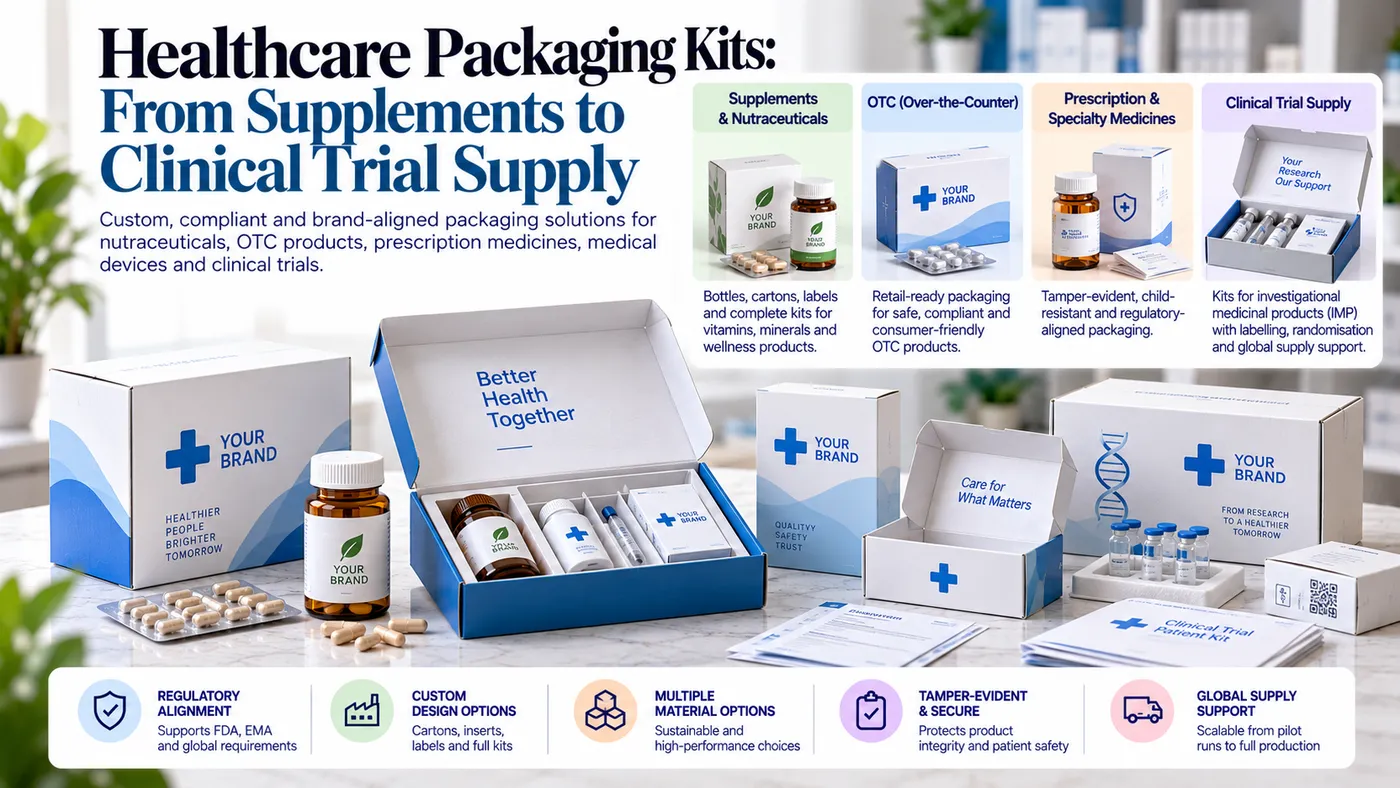
Healthcare packaging kits are custom outer boxes with fitted inserts. They hold products from consumer supplements to clinical trial drugs. Each category carries different label panels. Supplements need a Supplement Facts panel. OTC drugs need Drug Facts and a tamper-evident feature. Devices need a UDI barcode. Clinical trial kits are blinded and carry variable data fields.
Quick answer
- Supplement kits: Supplement Facts panel, fitted insert, no blinding.
- OTC kits: Drug Facts panel and a tamper-evident feature.
- Diagnostic and device kits: IVD or UDI labeling and a compartmented insert.
- Clinical trial kits: blinded carton with blank data areas.
- Order size: starts at 50 units.
The healthcare packaging kits spectrum
Healthcare packaging kits sit on a spectrum. Two things set a kit's place: how tightly the product is regulated, and how complex the contents are. Know your product's place before design starts. It decides the structure, panels and insert.
Category | Regulatory level | Kit complexity |
|---|---|---|
Supplement or nutraceutical | Low to moderate (FDA dietary supplement rules) | Simple: one container, one insert |
OTC medication | Moderate (FDA drug rules, tamper-evident) | Simple to moderate |
Wellness or gift kit | Low (general consumer goods) | Moderate: several components |
Veterinary supplement | Low to moderate (NASC quality standards) | Simple |
Diagnostic test kit (IVD) | Moderate to high (FDA, EU IVDR) | Moderate: components plus IFU |
Medical device secondary pack | High (FDA, EU MDR, UDI) | Moderate: device plus accessories |
Clinical trial IMP supply | High (GMP, blinding, protocol rules) | High: multi-period, variable data |
Supplement and nutraceutical kits
Supplement kits are where most brands start with custom healthcare packaging kits. US rules sit in 21 CFR Part 101. The structure is usually a folding carton around one bottle, jar or sachet.
Supplement kits need:
- A Supplement Facts panel with ingredients, amount and maker details.
- The structure/function claim disclaimer, if you make that kind of claim.
- A fitted insert that stops the container moving.
Use a tuck-end folding carton for single products. Use a rigid lid-and-base box for premium or starter sets. I've seen brands move from a labeled stock bottle to a custom carton as their first upgrade. It's usually the right step. See our custom supplement box kits for formats.
OTC medication kits
OTC packaging is a step up in complexity. The outer carton carries a Drug Facts panel in the FDA's set format. That means fixed headings, a fixed order and 6-point minimum body text, per 21 CFR 201.66.
Most OTC products sold at retail must have tamper-evident packaging. The rule is 21 CFR 211.132. Skin, toothpaste, insulin and lozenge products are excluded.
OTC healthcare packaging kits need:
- A Drug Facts panel built from final approved copy.
- A tamper-evident feature, such as a perforated tear strip or an induction seal.
- Marked fields for NDC number, lot number and expiry date.
- A fitted insert or card for the container.
Send final Drug Facts copy with the brief. The label must also name the tamper-evident feature. See custom OTC medication packaging for OTC healthcare packaging kits.
Wellness and healthcare gift kits
A wellness kit might hold a supplement bottle, a topical product, a printed guide and a sachet. It's usually not regulated as a drug unless one component is an OTC drug.
Presentation drives these healthcare packaging kits. The insert holds every part in a fixed layout. It should look neat when the lid lifts. It must also survive shipping.
Wellness kits need:
- A compartmented insert mapped to the full component list.
- A rigid box or sleeve-and-tray pack.
- Transit testing if the kit ships direct to consumers.
Browse our custom wellness kit boxes and rigid boxes. Our box insert types guide explains the compartment options.
Veterinary supplement kits
Veterinary supplement kits follow the same logic as human supplement kits: one container, one insert. Confirm the required panels with your regulatory contact. See custom veterinary supplement packaging.
Diagnostic test kits
Diagnostic (IVD) healthcare packaging kits cover home tests, lab kits and point-of-care products. A kit often holds a test device, a buffer and a leaflet. Every part must arrive intact.
Diagnostic kits need:
- IVD labeling under 21 CFR Part 809 (US) or EU IVDR: intended use, lot, expiry and storage conditions.
- Space for CE marking or FDA device labeling, as applicable.
- A tamper-evident seal for retail and online sales.
- A compartmented insert that holds each part still.
- Space for Instructions for Use (IFU), on the carton or as a leaflet.
See our custom diagnostic test kit packaging.
Medical device secondary packaging
The outer carton around a cleared device usually carries a UDI barcode and its readable text. The US rules are in 21 CFR Part 830. The EU rules are in EU MDR. Some devices are exempt, so ask your regulatory team.
Device healthcare packaging kits need:
- A UDI barcode and readable text in a panel with a quiet zone.
- Intended use, lot number and expiry date.
- An IFU reference, either a printed leaflet or an eIFU.
- ISO 15223-1 symbols, such as temperature limits.
- A fitted insert that holds the device and accessories in fixed positions.
We map the UDI panel on the dieline before artwork goes on. Confirm the barcode type, such as GS1-128 or GS1 DataMatrix, with the device maker first. See custom medical device packaging.
Clinical trial IMP supply kits
Clinical trial healthcare packaging kits are the most regulated category. An investigational drug (IMP) carton has needs no other kit shares:
- Blinding: the carton shows no drug branding. Protocol codes replace it.
- Variable data: patient ID, lot, expiry and site code are added later, at fill and finish.
- Multi-period kits: each dose period gets its own labeled slot.
Clinical trial kits need:
- A blinded carton with protocol number, data fields, storage conditions and an adverse-event contact.
- Data areas left blank on the dieline.
- A fitted insert or tray for one or several dose periods.
- A diary holder or instruction card, if the protocol asks for one.
Label copy for these healthcare packaging kits follows local rules and the protocol. In the US that includes 21 CFR 312.6. The sponsor's regulatory team confirms all copy first. We don't write or approve label content. See custom clinical trial supply kits.
Choosing the right structure across the spectrum
Category | Common format | Insert type | Tamper-evident | Variable data |
|---|---|---|---|---|
Supplement | Folding carton or rigid box | Fitted paperboard insert | Optional | No |
OTC medication | Folding carton with tear strip | Insert card or fitted tray | Required (most products) | Lot and expiry |
Wellness kit | Rigid lid-and-base or sleeve-and-tray | Compartmented insert | Optional | No |
Diagnostic test kit | Folding carton | Compartmented insert | Optional | Lot and expiry |
Medical device | Folding carton or rigid box | Foam or paperboard insert | Confirm per class | Lot and expiry |
Clinical trial IMP | Folding carton or multi-compartment | Compartmented tray | Confirm per protocol | Patient ID, lot, expiry, site |
My opinion: pick the insert before the box. The insert sets the inner dimensions. Our packaging glossary defines the terms above. Browse every format in our pharmaceutical and healthcare kits range, or read how industry-specific packaging differs by sector.
What to send your packaging manufacturer
Every brief for healthcare packaging kits starts the same way:
- Product category and the rules that apply.
- Filled primary container dimensions (L x W x H), measured sealed.
- The full component list, with dimensions and presentation order.
- Panel copy confirmed by your regulatory team.
- How many you need, and where they ship.
We draw the dieline around the real container and confirmed copy. Orders start at 50 units. See our manufacturing page for how orders run.
Key takeaway
Healthcare packaging kits share one structure: an outer box and a fitted insert. The label panels, tamper-evidence and data fields change. Confirm your regulatory copy first, then design around it.
Rules change. Treat this page as a design guide, not regulatory advice.