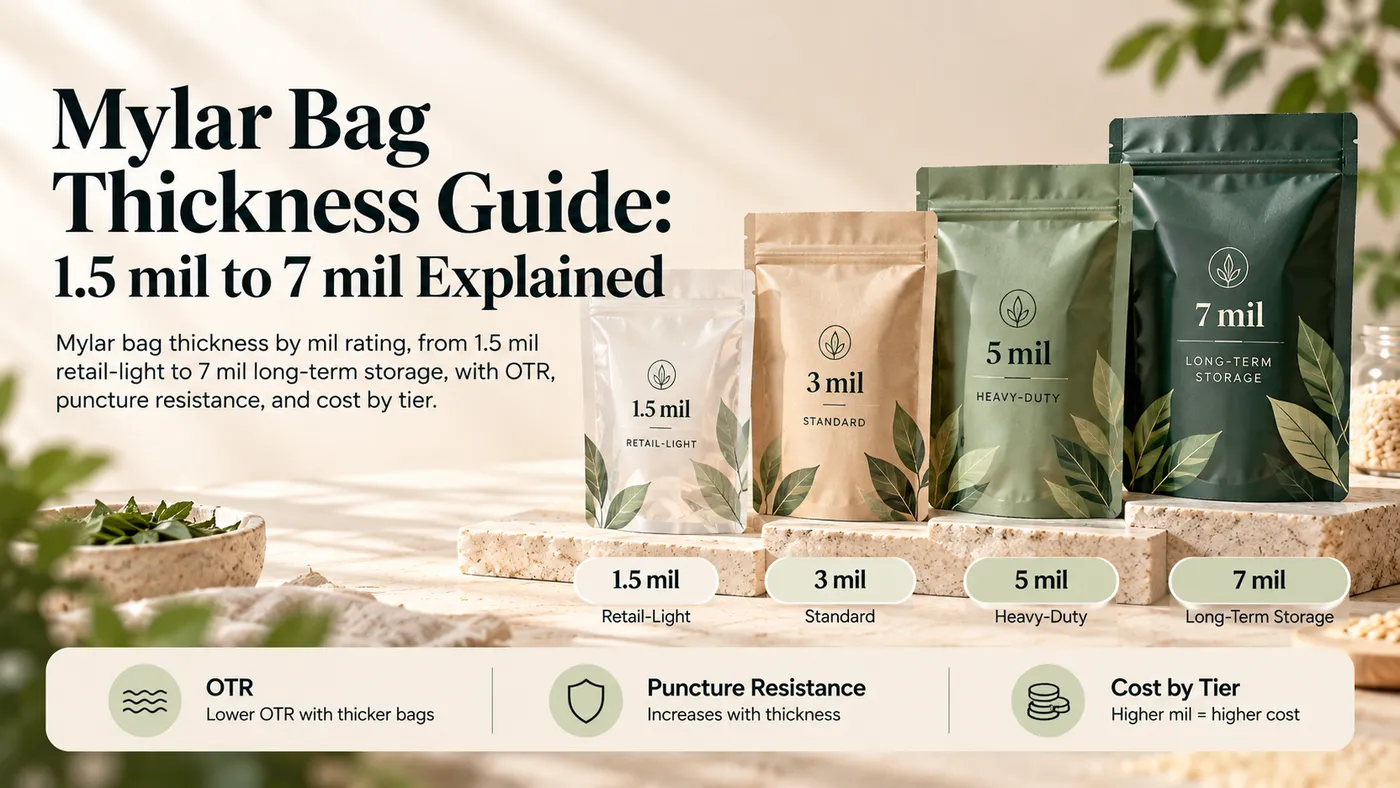
Quick answer: Mylar bag thickness is measured in mils. One mil equals 0.001 inch. Common tiers run 1.5 mil for light retail use and 3 mil for standard retail. 4 mil covers food storage and cannabis. 7 mil covers long-term, heavy-duty storage. A higher mil number means more puncture resistance and a tighter oxygen barrier. It also means a stiffer bag that's harder to heat seal. This guide charts mylar bag thickness by mil rating and matches each tier to the product it actually fits.
What a Mil Actually Is
A mil is a unit of thickness, not weight. One mil equals one thousandth of an inch, or about 0.0254mm. It's easy to confuse "mil" with "millimeter," but they're not the same unit at all. A millimeter is roughly 40 times thicker than a mil.
Mylar bag thickness specs always use mil, never millimeter, so a "4 mil" bag is thin by everyday standards. It's about the width of four sheets of standard printer paper stacked together. That thinness is normal for flexible barrier film. It's the layered foil construction, not raw thickness alone, that does most of the barrier work.
Mylar Bag Thickness Chart
Mil Rating
OTR Range (cc/100in²/day)
Puncture Resistance
Typical Use
Heat Seal Difficulty
Cost Index (vs. 3 mil)
1.5 mil
1.0–2.0
Low
Light retail, sample packs
Easy
0.6x
2 mil
0.7–1.5
Low-moderate
Standard retail, snacks
Easy
0.75x
3 mil
0.5–1.0
Moderate
Standard retail, coffee, snacks
Moderate
1.0x (baseline)
4 mil
Below 0.5
Moderate-high
Food storage, cannabis retail
Moderate
1.3x
5 mil
Below 0.3
High
Coffee, snacks, everyday dry goods
Moderate-hard
1.6x
7 mil
Below 0.01
Very high
Long-term food storage, heavy-duty
Hard
2.2x
OTR stands for oxygen transmission rate. A lower OTR number means less oxygen gets through the film. Mylar bag thickness and OTR move together in general, but the relationship isn't perfectly linear, which the next section explains.
3 Mil vs. 4 Mil vs. 7 Mil: The Three Most Common Choices
A 3 mil mylar bag is the standard retail choice. It's thin enough to heat seal fast on standard equipment. It holds up fine for a product with a shelf life measured in months, not years.
A 4 mil mylar bag steps up for food storage and cannabis retail. Most cannabis packaging and short-to-medium-term food storage lands in the 4 to 5 mil range. That mil rating balances barrier performance against cost and seal-ability.
A 7 mil mylar bag is the long-term storage tier. It's built for multi-year or multi-decade food storage, where a tiny oxygen leak compounds over years into real spoilage. This mylar bag thickness tier costs more and seals slower. It's still the standard for serious long-term preppers and bulk dry goods.
Products that fit this guide
A few Easy Box Packaging products that fit what this article covers.
Custom mylar food storage bags are printable, food-grade flexible pouches sized around the product, fill weight, closure, and storage routine. Choose a metalized or foil barrier direction, resealable zipper or heat-seal route, and matte or gloss finish. Share the filled dimensions, food type, artwork, and seal requirements so the dieline is built around the real pantry or retail pack.
Flat mylar bags are flat or lightly gusseted flexible pouches printed around a measured product, opening route, and barrier requirement. Choose food-grade film, a metalized or foil laminate when appropriate, a zipper or heat-seal closure, and a finish that suits the artwork. Share the packed width, height, thickness, weight, artwork, and storage context so the dieline is built around the actual fill.
Custom retail shipping boxes are sized around the packed product, the opening sequence, and the route from fulfillment to customer. Corrugated or paperboard construction, printed exterior and interior panels, practical closures, and optional support can be reviewed together so the box works as both a shipper and a retail touchpoint.
Custom retail cardboard boxes planned around the packed product, shelf position, opening route, board direction, printed panels, and finish. Choose a folding carton or more structural corrugated direction after sharing the real dimensions, weight, count, artwork needs, quantity, and delivery route.
A retail counter display groups several packaged units into a customer-facing tray or tiered presentation for a checkout, service desk, or compact retail surface. Specify the individual pack dimensions, unit count, facing, loaded weight, available footprint, board direction, print coverage, and finish so the display can be planned around the actual assortment.
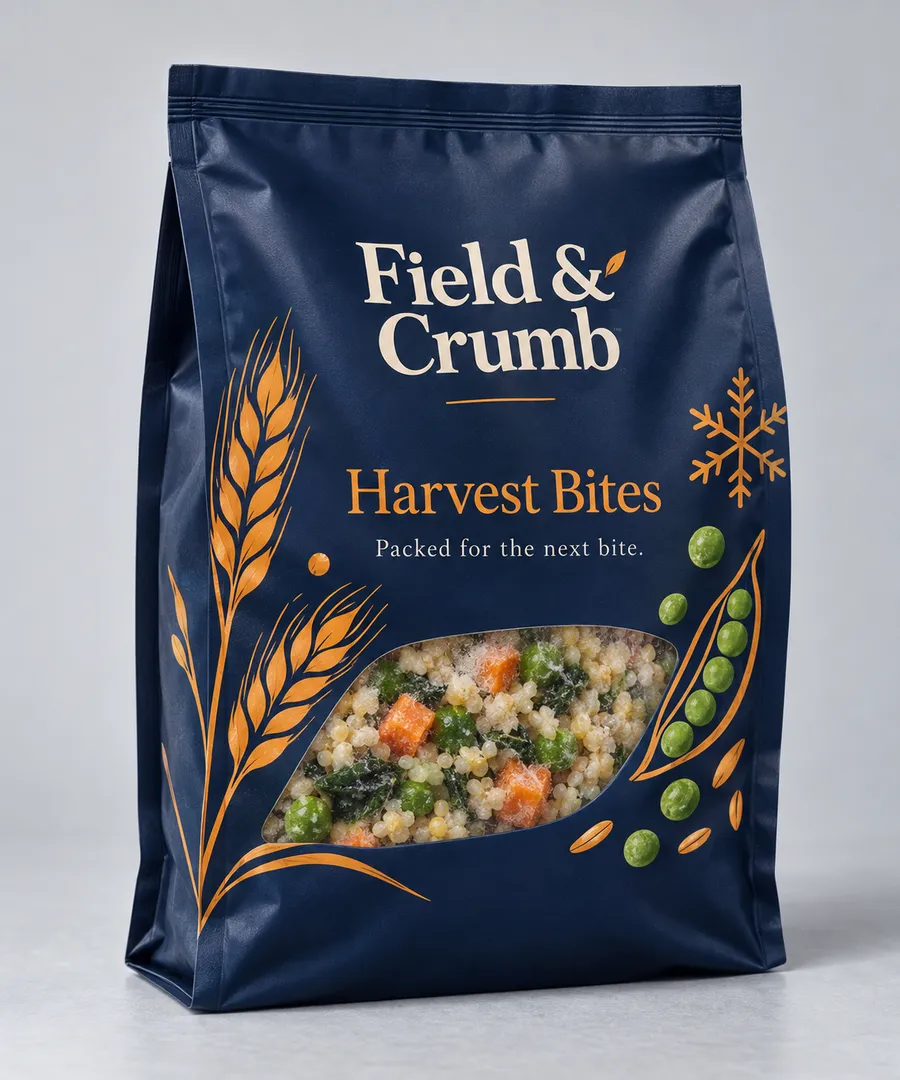
Custom frozen food bags give prepared meals, vegetables, proteins, and snack portions a printed flexible format planned around the filled product, seal area, opening route, and cold-chain handling brief. Food-Grade Flexible Pouch Film can be considered with the required barrier and contact review. Share the packed dimensions, fill weight, freezer conditions, and artwork so the bag structure and print panels are scoped together.
Not always. Barrier performance comes from the foil layer's quality, not raw mil count alone. A cheaply laminated 5 mil bag can underperform a well-constructed 4 mil bag with a cleaner foil layer.
Mil thickness is still a reasonable proxy for barrier strength within one manufacturer's product line. It's a less reliable way to compare two different suppliers. Ask any supplier for their actual tested OTR number, not just the mil rating on the spec sheet.
Minimum Mil for Specific Applications
Cannabis retail typically uses 4 to 5 mil mylar bags. That range balances a real barrier against the flexibility needed for child-resistant zipper closures. Food storage depends heavily on your timeline. Short-term pantry storage works fine at 4 mil. Multi-year or bucket-based long-term storage calls for 7 mil.
Coffee and snack bags usually run 3 to 5 mil. They often add a foil or metalized layer for aroma retention beyond what plain mil thickness measures. Pet food bags typically land at 3 to 4 mil. Most pet food turns over fast enough that extreme long-term barrier performance isn't the priority. For food contact applications, verify your supplier's compliance documentation. Don't assume any given mil rating is automatically food-safe.
When a Standard Mil Rating Doesn't Fit
The chart above covers the mil ratings most products need. A product with an unusual shelf-life target can call for a mil thickness outside the common tiers. So can a specialty barrier requirement or a non-standard closure. Standard mylar bag thickness tiers are the right starting point for almost any product. When a product doesn't fit, EBP cuts mylar bags to any custom mil thickness and barrier spec. Each gets matched to the actual shelf-life target, not the nearest standard tier.
The Bottom Line
Mylar bag thickness runs from 1.5 mil for light retail use up through 7 mil for long-term, heavy-duty storage. Match the mil rating to your actual shelf-life target, not just the thickest option available. Ask for tested OTR numbers when barrier performance really matters. Need custom dimensions or a specific barrier spec? Get a free quote. We run mylar bags in any mil thickness.
Questions, answered
Frequently Asked Questions
What does "mil" mean on a mylar bag?+
Mil is a unit of thickness equal to one thousandth of an inch, or about 0.0254mm. It's not the same as a millimeter, which is roughly 40 times thicker.
What mylar bag thickness is best for food storage?+
4 mil works for short-term pantry storage. 7 mil is the standard for long-term storage of a year or more, especially when bags go into buckets.
Is 4 mil mylar bag thickness good for cannabis?+
Yes. 4 to 5 mil is the typical range for cannabis retail packaging, balancing barrier protection with the flexibility child-resistant closures need.
What is the oxygen transmission rate of a 7 mil mylar bag?+
A 7 mil mylar bag typically has an OTR below 0.01 cc per 100 square inches per day, far tighter than thinner retail-grade bags.
Does a higher mil number always mean a stronger oxygen barrier?+
Not automatically. Barrier performance depends on foil layer quality as much as raw mil thickness, so compare tested OTR numbers between suppliers, not just mil rating.
Can I heat seal a 7 mil mylar bag with standard equipment?+
Standard impulse sealers struggle with 7 mil film. Thicker tiers typically need a longer dwell time or commercial-grade sealing equipment for a consistent seal.
What mil thickness do coffee bags typically use?+
Coffee bags usually run 3 to 5 mil, often paired with a metalized or foil layer that handles aroma retention beyond mil thickness alone.
Is a thicker mylar bag always more expensive?+
Generally yes. A 7 mil bag typically runs roughly double a standard 3 mil bag of the same size, though exact pricing depends on supplier and order volume.
Get the right size
Need mylar bags in the right thickness?
Share your product dimensions, quantity, and how it will be sold or shipped. Easy Box Packaging will review the specification and send a quote, with the minimum confirmed for your exact format.