
Jump to section10 sections
- Quick answer
- What a 3PL needs from your packaging
- Flat or assembled: which should you choose?
- Packaging for 3PL receiving: case packs and master cartons
- Barcodes and labeling
- Storage footprint in packaging for 3PL warehouses
- Kitting, inserts and assembly time
- Reordering and production consistency
- What to send your packaging manufacturer
- Key takeaway
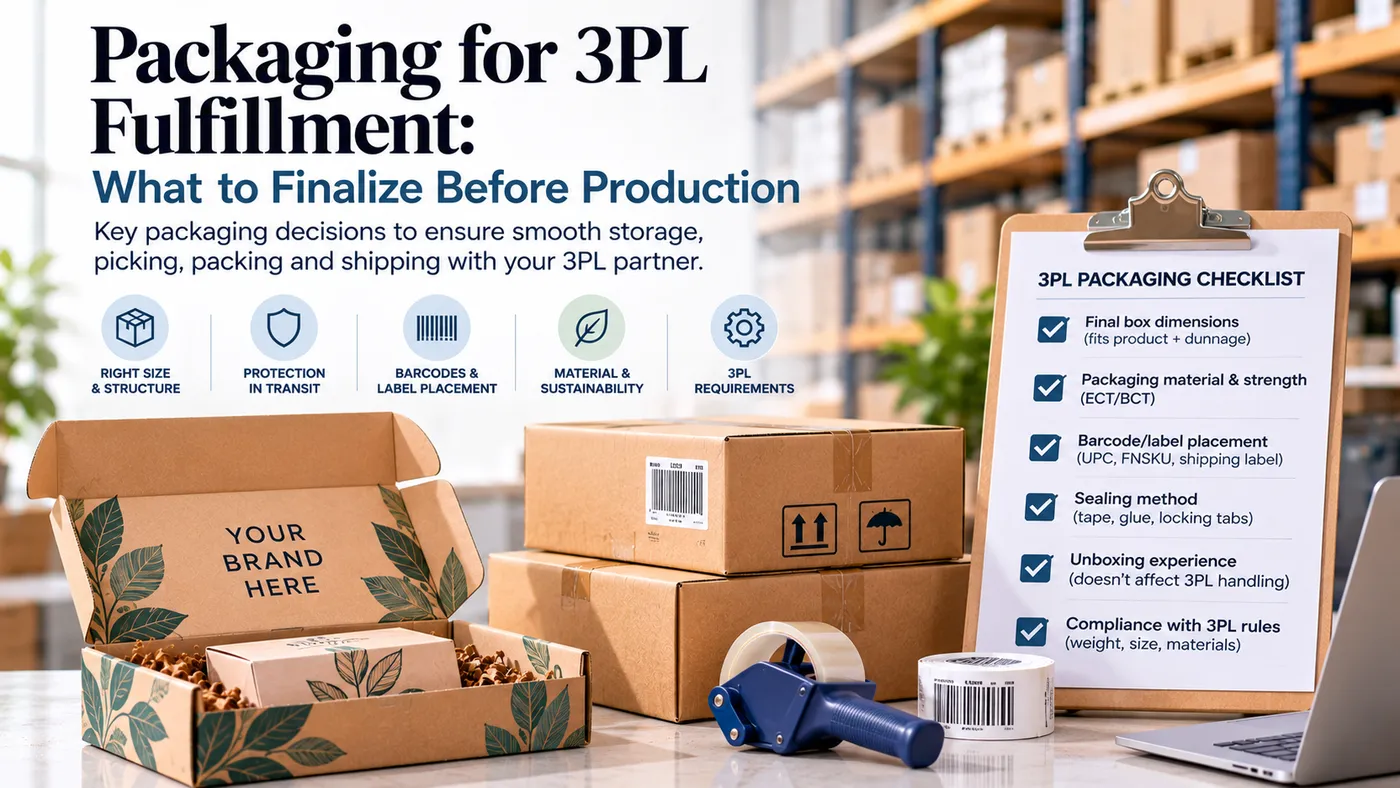
Packaging for 3PL fulfillment works when four things are settled before production. Those are flat or assembled delivery, case pack quantity, label placement, and storage footprint. Your 3PL needs cartons it can receive, scan, store and pack fast. Lock those four, test a sample with real packers, then approve production. Changes after printing mean reprints or relabeling.
Quick answer
- Ship cartons flat unless assembly is complex or your 3PL charges more for it than the freight savings.
- Set the case pack to the quantity one picker handles, not the quantity that fills a pallet neatly.
- Put a scannable identifier on every case and keep it off seams, corners and tape lines.
- Measure the packed box, because carriers bill on size as well as weight.
- Time ten real pack-outs before you approve a full run.
What a 3PL needs from your packaging
A warehouse sees packaging as a series of handling steps: receive, scan, store, pick, pack, ship. Every step costs labor. Good packaging for 3PL work removes steps instead of adding them.
In practice that means five things. Cartons that stack and ship on pallets without crushing. Case labels the receiving dock can scan. A consistent unit size so bins and shelves stay predictable. Clear pack-out instructions. And inserts that go in the same way every time.
Receiving rules, fees and labeling formats differ between warehouses. Ask your 3PL for its written inbound requirements before you finalize artwork or case counts.
Flat or assembled: which should you choose?
Flat cartons store compactly and cost less to move. Assembled boxes save pack-out time but eat shelf space. The right answer depends on who does the folding and how many boxes you ship a day.
Factor | Ship flat | Ship assembled |
|---|---|---|
Storage footprint | Small | Large (boxes hold air) |
Inbound freight | Lower volume | Higher volume |
Pack-out labor | Packer folds each box | Packer only loads product |
Best for | Mailers, auto-bottom and tuck-style boxes | Rigid boxes, complex gift sets |
Main risk | Slow or inconsistent folding | Crushed corners, wasted space |
My rule: ship flat by default. I've seen brands pay for assembled boxes, then lose the saving to pallet space and freight. Choose assembled only when folding takes real skill. Think rigid gift sets or a multi-piece subscription box.
Many corrugated mailers fold in seconds. Time it, though. Ten real folds will tell you more than any estimate.
Pack-out labor is the cost people forget. Apparel in a flat mailer is quick. A cosmetics set with a tray, a tissue wrap and a card is not. Ask your 3PL how it prices pack-out, then compare that with the storage saving.
Packaging for 3PL receiving: case packs and master cartons
A case pack is the number of finished boxes in one master carton. The master carton is the outer shipping case your 3PL receives. Match it to how the warehouse picks. In ecommerce fulfillment packaging, that usually means one case per replenishment, not one per order.
Size the case pack around three limits:
- Weight: a packer must lift it safely. As of October 2026, UPS caps packages at 150 lb and has special guidance above 70 lb.
- Pick unit: if the 3PL opens a case for every order, use smaller case packs. If it replenishes bins, use larger ones.
- Pallet fit: the carton footprint should tile a pallet without overhang.
A candle brand shipping 12 gift boxes per order might case-pack 12 or 24. A coffee roaster with single-bag mailers would pack far more. The number depends on the pick, not on the box.
Barcodes and labeling
Good packaging for 3PL receiving starts with clear identifiers. Two kinds matter. The product barcode identifies the item. The case label identifies the carton. GS1 says the Serial Shipping Container Code (SSCC) identifies a logistic unit. That can be a case, pallet or parcel (GS1).
Label item | Where it goes | Decide before production |
|---|---|---|
Product barcode (UPC/GTIN) | On the retail box or a sticker | Print it or apply it later |
Case label with SSCC | Lower part of the master carton | Reserve a flat, clear panel |
SKU and quantity | Case side, human-readable | Large, high-contrast text |
Handling marks | Case side | Fragile, this-side-up if needed |
Retailer routing guides vary, so placement rules vary too. SPS Commerce notes that a label can scan well and still fail. It may sit over a seam, wrap a corner or sit under tape (SPS Commerce). Leave a clean panel on your master carton artwork.
If the product barcode is printed on the box, send it as vector art. Our packaging glossary explains the terms. Our guide to print proofs shows how to check the barcode before press.
Storage footprint in packaging for 3PL warehouses
Storage is a design input. A box half an inch too tall can drop a shelf level. Measure the box as it will sit in the bin.
Carriers also bill on size. UPS divides length times width times height by 139 for Daily Rates or 166 for Retail Rates (UPS). The higher of actual or dimensional weight applies. Our guide on how to measure a box covers the measuring.
Kitting, inserts and assembly time
Kitting means the 3PL combines several items into one order. Every extra component is another pick and another chance for a missed item.
Keep kits simple. I've seen a missing insert card slip through a busy shift because the packing spot kept changing. Put the card in the same place every time. Use a die-cut insert that holds the product in one position. Our packaging inserts for ecommerce guide covers the options. For mailer formats, see our corrugated mailer boxes.
Gift sets and subscription boxes need the most care. A candle, a lid and a card each add seconds. Multiply that by monthly volume and the labor cost shows up fast. Good packaging for 3PL kitting keeps the component count low.
Reordering and production consistency
Your 3PL stocks against a size and a barcode. If the next production run changes box dimensions by a few millimeters, shelves, bins and pack-outs shift too.
Approve a proof and a physical sample, then treat them as the reference for every reorder. Lock the artwork file, board and dimensions. Set reorder points from real lead time, which our custom packaging lead times article breaks down.
Easy Box Packaging checks finished packaging against the approved specification before dispatch. Our manufacturing page shows the process. Pricing varies by specification.
What to send your packaging manufacturer
- Product dimensions and weight, plus packed size with inserts for your packaging for 3PL order
- Quantity per SKU and expected reorder rhythm
- Packaging format: mailer, carton or rigid, flat or assembled
- Case pack count and master carton limits from your 3PL
- Artwork status and barcode files
- Material, printing and finishing preferences
- Insert and kitting requirements
- Case label panel placement
- Destination warehouse and required date
Key takeaway
Packaging for 3PL success is decided before the press runs. Settle flat versus assembled, case pack, labels and storage footprint with your warehouse first, then approve production.
Limits: warehouse rules and carrier terms change, so confirm them with your 3PL and carrier.