
Jump to section9 sections
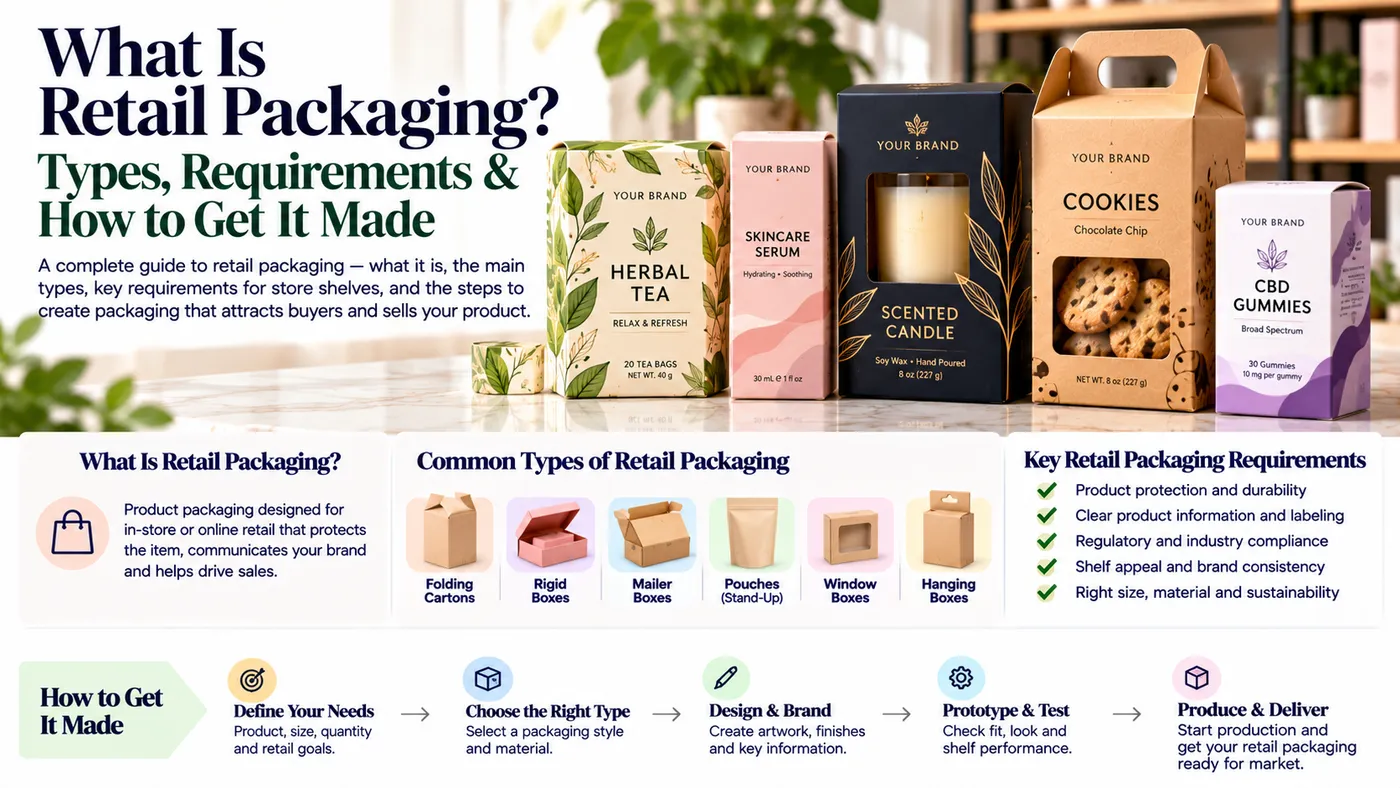
What is retail packaging? It is the outer box or carton a product is sold in on a shelf. It is secondary packaging, not the container touching the product. It must fit the shelf plan, carry a barcode and required labels, and survive the supply chain. The main types are folding cartons, rigid boxes, counter displays and shelf-ready packaging.
Quick answer
- Layer: retail packaging is secondary packaging, between the product's own container and the shipping carton.
- Jobs: fit the shelf, scan at checkout, carry required labels, survive handling, and stand out.
- Common formats: folding cartons, rigid boxes, counter display units and shelf-ready packaging.
- Order size: Easy Box Packaging retail packaging starts at 50 units.
What is retail packaging?
Retail packaging is the box, carton or case that holds a product in its final saleable unit. Shoppers see it, pick it up and read it before they buy. Retail buyers check it before they list the product. Warehouse teams handle it before it reaches the shelf.
Retail packaging usually does five things:
- Holds the product in its final saleable unit.
- Presents the product on a shelf for selection.
- Carries the labels the product category requires.
- Fits the dimensions the retail buyer specifies.
- Passes through distribution without damage.
Packaging comes in three layers. Primary packaging touches the product, such as a bottle, pouch or blister. Secondary packaging is the retail box around it. Tertiary packaging is the plain corrugated carton that moves many retail units through distribution. A product can have all three. Our packaging glossary defines each term.
Types of retail packaging
Type | What it is | Best for |
|---|---|---|
Tuck-end folding carton | Printed board, assembled when packed | Single-unit products in most categories |
Auto-bottom folding carton | Base locks into shape when opened | Heavier or bulkier single units |
Folding carton with window | Die-cut opening shows the product | Products that sell on sight |
Folding carton with hang tab | Punched tab for peg hooks | Small items sold on pegs |
Rigid lid-and-base box | Pre-assembled, solid structure | Premium goods and gifts |
Counter display unit | Branded box holding several units | Small, fast-selling items |
Shelf-ready packaging (SRP) | Outer carton that opens into a display | High-volume items |
Once you know what is retail packaging, the format choice is next. Single-unit products usually start with a folding carton. See how straight tuck and reverse tuck boxes differ, or compare auto-bottom box styles. For premium positioning, read rigid boxes vs folding cartons. For windows, see window display boxes for retail. For counters, browse counter display boxes and our display boxes.
My opinion: pick the format from the shelf and the buyer, not from the artwork. Design comes after the structure fits.
What retail packaging has to do
What is retail packaging expected to do? It works across five areas at once.
1. Fit the shelf. Get the shelf plan (planogram) dimensions from the retail buyer. That means face width, depth and height. Don't estimate them. A box that misses the spec can cause problems at the retailer's warehouse.
2. Carry a scannable barcode. Most retail systems need a valid UPC-A or EAN-13. Each product variation needs its own number, per GS1 US. Leave the clear quiet zone GS1 specifies around the symbol. Ask your printer to verify it. Placement is often the back or base panel, but follow the retailer's rule.
3. Show required labeling. Typical copy is product name, net quantity and manufacturer name and address. Many categories add rules: Nutrition Facts, Supplement Facts, Drug Facts, age grades or safety warnings. These vary by category and country. Confirm copy with your regulatory team before briefing.
4. Survive the supply chain. The box passes through pallets, warehouses and shelf handling. Board weight, corner strength and construction should match that journey.
5. Communicate at the shelf. Shoppers decide fast. Keep the brand and product clear on the front panel. This is where design earns its keep, after structure and labels are fixed.
Retail packaging vs e-commerce packaging
Factor | Retail | E-commerce |
|---|---|---|
Seen | On a shelf, before purchase | At home, after delivery |
Main challenge | Shelf fit and legibility | Unboxing and transit protection |
Barcode | Usually required | Not needed for most direct sales; marketplaces often need one |
Labels | Full retail labeling | Same product rules, different placement |
Structure | Shelf stability and warehouse handling | Parcel transit and secure inserts |
A direct-to-consumer brand asking what is retail packaging for stores should treat it as a new project. The structure, front panel and label placement all change. Sometimes one box serves both channels. Often it can't. Decide which channels the brief must cover first.
What retail packaging is not
Part of what is retail packaging is knowing its limits.
Not the primary container. The bottle, pouch or sachet is primary packaging.
Not the shipping carton. The plain corrugated box used for transit is tertiary packaging. The branded retail box can travel inside it.
Not luxury by default. Luxury is a positioning choice. A supplement in a tuck-end carton and a perfume in a rigid box are both retail packaging.
How to get custom retail packaging made
Once you know what is retail packaging in your channel, follow these steps.
- Confirm the channel and shelf spec. Get dimensions from the buyer before you brief.
- Measure the product. Use length, width and height of the filled, sealed product as packed.
- Confirm copy and barcode. Have regulatory-approved label copy and the real barcode number ready. Don't send placeholders.
- Choose the format. Pick a folding carton style, rigid box, display unit or SRP.
- Send the brief. Use our retail packaging quote form or the packaging RFQ template.
- Review the dieline. Check the front panel, barcode, labels and shelf fit.
- Approve the digital proof. Production starts after approval.
What to send your packaging manufacturer
- Product dimensions (L x W x H), filled and sealed, plus weight.
- Retail channel and the buyer's shelf spec.
- Format: carton style, rigid, display unit or SRP.
- Quantity and the number of variations (each needs a barcode).
- Barcode number and confirmed label copy.
- Material, print and finish preferences.
- Insert needs and delivery destination.
- Required date.
Production for retail packaging at Easy Box Packaging runs from 7 business days after digital proof approval. Orders start at 50 units. See our retail packaging page and how we manufacture.
Key takeaway
What is retail packaging? It is the shelf-facing box that must fit, scan, carry the right labels and survive handling. Confirm the shelf spec and label copy first, then design.
Rules differ by retailer, category and country. Treat this page as a planning guide, not compliance advice.