Noodle and lo mein takeaway
A taller tuck-top direction for noodle portions when the filled height, opening, and closure need room for the meal.

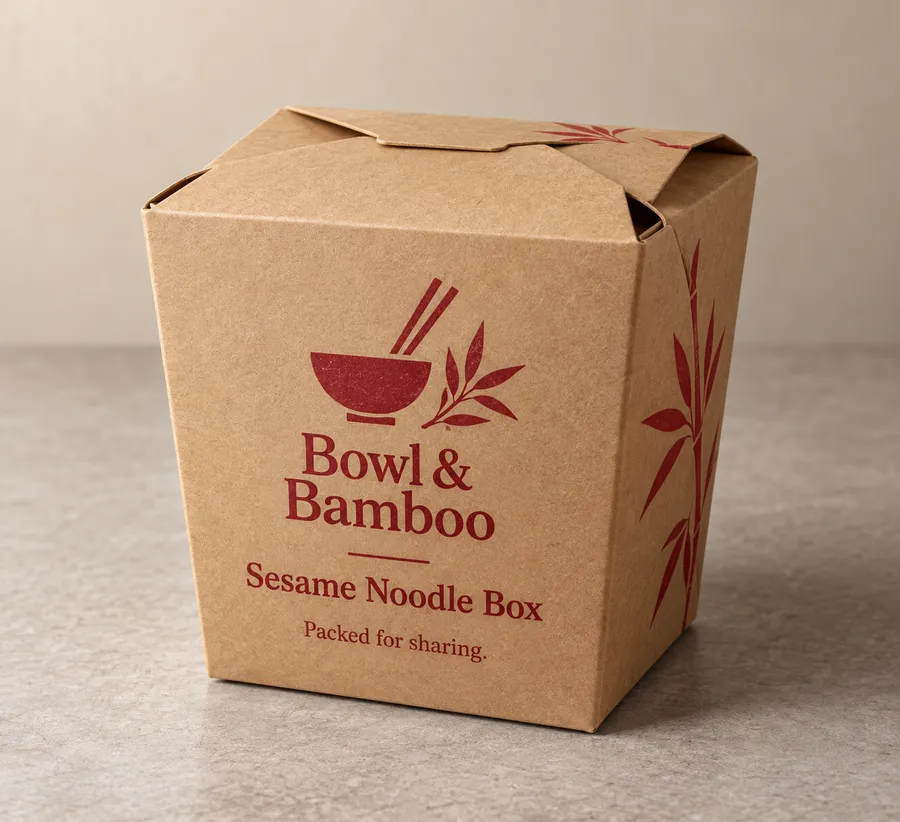
Custom kraft Chinese food box with Bowl and Bamboo printed front panel
Food Boxes
Custom Chinese food boxes are printed paperboard cartons for noodles, rice, dumplings, and other takeaway portions. Choose a tuck-top or folding shape around the packed food, sauce clearance, and serving method, then review the paper direction, print panels, and finish in a digital proof before production.
Last updated
Working quote
Product brief
Custom Chinese food boxes give a takeaway portion a defined container, a visible printed surface, and a practical handoff shape. A tuck-top carton can hold noodles, rice, dumplings, fried sides, or a mixed order when the opening and base are sized around the portion. The box is not interchangeable with a sealed pouch or a rigid gift carton. Its usefulness depends on the food geometry, whether steam needs an intentional path, how much sauce or oil is present, and whether the customer carries it from a counter or receives it after a short delivery. Start the specification with the filled arrangement rather than choosing a generic restaurant size.
Send the packed length, width, and height of the food, the approximate portion count, the orientation of noodles or rice, and the space needed for a sauce cup, chopsticks, fork, napkin, or liner. A tall noodle portion and a shallow rice serving may use different lid clearances even when their outside footprint is similar. Dumplings need room for the pieces to sit without being pressed against the top fold, while a sauced stir-fry may need interior clearance that leaves the closure usable. If the menu uses two meaningful pack arrangements, describe both so the carton can be scoped around the actual service rather than an assumed stock dimension. The final allowance, opening, and fold lines are confirmed during specification and dieline review.
The material direction should follow the food and the handoff moment. Kraft Paperboard gives a tactile printed carton direction, while Grease-Resistant Kraft Paper can be considered when the menu includes oily fried items or sauced portions. SBS Paperboard is another smooth printable direction for a more controlled retail-style surface. The selected paper, opening, base, and closure should be discussed together with the food's warmth, oil level, and time in the package. A hot noodle portion may need a practical opening and internal space rather than a tightly closed presentation. A box that sits in a delivery bag beside other orders should be reviewed for stacking and movement. These are specification questions, not promises of a universal barrier or leakproof result.
The front and side panels are visible while a customer carries the meal, so artwork should be planned around the tuck flap, folds, and the filled orientation. A restrained one-color mark can keep a kraft surface legible, while fuller coverage can establish a stronger restaurant identity. Matte Lamination, Gloss Lamination, or Spot UV can be considered when the paper and artwork support the chosen surface direction. Foil Stamping or Embossing/Debossing can highlight selected lettering or a small bowl, chopsticks, or rice-grain motif, subject to artwork review. Keep critical type away from crease lines and the lid opening. The print and finish are visual and handling choices; they do not by themselves establish a food-contact, grease, or moisture performance claim.
A Chinese food box is easier to approve when artwork is shown on the folded construction instead of a flat rectangle alone. The review should identify the main front panel, side information, tuck flap, base folds, opening, and any required preparation or serving copy. Easy Box Packaging includes dieline and digital proof review on every order at no extra charge. That review is where the packed food, closure, print coverage, and finish are checked together. Production begins after digital proof approval. If the restaurant changes from a rice bowl to a taller noodle portion, adds a sauce cup, or changes the serving utensil after the first layout, flag that change before approval so the carton can be reviewed against the new arrangement.
Send the filled food dimensions, portion quantity, temperature at handoff, sauce or oil considerations, preferred tuck-top or folding direction, artwork status, print coverage, finish preference, expected units, and delivery destination. The standard minimum order is 50 units. Production starts from 7 business days after digital proof approval. Quote requests are typically answered the same business day and always within 24 hours. Free US shipping is available on the standard fulfillment path. Pricing remains quote-only because the carton size, opening, paper direction, print coverage, finish, and quantity are set from the actual menu and service workflow rather than one universal stock specification. A sample kit can be requested to inspect the paper surface, fold behavior, and printed treatment before a full run.
A shallow folding carton can suit a rice plate or dumpling order that needs a broad opening and easy loading. A taller tuck-top box can suit noodles or a layered portion when the top clearance and closure are set around the packed height. A kraft direction can work for a casual takeaway identity, while a smooth SBS direction can support a more controlled printed panel for a retail counter or catering presentation. If a menu combines a main dish with a sauce cup or side, state how those pieces travel together so the base and side walls are reviewed with the real arrangement. The box should make the handoff clear without suggesting that one construction works for every portion.
Short-distance delivery changes what the carton needs to do after it leaves the counter. Tell the quote team whether boxes are placed upright, stacked in a carrier, or grouped with sauce containers and utensils. The closure should remain usable after the meal is loaded, and the printed front panel should stay visible in the intended orientation. Warm food, condensation, oil, and movement can change the practical choice between a more open folding style and a taller tuck-top shape. These variables belong in the dieline conversation. They are more useful than a generic claim about durability because they show how the package will actually be handled from kitchen pass to customer.
For a useful first quote, provide the menu item or portion description, packed length, width, and height, expected quantity per carton, number of cartons, sauce or utensil details, artwork status, print coverage, finish preference, and delivery destination. Include a photo or simple sketch of the filled arrangement when the food has an irregular shape. Easy Box Packaging can then prepare the construction direction and digital proof for review. The minimum is 50 units, and the production estimate begins at 7 business days after proof approval. A sample kit is an option when the team wants to inspect the material and finish before committing to the production quantity.
Custom Chinese food boxes work best when the package is described as a filled portion with a real service moment, not merely as a printed carton. The food height, sauce or oil level, opening, base, closure, carrying distance, and artwork panel all influence the choice. Share those details with the quantity and destination, and the quote can stay tied to the menu rather than a generic box label.
Proof points
This format is a printed folding carton or tuck-top takeout box rather than a sealed pouch or rigid gift box. The key construction questions are the filled height, opening, base folds, closure, paper direction, and panels that remain visible in the carrier. Those details are reviewed with warmth, oil or sauce level, portion count, stacking, and counter or short-distance delivery in mind.
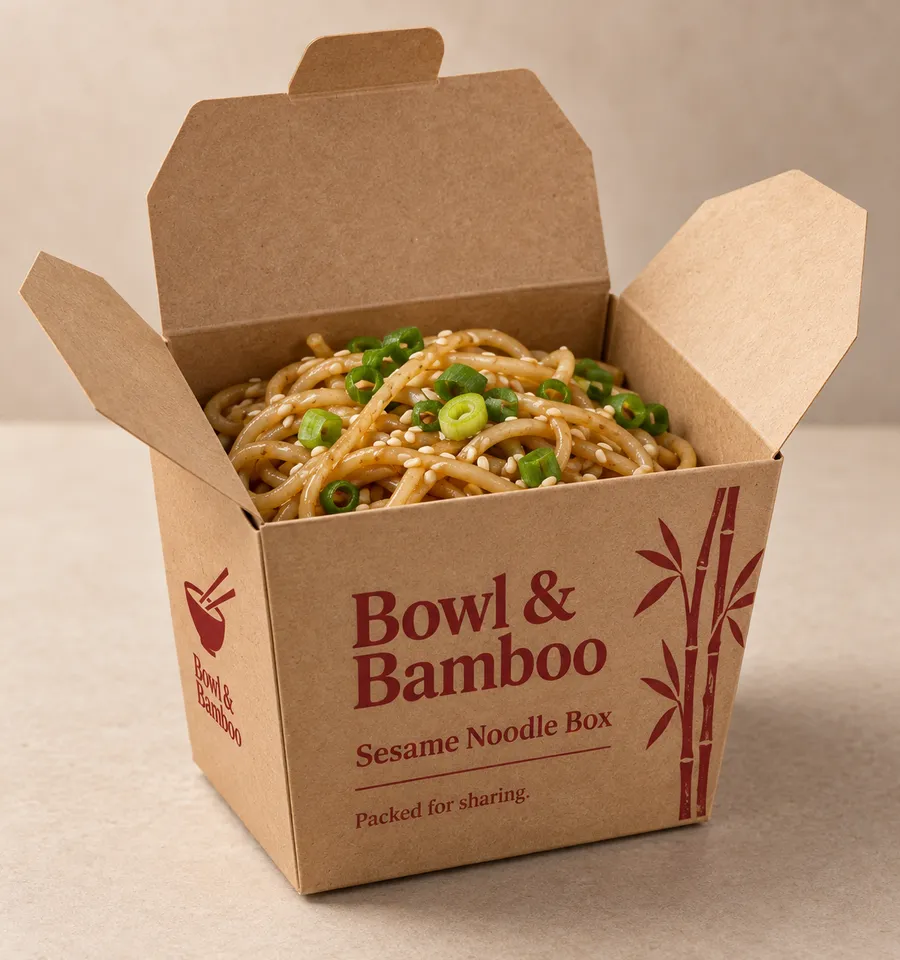
Size the carton from the packed food, not from a generic takeout label. Share the filled length, width, and height, portion count, orientation, sauce or utensil clearance, and any liner. A taller noodle portion, a shallow rice serving, and a dumpling order use different lid and base clearances. The tuck flap and opening need to remain practical when the box is full, and final allowance is confirmed during specification and dieline review.
A taller tuck-top direction for noodle portions when the filled height, opening, and closure need room for the meal.
A shallow or medium folding carton for rice-based portions, sized around sauce, steam, and the way the customer receives the order.
A broader opening for dumplings or shared sides when pieces need to sit without being pressed against the top fold.
Printed cartons for grouped meal service where boxes may be stacked or carried with sauce containers and utensils.
The carton surface can carry a restrained restaurant mark or fuller coverage, depending on the artwork and the folds. Matte Lamination and Gloss Lamination change the surface appearance, Spot UV can add a localized gloss contrast, and Foil Stamping or Embossing/Debossing can highlight selected lettering or a small food motif subject to artwork review. Each direction should be checked against the tuck flap, crease lines, small type, and the panels visible in the customer's hand.
The carton is reviewed as a filled food container, a printed surface, and a handoff format. Dieline and digital proof review are included on every order at no extra charge, so the opening, folds, closure, print coverage, and finish can be checked together. Quote requests are typically answered the same business day, always within 24 hours, once the menu portion and quantity are clear. A sample kit is available when you want to inspect the paper and print direction first.
The tuck flap, base folds, opening, panel orientation, and artwork placement are reviewed together before approval.
Quote requests are typically answered the same business day, always within 24 hours.
Request a sample kit to examine the paper surface, fold behavior, and printed finish direction before ordering.
A quote can be scoped accurately when the menu portion, pack arrangement, and handoff use are described together. Send the packed dimensions, portion count, sauce or utensil details, artwork status, print coverage, finish preference, quantity, and delivery destination.
Provide the length, width, and height of the noodle, rice, dumpling, or mixed portion as it will sit inside the carton.
State the portion count, orientation, sauce cup, chopsticks, fork, napkin, or liner that travels with the food.
Note the expected warmth, oil or sauce level, counter service, carrier stacking, and short delivery distance.
Share the panels that need branding and any preference for one-color print, fuller coverage, or a selected finish.
Send available artwork or note that the restaurant identity, menu mark, and serving copy are still being prepared.
Request a sample kit to inspect the paper surface, tuck-top construction, fold behavior, and printed finish direction before committing to a full Chinese food box run.
Shipping charge: $44.99. Credited toward your first order.
Request a Sample KitCustomer reviews
5 out of 5 from 25 reviews.
We're pleased with our custom food box. It protects and presents our product well, and the custom sizing made a noticeable difference for our business.
We compared several packaging options before ordering food boxes. The a practical food-safe style and clear branding gives our product a cleaner presentation and makes the customer experience feel more considered.
The artwork on our custom food box came through clearly, and the structure feels right for takeaway meals and packaged food. We were happy with the communication and the finished packaging.
Our team needed a practical food-safe style and clear branding for our products, so we chose Easy Box Packaging for food boxes. The result is sturdy, practical, and well suited to our daily packing process.
We ordered custom Food Boxes for our takeaway meals and packaged food, and the fit worked well. The a practical food-safe style and clear branding made packing straightforward and the finished custom food box looks professional.
We’re pleased with our custom packaging order from Easy Box Packaging. The boxes suit our products well, and we’d be happy to order again.
Find clear answers about fit, materials, and ordering below.
Noodles, rice, dumplings, fried sides, and mixed takeaway portions can use a custom carton when the filled dimensions, opening, closure, and sauce or utensil space are reviewed together.
Share the packed length, width, and height, portion count, orientation, and any sauce cup, chopsticks, fork, napkin, or liner. Final allowance and fold clearance are confirmed during the dieline and digital proof review.
Kraft Paperboard, Grease-Resistant Kraft Paper, and SBS Paperboard are category material directions. The suitable choice depends on the menu, artwork, warmth, oil or sauce level, and intended handoff, and should be confirmed for the order.
The standard minimum order is 50 units. Production begins from 7 business days after digital proof approval, and pricing is quote-only because the carton specification follows the menu and artwork.
Yes. A sample kit can be requested to inspect the paper surface, fold behavior, tuck-top construction, and printed finish direction before a full run.
Orders start at 50 units and scale up to 500,000 for bulk runs, with pricing from $0.30 per unit on larger quantities. Standard production is 5–7 business days from art or dieline approval.
Compare nearby products and request the format that best fits your next run.
Available product
Available product
Available product
Available product
Get a Chinese Food Box Specification
Send the packed food dimensions, portion count, sauce or utensil details, artwork status, and finish preference to start a quote for custom Chinese food boxes.
Add your product details to see a quote summary.