Skincare single units
An upright folding carton can give a serum bottle, cream jar, or facial treatment a defined shelf-facing panel while the internal space is reviewed around the container.

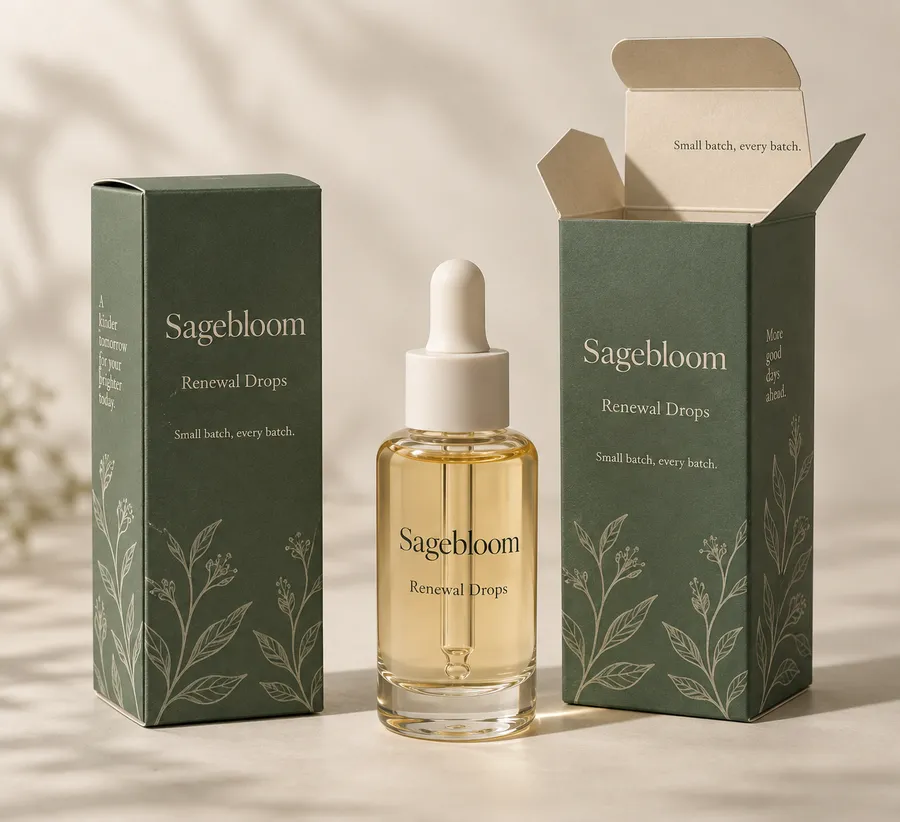
Open sage-green folding carton beside a clear dropper bottle with an ivory cap and amber liquid.
Custom Cosmetic Boxes
Cardboard cosmetic packaging gives skincare, makeup, and beauty products a printed outer pack shaped around the item inside. A folding carton can be specified with SBS Paperboard or Kraft Paperboard, then finished with options such as Matte Lamination, Spot UV, or Foil Stamping. Product dimensions, closure geometry, and artwork are reviewed together before production.
Last updated
Working quote
Product brief
Cardboard cosmetic packaging has two jobs to balance: present a clear printed surface and give the packed item a considered place inside the carton. That makes the product itself the starting point. A skincare bottle, compact, cream jar, or makeup accessory may need a different panel layout, opening style, and internal clearance. The right brief describes the product, the way it should sit, and the moment when the customer opens it. From there, the carton can be developed as a folding paperboard package rather than selected from a generic stock shape.
Begin with the assembled height, widest body, closure or cap profile, shoulder shape, and preferred orientation of the product. Note any parts that extend beyond the main body, such as a dropper, pump, lid, or raised compact hinge. Those details affect the internal cavity, panel proportions, opening clearance, and the amount of printed area that remains visible when the package is closed. If the box will hold a set, provide the dimensions of every item and explain how the pieces should be arranged. A photograph beside the measurements can also clarify the shape, but the final dieline is prepared from the confirmed product information.
A folding carton with a tuck-top closure and locking bottom suits an upright single product when the opening should be easy to understand and the printed panels should remain visible. A different carton style may be more appropriate when the pack must open in a particular direction, hold several coordinated pieces, or create a broader reveal. The choice is not only visual. Closure geometry, product orientation, panel width, internal clearance, and the way the cartons will be handled all belong in the same specification conversation. The same style can be adapted to different products, but each size still needs its own dimensions and dieline review.
SBS Paperboard offers a smooth substrate for printed cosmetic panels, while Kraft Paperboard introduces a natural paper tone and a more tactile surface character. The suitable option depends on the intended presentation, artwork, product weight, and how the uncoated or coated surface should read. An FSC-certified paper option is available when that material choice fits the project; it does not mean every package is automatically certified. Matte Lamination, Gloss Lamination, Spot UV, Embossing/Debossing, and Foil Stamping can each change the visual or tactile treatment of selected panels. Finish selection should follow the artwork and board choice, with the final combination reviewed before production.
Internal support is a specification decision, not a default add-on. It depends on product geometry, weight, fragility, orientation, the folding carton structure, the desired reveal, and how the package will be fulfilled. Support may be integrated into the paperboard or developed as a separate component when the product and presentation call for it. Share the intended product position and any movement or contact concerns at quotation so the construction can be discussed clearly. Easy Box Packaging includes dieline and proof review on every order at no extra charge. Artwork is placed on the approved dieline, a digital proof is reviewed, and production follows after the proof is approved.
Send the packed product measurements, the number of items per box, preferred orientation, carton style if known, artwork status, board preference, finish choices, and any support or presentation requirement. Include the order quantity so the quotation reflects the actual project rather than a generic package. The standard minimum order is 50 units. Production begins from 7 business days after digital proof approval, and Free US shipping is included on the standard fulfillment path. If you want to check the board, fold, print surface, or fit before a full order, a sample kit can be requested with a $44.99 shipping charge credited toward your first order.
A clear brief lets the quotation address the decisions that change the box: product geometry, carton structure, material, print treatment, and fulfillment context. It also gives the design review a concrete starting point, so the finished package can be assessed as a real cosmetic carton rather than as a flat artwork concept.
Proof points
The quotation and design review turn a product description into a defined carton specification. Dimensions, construction, board, finish, artwork placement, and any internal support are checked together before the digital proof is approved.
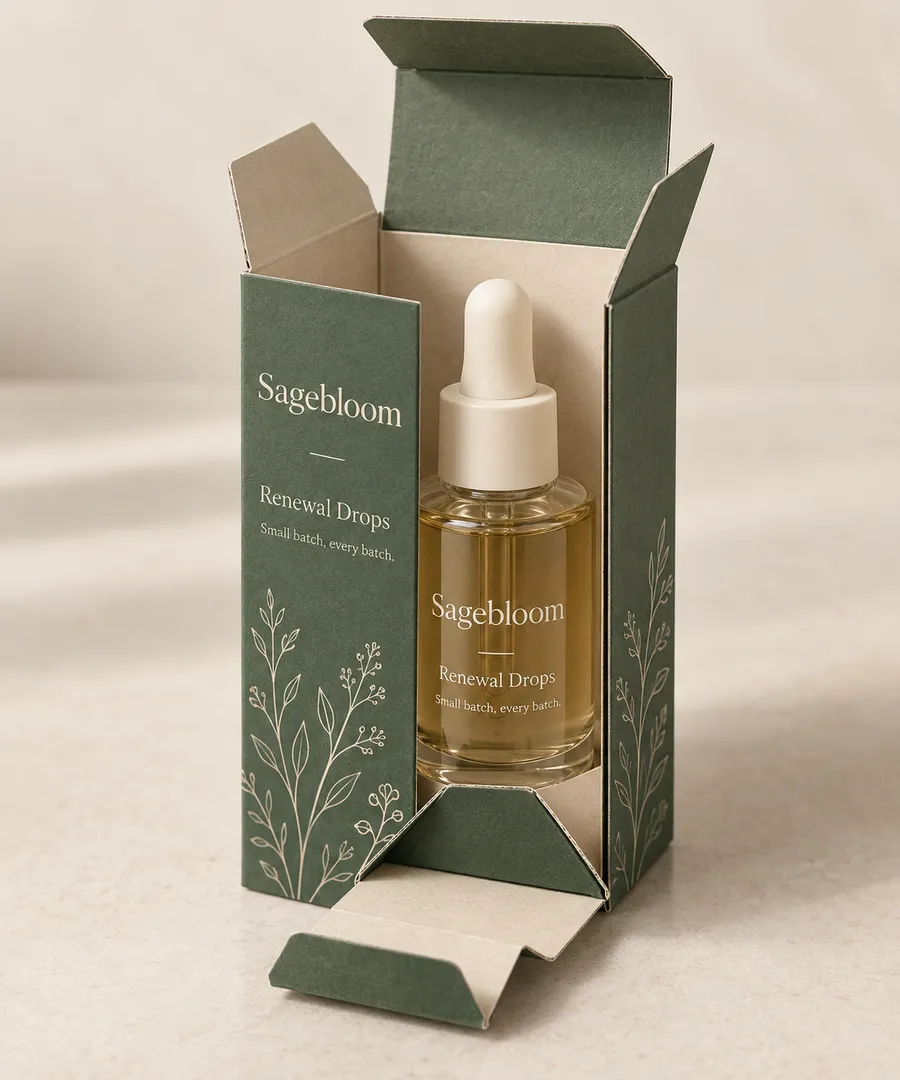
A folding paperboard carton gives a small cosmetic product a defined front, side, and opening sequence without forcing every item into the same stock shape. The carton style, tuck-top closure, locking bottom, and panel proportions are selected around the packed product and the presentation the buyer needs to see.
An upright folding carton can give a serum bottle, cream jar, or facial treatment a defined shelf-facing panel while the internal space is reviewed around the container.
Compacts, palettes, and other makeup pieces can use printed panels that explain the product while the opening and closure are shaped around the item.
A coordinated set can be arranged around the order of reveal, with the carton structure and support discussed around the number and shape of the included pieces.
Small-format cosmetic products can be presented in a compact carton when the product dimensions, orientation, and intended handling are supplied for review.
Printed panels establish the product identity, while the finish controls how selected areas look or feel in the hand. Choose the treatment with the board, artwork, and desired presentation in view.
Support planning considers geometry, weight, fragility, orientation, the carton structure, fulfillment, and the desired reveal together. Depending on those requirements, support may be built into the paperboard folds or scoped as a separate insert during quotation.
Provide the widest body, closure profile, shoulder shape, and preferred orientation so the internal space reflects the actual item.
For a bundle, describe the position of each piece and the order in which the contents should be revealed when the carton opens.
Mention how the package will be packed, displayed, or shipped so construction and support choices are reviewed against the intended use.
A useful quotation starts with the product and ends with an approved proof. These steps keep the structural and visual decisions connected.
Send packed product measurements, closure or cap details, orientation, item count, and the intended use of the carton.
Discuss the folding carton structure, board option, print coverage, finish, and any support or presentation requirement.
Place the artwork on the prepared dieline and review the panel layout, folds, closure, and printed finish choices.
Confirm the final specification and digital proof so production can begin on the approved package.
Need help with structure, materials, or production planning? See how we manufacture custom packaging.
Request a sample kit to review the board, fold, print surface, or fit. The sample-kit shipping charge is $44.99 and is credited toward your first order.
Shipping charge: $44.99. Credited toward your first order.
Request a Sample KitFind clear answers about fit, materials, and ordering below.
Each product size should be scoped around its own height, widest body, closure profile, and orientation. The same carton style can be adapted, but the dimensions and dieline need to be reviewed for each size.
That depends on the product geometry, weight, fragility, orientation, carton structure, fulfillment method, and desired presentation. Support can be integrated into the paperboard or discussed as a separate component when the specification calls for it.
SBS Paperboard provides a smooth printed surface, while Kraft Paperboard brings a natural paper tone and tactile character. The choice should be reviewed with the artwork, finish, product weight, and intended presentation.
Foil Stamping can add selected metallic or pigmented accents, and Embossing/Debossing can add raised or recessed detailing. Both should be considered with the artwork and board during review.
Send the product measurements, item count, orientation, preferred carton direction, quantity, artwork status, board or finish preference, and any support or presentation requirement. Those details give the quotation a usable starting point.
Orders start at 50 units and scale up to 500,000 for bulk runs, with pricing from $0.16 per unit on larger quantities. Standard production is from 7 business days after digital proof approval.
Cardboard cosmetic packaging gives skincare, makeup, and beauty products a printed outer pack shaped around the item inside. Each order is made to order around your packed product and artwork, and the specification is confirmed against a digital proof before production.
Compare nearby products and request the format that best fits your next run.
Available product
Available product
Available product
Available product
Plan the package around the product
Send the product dimensions, quantity, artwork status, board or finish preference, and any support requirement. Easy Box Packaging can then review the carton direction and prepare the next step.
Add your product details to see a quote summary.