Client and team gifting
A structured box can bring a branded card, bottle, candle, or keepsake into one considered presentation while leaving the artwork focused on the sender and the occasion.

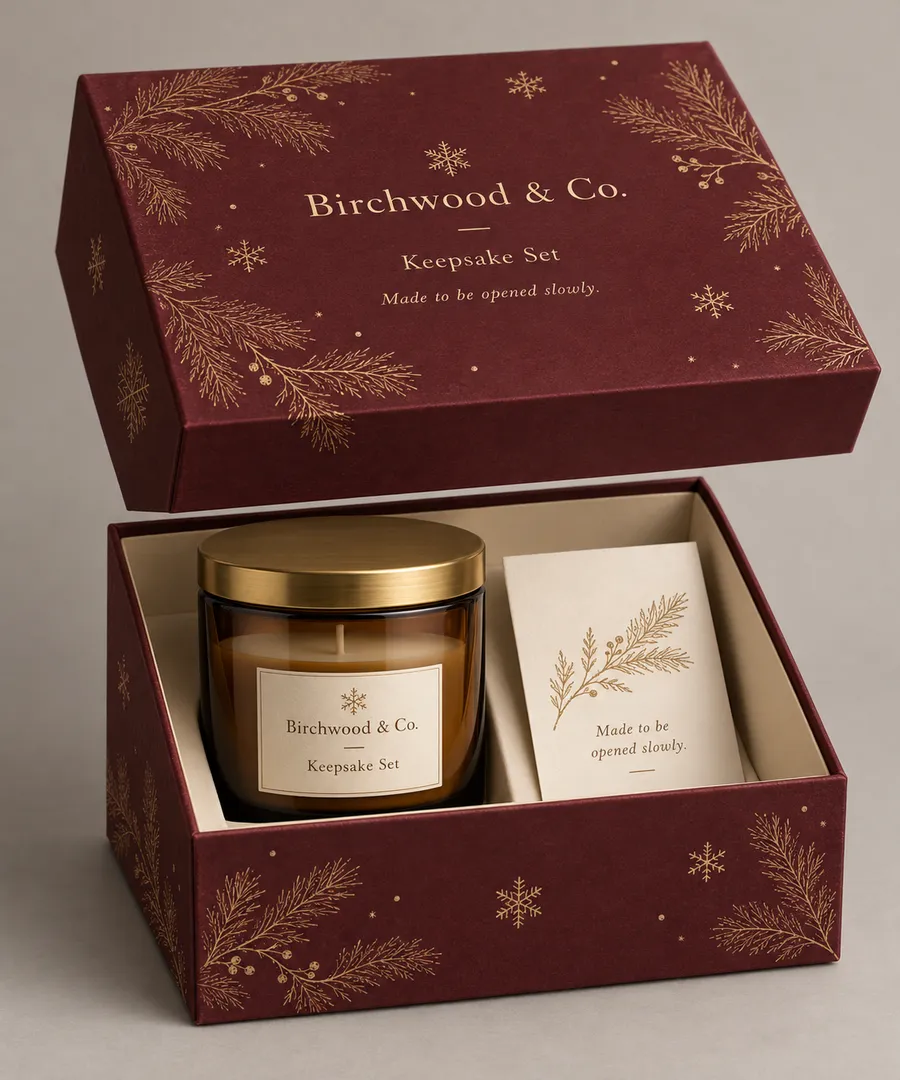
Cranberry two-piece Christmas gift box with gold seasonal print, candle, and gift card
Gift Boxes
Custom Christmas gift boxes are planned around the item, set arrangement, and opening moment the season calls for. Choose a rigid two-piece box for a deliberate lift-off-lid presentation or a folding paperboard format when flat shipping and efficient assembly matter. Share the packed dimensions, artwork, material direction, and finish preference so the dieline can be reviewed around the real gift.
Last updated
Working quote
Product brief
Christmas gift boxes do more than carry an item to a recipient. The box is part of the occasion, so the first useful decision is what the recipient should see and do: lift a separate lid, open a tuck panel, slide off a sleeve, or reveal a coordinated set in an arranged interior. A single candle, bottle, jar, keepsake, or gift card can call for a different opening sequence than several smaller items packed together. Describe that moment before choosing a box style, because the opening route changes the visible panels, the interior space, the closure, and the way seasonal artwork is read.
A custom holiday gift box also needs to work for the people packing it. A rigid two-piece structure arrives as a separate base and lid, giving the package a defined shape for a deliberate presentation. A folding paperboard format can be considered when the package needs a folded construction and a defined tuck or locking route. Neither direction should be selected from the holiday graphic alone. The packed product, the intended orientation, the amount of clearance, the handling route, and the way the recipient reaches the gift all belong in the first conversation.
A rigid two-piece Christmas gift box can suit a higher-value single item or a small set whose reveal deserves a clear lid and base relationship. The lid may carry the main seasonal pattern while the base frames the gift and any accompanying card. That format gives the designer distinct surfaces to consider: the lid top for the first view, the front wall for a brand or product name, the interior for the reveal, and the base for supporting information. The finished proportions still need to be derived from the packed contents rather than from a decorative square or rectangle chosen before the product is measured.
A folding box can suit a lighter seasonal product or a set that needs a defined front, tuck, sleeve, or folded opening. It can place the brand message on the panel the recipient sees first while keeping the remaining panels available for product information, a short seasonal note, or artwork that wraps around the package. The exact closure and panel order depend on the dieline. Share the widest points, protrusions, orientation, and any card or tissue that occupies space so the box is reviewed around the item as it will actually be packed.
Christmas gift boxes may also combine a primary package with an internal paperboard feature. Support depends on the product geometry, weight, fragility, orientation, the structure of the box, the desired reveal, the packing route, and the clearance the gift needs. A candle with a card may need a simple arranged base. A bottle or jar may need a defined position and a review of its cap or shoulder. A set of smaller products may need separated positions so the items do not obscure the printed message. The suitable support is confirmed from the real arrangement, not from a single assumption about weight or size.
For a gift set, send the actual layout rather than a list of individual product dimensions. Note which items sit beside one another, which item is visible first, where a card rests, whether tissue changes the packed height, and how the recipient should remove each component. This information helps the box structure and artwork stay aligned. A front panel that looks balanced on a flat file can feel crowded after dividers, a lid overlap, or a standing card takes up the space around the gift.
The interior is also where the presentation promise becomes practical. A candle may sit low in a fitted base so the lid can close without hiding the first view. A bottle may need its shoulder and cap position understood before a front window or printed reveal is considered. A small food or beverage collection may need an ordered arrangement rather than an open cavity. These are not stock rules for every Christmas gift box; they are specification questions that turn a seasonal idea into a package that can be quoted and proofed.
If the package will be packed in batches, describe the handoff from packing table to finished carton. Explain whether the box arrives flat or in a formed rigid construction, whether the product is added before the lid or after a folded closure is secured, and whether a card or tissue is part of every set. The production file can then show the structure, the panels, the interior feature, and the intended assembly route in a way a buyer can review before approving it.
SBS Paperboard and Kraft Paperboard are the category material directions for this page. The suitable board depends on the box format, span, packed product, handling path, printed surface, and the character the seasonal design needs. SBS Paperboard can be considered for a clean printed surface and a controlled color direction. Kraft Paperboard can be considered when the artwork is planned around its paper character. Board selection remains part of the product specification, not a decorative choice made after the design is complete.
Christmas artwork can use a deep seasonal color field, a quiet border, a small product name, or a restrained pattern rather than filling every panel with decoration. Foil Stamping may highlight a selected star, border, wordmark, or line of type, subject to artwork review. Embossing/Debossing may add a tactile treatment to a chosen mark or pattern, with depth and placement reviewed against the board. Spot UV may distinguish a selected detail from a surrounding printed surface. Matte Lamination or Gloss Lamination can be considered as surface directions, with the final choice reviewed alongside the palette, handling route, and selected accents.
The finish map should identify what is printed, what is left quiet, which edges or folds need clearance, and which marks need to remain legible at the first reveal. Small seasonal lettering, a lid border, or an accent placed too close to a fold can change after the package is assembled. A digital proof gives the buyer a chance to review those relationships before production rather than judging the holiday design only as a flat artwork file.
Send the brand guidelines, logo files, product name, seasonal palette, motif, copy, and current artwork status with the packed gift details. If the Christmas gift boxes are part of a campaign, include the exact occasion language and any product information that must remain on the package. The artwork should be mapped against the lid, base, front, sides, interior, folds, closures, and any card or divider so the package reads in the order the recipient encounters it.
The pictured print is an example of artwork placement. Your own artwork can replace it after the structure and panel map are reviewed. The same principle applies to a holiday motif: use a graphic language that supports the product and opening moment, then confirm how that motif wraps, stops, or changes at the assembled edges.
A quote-ready brief should include the packed length, width, and height; item count; orientation; approximate weight; widest points; caps, handles, tapers, or unusual corners; the desired opening; board direction; print coverage; finish preference; artwork status; quantity; and delivery destination. For a set, include the actual arrangement and any card, tissue, divider, or insert that occupies space. If the package is seasonal, share when the finished boxes need to be ready so the production conversation can account for proof approval and the intended fulfillment route.
The standard fulfillment path starts at 50 units. Production begins from 7 business days after digital proof approval, and dieline and proof review are included at no extra charge. Pricing remains quote-only because the box format, packed dimensions, board, print coverage, finish, quantity, and set arrangement change the specification. A sample kit carries a $44.99 USD shipping charge credited toward the first order when you need to check board feel, printed color, or finish direction in hand.
Once the structure and artwork are reviewed, check the assembled reading order rather than only the flat panels. Confirm that the lid or closure works with the packed gift, the main brand message sits on the intended first-view surface, the seasonal motif does not hide important product information, and the interior arrangement matches what the packing team will place inside. Those checks give Christmas gift boxes a clear relationship between the gift, the package, and the occasion before the production file is approved.
Proof points
The useful proof is more than a flat artwork file. It shows how the printed panels, folds, lid or closure, interior arrangement, and selected seasonal accents relate once the package is assembled around the actual gift.
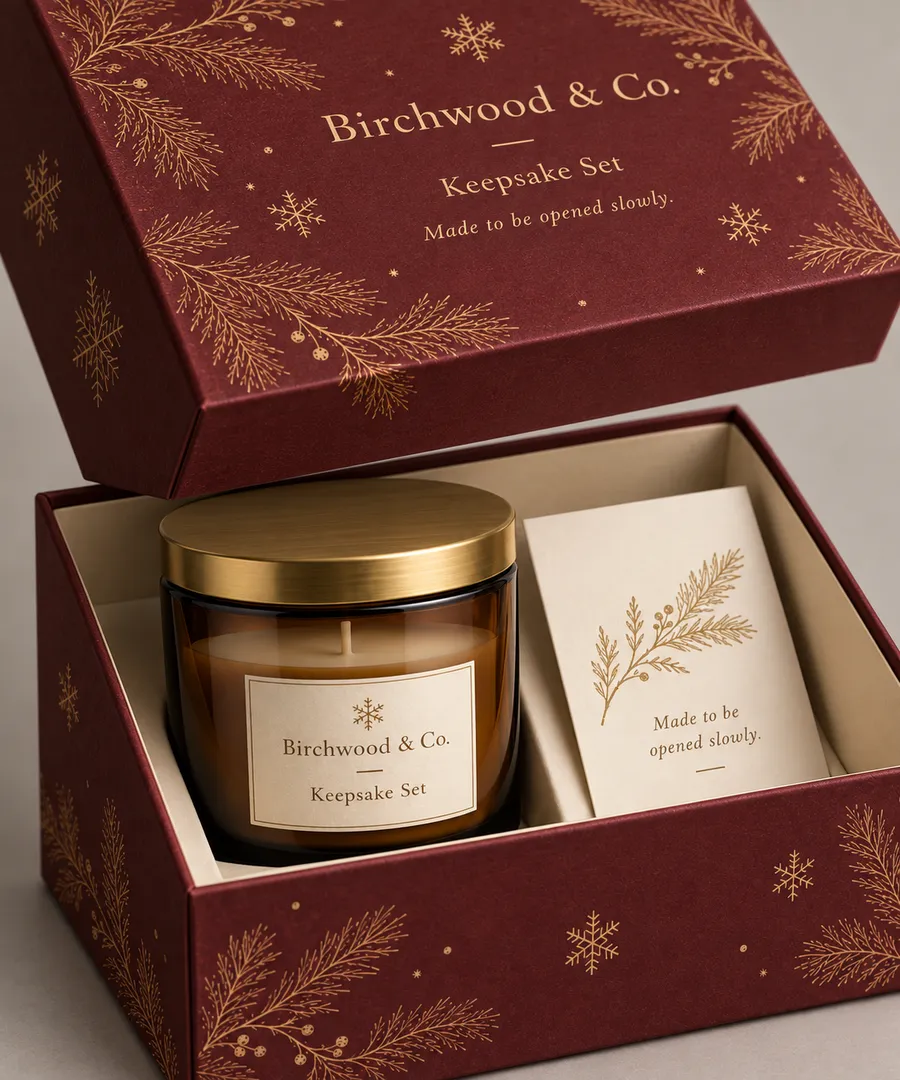
Start with the moment the recipient will see: a lid lifting from a rigid base, a printed folding carton opening from the front, or a set revealed in an arranged interior. Christmas gift boxes work best when the construction, product position, seasonal artwork, and opening sequence are considered together rather than treating the holiday graphic as the whole specification.
A structured box can bring a branded card, bottle, candle, or keepsake into one considered presentation while leaving the artwork focused on the sender and the occasion.
A seasonal set can combine related products inside one printed package when the item count, arrangement, and front-facing product story are defined before the dieline is prepared.
A custom holiday pattern, restrained foil accent, or special product name can distinguish a short-run presentation while keeping the underlying box structure tied to the real gift.
A folding format can be considered when a coordinated seasonal item needs a defined printed opening and an assembly route that works with the way the gift is packed and handed off.
Seasonal artwork has to work on the assembled box, not only on a flat dieline. Map the brand mark, holiday motif, product information, quiet panels, folds, lid or closure, and finish accents together so the first visible surface carries the intended message.
The outer format and the packed arrangement are reviewed as one package. A rigid base and lid can give a single candle, bottle, jar, or keepsake a slower reveal, while a folding paperboard box can organize a lighter item or coordinated set around an efficient opening and assembly route.
A lift-off lid or defined front panel can frame one gift item when its packed height, widest points, orientation, and desired reveal are known.
A candle with matches, a bottle with a card, or another small collection can be reviewed as a complete arrangement so dividers, spacing, and presentation order have a clear purpose.
A tuck closure, separate lid, sleeve, or folded panel changes how the recipient reaches the gift. The chosen route should match the box geometry and the amount of printed surface visible at the first reveal.
A useful quote begins with the packed gift and the recipient-facing moment, then works outward to the box format and artwork. Send the details below so structure, print, finish, and timing can be reviewed as one seasonal specification.
Provide packed length, width, height, item count, orientation, approximate weight, widest points, and any cap, taper, handle, card, tissue, or unusual corner.
Explain whether the box needs a lift-off lid, a folding tuck, a sleeve, a visible front, an organized set layout, or another defined reveal.
Share the holiday palette, brand guidelines, copy, motif, product name, artwork status, and any preference for a paperboard or finish direction.
Check panel order, folds, cut edges, lid or closure placement, product orientation, artwork alignment, finish areas, and the way the package reads when assembled.
Confirm the reviewed structure, packed arrangement, printed panels, and finish representation before production begins.
Need help with structure, materials, or production planning? See how we manufacture custom packaging.
A sample kit carries a $44.99 USD shipping charge credited toward your first order, useful when you need to compare board feel, printed surface, holiday color direction, or finish treatment before approving a custom Christmas gift box.
Shipping charge: $44.99. Credited toward your first order.
Request a Sample KitFind clear answers about fit, materials, and ordering below.
Send the packed length, width, height, item count, orientation, approximate weight, unusual projections, desired reveal, artwork status, material direction, finish preference, and delivery destination. For a set, show the actual arrangement with its spacing and presentation components rather than listing isolated item dimensions.
A rigid two-piece box can suit a deliberate lift-off-lid presentation for a single item or a defined set. A folding paperboard format can suit a package that needs a more compact structure or a defined tuck opening. The choice is reviewed against the packed gift, opening route, handling path, and artwork.
A coordinated set can be considered when the item count, orientation, spacing, fragility, desired reveal, and packing route are known. The interior may use an integrated paperboard feature or a separate paperboard component after the actual arrangement is reviewed.
SBS Paperboard and Kraft Paperboard are the category material directions. Foil Stamping, Embossing/Debossing, Spot UV, Matte Lamination, and Gloss Lamination can be considered for selected artwork, with placement reviewed near folds, cut edges, closures, and small type.
Yes. Share the brand guidelines, seasonal palette, product name, holiday motif, copy, logo files, and current artwork status. The artwork is reviewed on the assembled panels so the first reveal, lid or closure, side panels, and finish accents work together.
The standard fulfillment path starts at 50 units. Production begins from 7 business days after digital proof approval, and dieline and proof review are included at no extra charge. Your final unit price is confirmed in a quote because the packed gift, box format, board, print coverage, finish, and quantity determine the specification.
Orders start at 50 units and scale up to 500,000 for bulk runs, with pricing from $0.39 per unit on larger quantities. Standard production is from 7 business days after digital proof approval.
Compare nearby products and request the format that best fits your next run.
Available product
Available product
Available product
Available product
Plan the holiday presentation
Send the packed dimensions, item or set arrangement, opening moment, holiday artwork direction, and desired material or finish. Easy Box Packaging can then review the box structure, printed panels, and seasonal details as one quote-ready specification.
Add your product details to see a quote summary.