Salon skincare counter
Group matching skincare sale units beneath a shared range header.

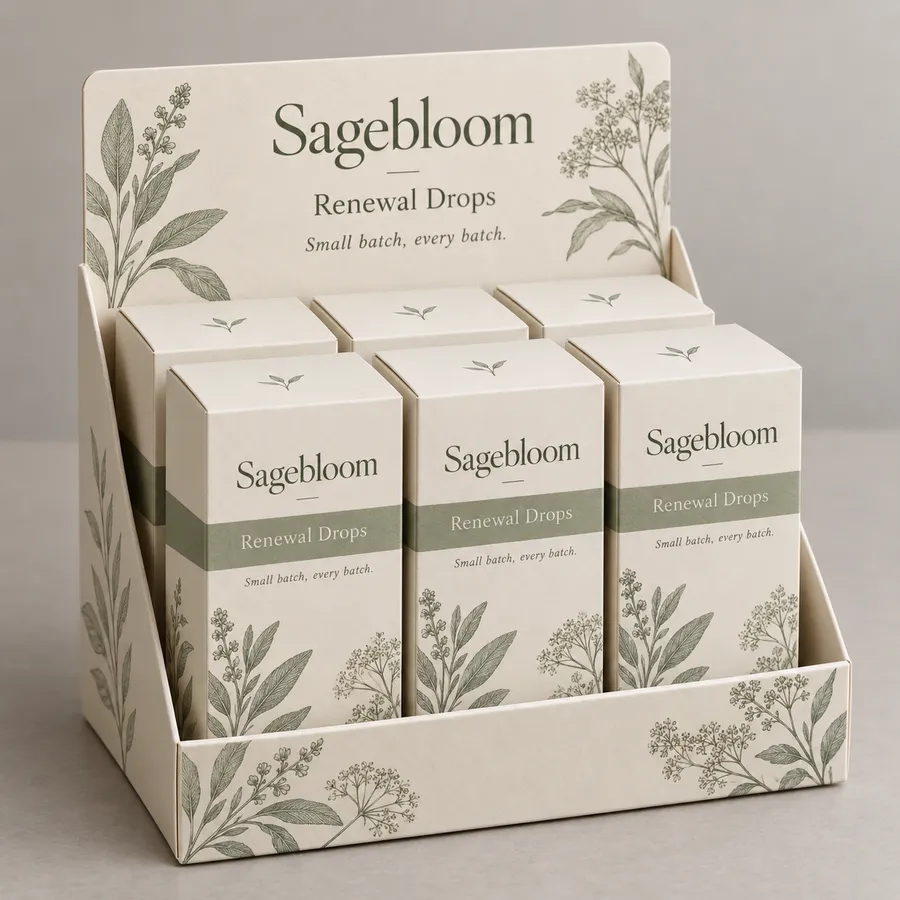
Ivory and sage cosmetic counter tray with six cartons and a printed Sagebloom rear header.
Custom Cosmetic Boxes
Custom cosmetic display boxes group skincare or makeup sale units in an accessible counter tray with a raised printed header. Easy Box Packaging develops the layout around your product arrangement and retail footprint, with SBS or kraft paperboard options and selected print finishes. Specify the fill pattern, wall heights and support needs before approving the display.
Last updated
Working quote
Product brief
Start with what the customer needs to see and what the retailer needs to refill. An open-front tray keeps individual packs accessible, while a raised back panel provides a separate surface for the range name. The front lip should be considered alongside the label position on the packed item: a bottle name hidden behind the lip cannot be read from the same angle as the header. Cosmetic display boxes are shared presentation packaging for several sale units, rather than individual cartons enclosing each item.
Decide whether the display will hold one product shape or a mixed assortment. A row of matching skincare cartons creates a different layout from jars and tall dropper bottles placed together. Provide the intended arrangement as well as the overall quantity; a total count alone does not explain which products should face forward. Also identify whether the display arrives filled or is assembled and stocked at the destination. That changes the handling questions to resolve before the structure is approved.
Measure the complete sale unit, including its carton if the carton goes into the display. Supply its widest width, depth and assembled height, together with its weight and any cap or shoulder that projects beyond the body. For a mixed range, provide this information for each shape rather than using the largest item's dimensions for the entire assortment.
The available counter area is a separate constraint. Give the maximum footprint and any height restriction, then describe the intended product facing and refill access. A display that fits on the counter may still place its header behind another fixture or make the rear products awkward to reach. Allowance around the items and the final wall heights belong in the specification review; there is no universal clearance to apply to every bottle or compact.
SBS paperboard and kraft paperboard are category material options. Compare their appearance against the artwork and the intended presentation rather than assuming that a particular stock name determines the display's load capacity. Board choice, folds, wall construction and the loaded arrangement need to be considered together. Supply the expected loaded weight so the proposed construction can be reviewed for that use.
Internal support is a separate decision from the outside print. Bottle geometry, weight, fragility, orientation, spacing and the retail presentation all influence whether the layout needs support. Discuss an integrated paperboard feature or separate insert if the items need defined positions. Keeping each product in a dedicated position can also affect refill access, so review that interaction before committing to a divided layout. An open retail tray should not be treated as the sole protective shipping package for fragile cosmetics; describe any outer packing requirements separately.
Give each printed surface a purpose. The header can identify the range from above the products, the front panel can carry a short message, and the side walls can continue the visual identity. Keep essential text away from areas covered by the packed items. Review the design with the planned fill arrangement so a print proof does not imply that every printed surface remains visible when stocked.
Matte or gloss lamination can change the surface appearance. Foil stamping and spot UV can highlight selected artwork, while embossing or debossing can add a tactile feature, subject to artwork and construction review. Avoid placing a finish across a fold without discussing how that position affects the intended result. The dieline and proof review should establish where the artwork sits on the assembled display.
Send product measurements, loaded weight, the desired arrangement, counter limits, order quantity and artwork status. Include the destination stocking method and any insert or outer-packing needs. Easy Box Packaging quotes this display to its specification; a unit price is supplied with the quote rather than assumed from an unrelated cosmetic carton.
The minimum order is 50 units. Production is from 7 business days after digital proof approval, and free US shipping is available on the standard fulfillment path. Quote requests are answered within 24 hours, typically the same business day. Confirm the specification and approve the digital proof before production begins, especially if the assortment or counter footprint has changed since the initial request. The sample kit has a $44.99 shipping charge, credited toward your first order; it can inform material and finish discussions without replacing review of your custom display.
Proof points
Use the display dieline and digital proof to check the relationship between header, front lip and side panels before approval.
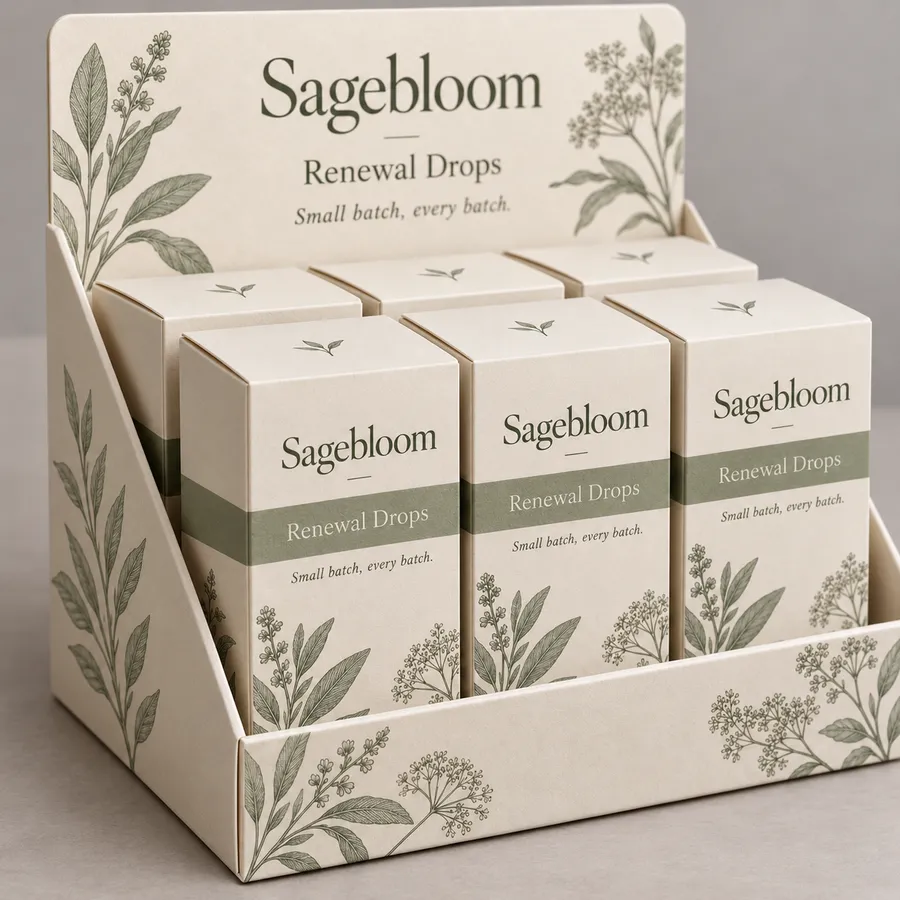
A low front panel and raised header give the product labels and range identity separate viewing areas. Consider the filled arrangement before choosing panel heights.
Group matching skincare sale units beneath a shared range header.
Present several cosmetic variants in a layout that keeps their labels accessible.
Place the range name above the products and reserve front-panel space for a concise message. Review finish placement around folds and covered areas.
Explain how staff will stock the cosmetic tray so access can be reviewed alongside its presentation.
Describe how individual sale units will be placed into the open tray.
Identify outer packing and handling needs separately from the counter presentation.
Resolve the packed arrangement before final artwork approval.
Provide product measurements, counter footprint, loaded weight, quantity and artwork status.
Check the proposed tray, header and any support against the intended assortment.
Confirm artwork placement before production begins.
Need help with structure, materials, or production planning? See how we manufacture custom packaging.
The sample kit has a $44.99 shipping charge, credited toward your first order. Use it to discuss material and finish preferences; it is not a custom filled-display prototype.
Shipping charge: $44.99. Credited toward your first order.
Request a Sample KitFind clear answers about fit, materials, and ordering below.
A mixed assortment can be discussed. Send measurements and weights for each shape plus the intended arrangement so the layout and any support can be reviewed together.
Check the new product dimensions, weight and label positions against the approved layout. A change in assortment may require a revised structure or dieline, even when the overall style stays the same.
Its purpose is open retail presentation. Specify outer packing separately if it will travel filled, particularly with fragile cosmetic containers.
Pricing is quoted to the dimensions, construction, quantity, print and finish requirements of your display.
Custom cosmetic display boxes group skincare or makeup sale units in an accessible counter tray with a raised printed header. Each order is made to order around your packed product and artwork, and the specification is confirmed against a digital proof before production.
Common uses include salon skincare counter and makeup launch assortment. The final specification is set by the packed product and how it will be handled.
The standard minimum order for Cosmetic Display Boxes is 50 units. Each order is built around your packed product, artwork, and quantity, and the details are confirmed in your quote.
Compare nearby products and request the format that best fits your next run.
Available product
Available product
Available product
Available product
Scope your counter display
Share the product arrangement, loaded weight and available footprint to request a specification-based quote.
Add your product details to see a quote summary.