Single-SKU Retail Cartons
An upright printed carton for one cereal product, with the front panel carrying the product name and the side panels carrying supporting information.

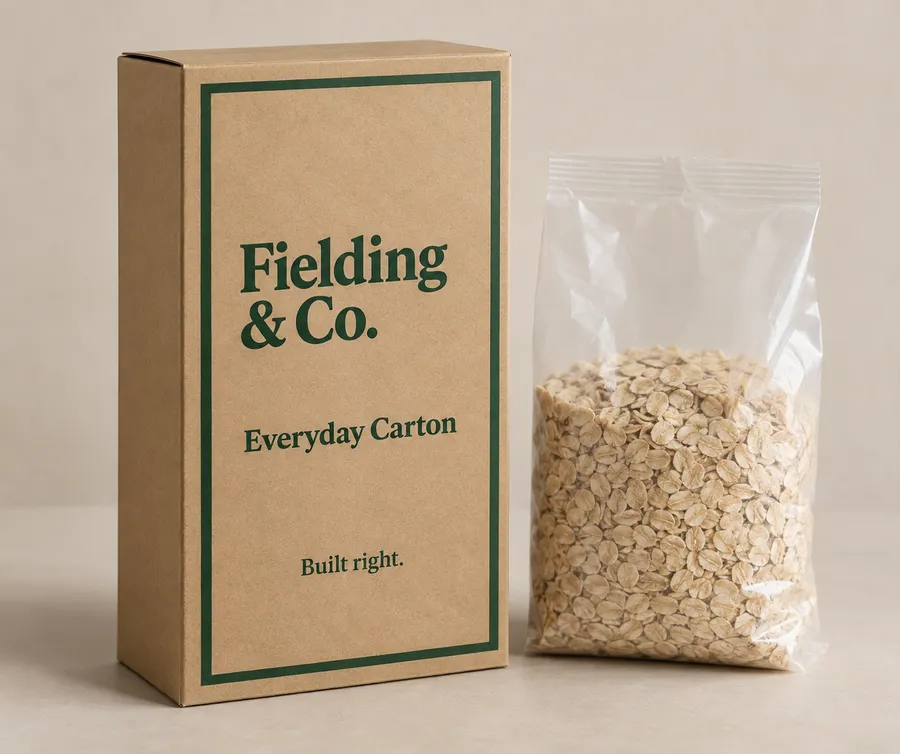
Closed custom cereal cardboard box beside a plain inner cereal pouch with green printed branding
Cardboard Boxes
Custom cereal cardboard boxes made to order around the filled inner pouch, upright shelf footprint, top closure, and printed panel layout. Choose a paperboard direction and finish around the cereal product, artwork, and handling route so the carton is sized for the package you actually plan to sell.
Last updated
Working quote
Product brief
Custom cereal cardboard boxes bring several jobs together in one folded package: the carton needs to hold a sealed inner cereal pouch, stand upright for presentation, close cleanly at the top, and give the printed artwork enough uninterrupted surface to be read. Those requirements are connected, but they are not interchangeable. A carton that looks right on a flat dieline can feel too shallow once the filled pouch is inside, while a carton sized around an empty bag may not account for the filled product's shape.
This is a made-to-order format rather than a stock box selected by a nominal size. The box style, panel proportions, fold positions, and closure are coordinated around the product brief, then checked in a digital proof. Start with the package as it will be sold: the filled inner pouch, its folded or sealed top, the product weight, and the way the carton will be placed on a shelf or packed for delivery. That gives the quote and dieline a useful starting point.
Share the filled pouch's length, width, height, weight, and widest points rather than measuring an empty bag. If the pouch has a folded top, gusset, seal, or closure area that changes its profile, include that information. The carton also needs the intended orientation of the pouch, because a package that stands vertically presents different panel and closure requirements from one intended to lie flat. A photograph or simple side view can help clarify an uneven fill, a soft pouch, or a product that settles differently after packing.
The outer carton should leave room for the pouch and for the folds that make the carton close, while avoiding unnecessary space that can let the inner pack shift. There is no single clearance number that fits every cereal product: the final allowance depends on pouch material, fill weight, product arrangement, board direction, closure, and how the finished package is handled. If the cereal is sold as a variety set or with more than one inner pouch, describe the complete arrangement rather than quoting only one pouch's measurements.
Material choice should follow the carton’s visible role and the handling it will see. Kraft paperboard gives the package a natural, tactile surface and can suit artwork that wants the board character to remain part of the presentation. SBS paperboard provides a smoother, brighter base for detailed printed panels and can be considered when the cereal name, flavor callout, or illustration needs a clean surface. Corrugated board is another category direction, but it answers a different structural question and should be reviewed if the package needs more separation from transit handling rather than only a retail carton.
These choices are not interchangeable labels for the same result. The substrate changes the way color, folds, edges, and finishes read after the carton is assembled. An FSC-certified paper option is available as a material direction when that sourcing detail matters to the brief; that option should be confirmed for the selected stock rather than treated as a blanket certification of every box. The final board choice belongs in the quotation and proof review, where the packed pouch, printed panels, and intended handling route can be considered together.
A cereal carton needs a closure that works with the filled pouch and leaves the front panel available for the product name. A folding carton with an aligned tuck-top flap can give the package a clear opening sequence, while the side panels can carry supporting information without taking the main face out of view. The bottom structure, side seam, top flap, and panel widths all affect how the finished carton stands and how the artwork reads after folding.
The dieline is prepared around the chosen carton format and the product's actual packed dimensions. A change in pouch size, number of inner packs, orientation, closure style, or panel arrangement can change the dieline even when the carton is still described as a cereal box. If a brand has several cereal varieties, the family can share a visual system while each size or fill configuration is reviewed around its own dimensions. That keeps the front panel, side copy, and opening sequence tied to the physical package instead of assuming one flat layout will work for every SKU.
The printed surface can carry the brand name, cereal name, flavor or variant wording supplied by the customer, preparation copy, and a restrained graphic system across the panels that remain visible after assembly. Foil stamping can highlight a short brand mark or selected detail when the artwork and surface support it. Matte lamination gives the printed panels a lower-sheen appearance, while gloss lamination creates a brighter reflective surface. Finish selection should be reviewed with the board and artwork because folds, seams, closure flaps, and coverage areas change what a customer actually sees.
Keep the most important message on the front panel that faces the buyer, and use the side panels for information that can be read once the carton is turned. The proof should show the assembled orientation, not only the flat artwork. Check that the cereal name is not split by a fold, that the top flap does not cover a key line, and that the panel sequence still makes sense when the pouch is inside. Dieline and proof review are included on every order at no extra charge; that review is the point to resolve panel placement and finish decisions before production.
A single-SKU cereal carton can give a retail product a consistent front face while keeping the inner pouch separate from the printed outer package. A multi-variant cereal line can use the same broad visual system across flavors while adjusting the product name, color direction, and information hierarchy for each carton. A carton used for a subscription or direct-to-customer shipment may need the same shelf-facing artwork but should also be discussed in relation to the outer shipping pack and the way the package will be handled.
These are different use conditions, even when the box title is the same. Shelf presentation puts more attention on the front panel, upright stability, and the opening sequence. Direct shipment adds questions about the outer pack, product movement, and the route from fulfillment to the customer. Share the intended handoff so the construction is reviewed as a complete package rather than judged by the printed face alone.
Orders start at 50 units on the standard fulfillment path. Production typically begins from 7 business days after digital proof approval, and free US shipping is included. A sample kit can be used to examine board feel, printed surface, closure, and a comparable carton before committing to a full run; the sample-kit shipping charge is $44.99 and is credited toward the first order. This product does not have a defensible product-specific unit price in the supplied evidence, so pricing remains quote-based and depends on the packed pouch, carton format, quantity, material direction, artwork, and finish.
For a useful first quote, send the filled pouch dimensions and weight, the number of inner pouches per carton, the intended carton orientation, order quantity, artwork status, and whether the box will sit on a shelf, move through fulfillment, or be placed inside another shipping package. Include any preferred board or finish direction, plus the front-panel wording and the information that belongs on the sides. If the filled pouch changes shape after packing, explain that as well.
The team can then review the structure, prepare a dieline, and return a digital proof showing the carton panels, folds, closure, and artwork. Compare the proof with the real filled pouch before approval, including the fit at the top flap, the position of the cereal name, and the way the package stands. Quote requests are typically answered the same business day and always within 24 hours. After approval, production begins from 7 business days under the standard estimate, giving the custom cereal cardboard box a clear path from product measurements to printed production.
Proof points
The finished package is reviewed as a folded carton around the filled pouch, printed face, closure, and route it will take after production.
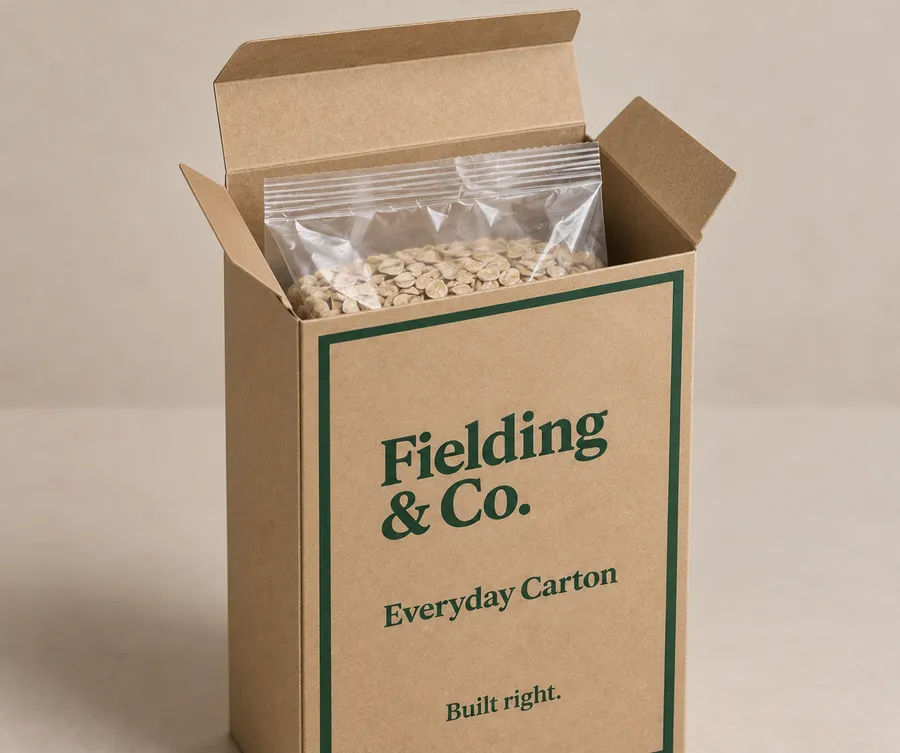
Sizing begins with the filled inner pouch, its weight, its sealed or folded top, and the number of pouches in the carton. The dieline then coordinates the pouch clearance, panel proportions, top flap, bottom structure, and the printed face that needs to remain readable when assembled.
An upright printed carton for one cereal product, with the front panel carrying the product name and the side panels carrying supporting information.
A repeatable carton system for multiple cereal variants where the structural format stays coordinated while product names and artwork change by SKU.
A branded cereal carton placed into a subscription or direct-to-customer shipment, reviewed alongside the outer shipping pack and handling route.
A custom printed carton for a limited flavor, campaign, or seasonal presentation where artwork changes but the filled pouch and closure still need to be checked.
Artwork is mapped to the assembled carton so the cereal name, front-panel hierarchy, side copy, folds, closure, and finish remain intentional after the box is folded.
The most useful brief connects the physical inner pouch to the carton format, artwork, and handling route so the quote can be reviewed around a real package.
Share the filled pouch dimensions, weight, widest points, top seal or fold, and the number of inner packs the carton must hold.
Explain whether the carton is primarily shelf-facing, handed over in a store, placed in a subscription shipment, or packed inside another shipping box.
Review the front panel, side copy, top flap, folds, and finish coverage in the digital proof before approval.
The order path turns the filled pouch and artwork brief into a confirmed carton structure, printed layout, and production-ready proof.
Provide the packed dimensions, weight, top seal or fold, pouch count, and intended carton orientation.
Explain whether the carton is shelf-facing, handed over in a store, or placed into a subscription or shipping pack.
Discuss kraft paperboard, SBS paperboard, or corrugated board with the intended print and finish treatment.
Send the cereal name, variant wording, artwork, and panel priorities so the layout can be mapped to the carton.
Check the front panel, side copy, folds, top closure, pouch clearance, and finish coverage against the actual product.
Need help with structure, materials, or production planning? See how we manufacture custom packaging.
Review board feel, printed surface, closure, and carton fit before a full run; the $44.99 sample-kit shipping charge is credited toward the first order.
Shipping charge: $44.99. Credited toward your first order.
Request a Sample KitFind clear answers about fit, materials, and ordering below.
Measure the filled inner pouch, including its length, width, height, weight, widest points, and sealed or folded top. Also share the pouch count and orientation so the dieline can be reviewed around the complete packed arrangement.
Kraft paperboard, SBS paperboard, and corrugated board are available material directions in the cardboard-boxes category. The right direction depends on the printed surface, carton structure, and whether the package is primarily shelf-facing or exposed to transit handling.
The minimum order is 50 units on the standard fulfillment path. Production typically begins from 7 business days after digital proof approval, and free US shipping is included.
Yes. Custom printed panels can be reviewed with foil stamping, matte lamination, or gloss lamination, subject to the selected board, folds, closure, surface coverage, and artwork.
Send the filled pouch dimensions and weight, pouch count, carton orientation, quantity, intended handling route, artwork status, and any preferred material or finish. A filled-product photo or side view can help clarify the pouch profile.
Orders start at 50 units and scale up to 500,000 for bulk runs, with pricing from $0.39 per unit on larger quantities. Standard production is from 7 business days after digital proof approval.
Yes. Free US shipping is included on the standard fulfillment path. Delivery timing and carrier details are confirmed when your quote is prepared.
Compare nearby products and request the format that best fits your next run.
Available product
Available product
Available product
Available product
Get Started
Send the filled pouch dimensions, pouch count, carton orientation, quantity, material direction, artwork status, and intended handling route to request a quote.
Add your product details to see a quote summary.