Package seals
A two-sided seal can cross a carton flap, tissue wrap, or pouch closure when the outside mark and the reverse view both have a job.

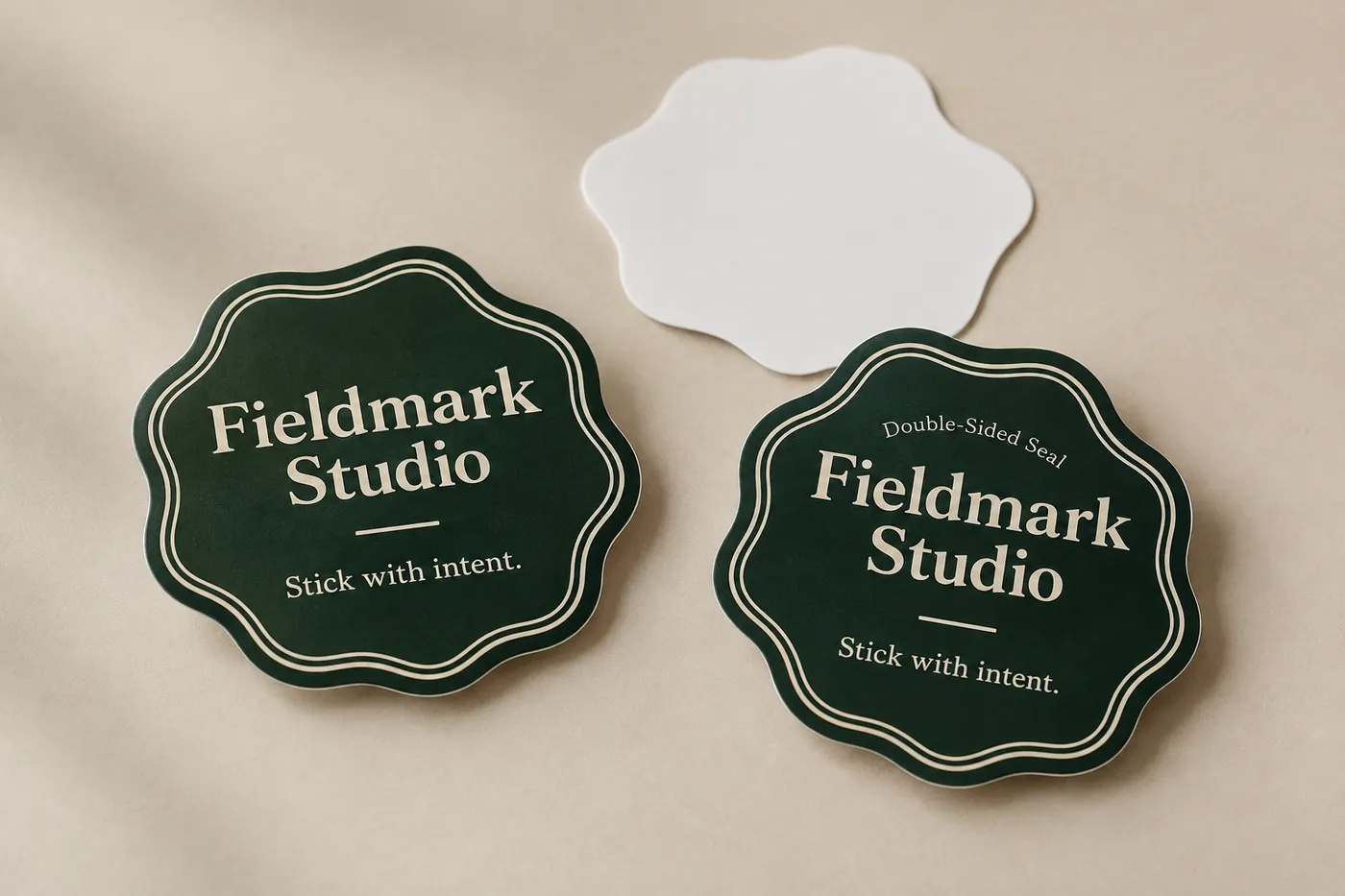
Custom double-sided stickers showing aligned front and reverse printed faces beside a white release liner
Stickers and Tape
Custom double-sided stickers carry a planned printed treatment on two faces or create a two-part adhesive application where one side alone is not enough. They can support package seals, transparent-panel messaging, layered inserts, and other defined applications when the viewing direction, substrate, liner, and handling sequence are clear. Share the finished size, artwork for each face, receiving surface, and finish preference for review.
Last updated
Working quote
Product brief
Custom double-sided stickers are specified around two printed faces or a two-part application rather than a single label front. That distinction matters when a mark must be read from opposite sides, when a transparent panel needs artwork visible through it, or when two surfaces must meet with a printed detail between them. The useful starting point is the job: identify which face is seen first, which face is seen after application, and whether the adhesive is exposed before or after the piece is positioned.
A double-sided sticker is not automatically a back-to-back version of a one-sided label. The artwork, orientation, liner presentation, and adhesive arrangement have to agree. If the piece is a package seal, explain which flap or panel it crosses. If it sits against a transparent window, state which side the viewer approaches from. If it joins two printed surfaces, describe the order in which the operator handles the piece. These details keep the proof tied to a real application instead of an abstract two-sided description.
Begin with the finished width and height, the widest and tallest points, and the edge that must remain visually clear. Then list the content for face 1 and face 2 separately. One face may carry a brand name while the other carries a short instruction, variant, or reverse-reading mark. The two designs can share a color system without being identical. A small type line that works on the front may become hard to read when viewed through another material, so the viewing route belongs in the brief.
Describe whether the two faces should align, mirror, rotate, or remain deliberately offset. Include any clear zone around a cut edge, fold, window, or seam. A transparent surface can reverse the apparent order of artwork, while an opaque join can hide one face after application. The digital proof should show the intended orientation and the application sequence together, including which side remains on the liner until the operator is ready. Do not approve the faces as two unrelated flat files.
The substrate changes the construction conversation. A smooth SBS carton, a natural kraft panel, a coated insert, a flexible pouch, and a transparent film window each present different questions about contact area, edge lift, hand placement, and the amount of movement during packing. State whether the surface is flat, curved, textured, coated, or already printed. Also note whether the sticker is applied once at a packing bench or handled several times during an event or unboxing workflow.
The final face-stock and adhesive direction remain subject to the actual application review. Avoid assuming that one two-sided construction works on every surface, and avoid claiming permanent, removable, outdoor, or water-resistant behavior without a confirmed source for the exact build. The quote brief should include the receiving material, the expected contact area, storage conditions that matter to the buyer, and the reason both faces need to be printed.
Matte Lamination can keep glare lower on a face with small type, while Gloss Lamination can give a high-shine surface direction when the artwork relies on saturated color. Spot UV can reserve localized gloss for a word or mark, and Foil Stamping can be considered for selected lettering or linework. Embossing/Debossing may suit a tactile detail when the stock, scale, and application leave enough room around the edge. These are directions for review, not automatic performance upgrades.
Finish placement should be checked on both faces and against the way the sticker is turned or seen through a panel. A metallic accent that reads on face 1 may need a different position on face 2 to avoid colliding with a seam or liner edge. Keep the shared sample print layout, Fieldmark Studio, Double-Sided Seal, Stick with intent., as a visual demonstration only; production artwork must use the approved customer brand, product information, and any required regulatory copy.
The standard fulfillment path starts at 50 units. Production begins from 7 business days after digital proof approval, and Free US shipping is included. Dieline and proof review are included on every order at no extra charge. A sample kit can be requested when you need to compare the printed faces, liner handling, or finish direction in hand; its shipping charge is $44.99 USD and is credited toward the first order. Pricing remains quote-only because the two-face artwork, size, adhesive arrangement, material direction, finish, and quantity change the specification.
Before approval, check face 1, face 2, orientation, mirror or rotation requirements, visible border, cut path, liner side, and the moment at which adhesive is exposed. If the sticker will be applied to more than one surface, include each surface before the proof is approved. Quote requests are typically answered the same business day and always within 24 hours.
A two-sided seal can cross a carton flap or tissue wrap when both the closure and the outside presentation need a considered mark. A transparent-panel sticker can place a brand or instruction where it is readable from the intended viewing direction. A layered insert can use one face for the recipient and another for the packer, provided the application sequence is described. Event, campaign, and unboxing details can also use the format when the operator needs a deliberate front and reverse message rather than a generic single-sided handout.
The correct use case depends on the surface, viewing direction, operator movement, and whether the faces need to align. A sticker designed for a clear panel may need a different brief from one crossing an opaque carton seam. State where the piece goes, which face is visible at each stage, and how the operator will pick it up so the print and adhesive direction are reviewed around the real task.
Send the artwork for face 1 and face 2, finished width and height, widest and tallest points for an irregular shape, quantity, receiving surface, application sequence, artwork status, and preferred material or finish. State whether the faces should align, mirror, rotate, or remain offset. Identify which side stays on the liner first and whether the finished piece crosses a flap, seam, window, or other boundary. Include a sample or simple diagram when the viewing direction is difficult to explain in words.
The team can then review the cut path, face stock, adhesive arrangement, print coverage, finish placement, liner presentation, and final proof as one specification. Once the proof is approved, production can begin from 7 business days under the standard estimate. This keeps the two printed faces and the physical application connected while leaving the product-specific price to the quote.
Proof points
The proof brings both printed faces, the cut edge, adhesive arrangement, liner presentation, viewing direction, and finish placement into one review.
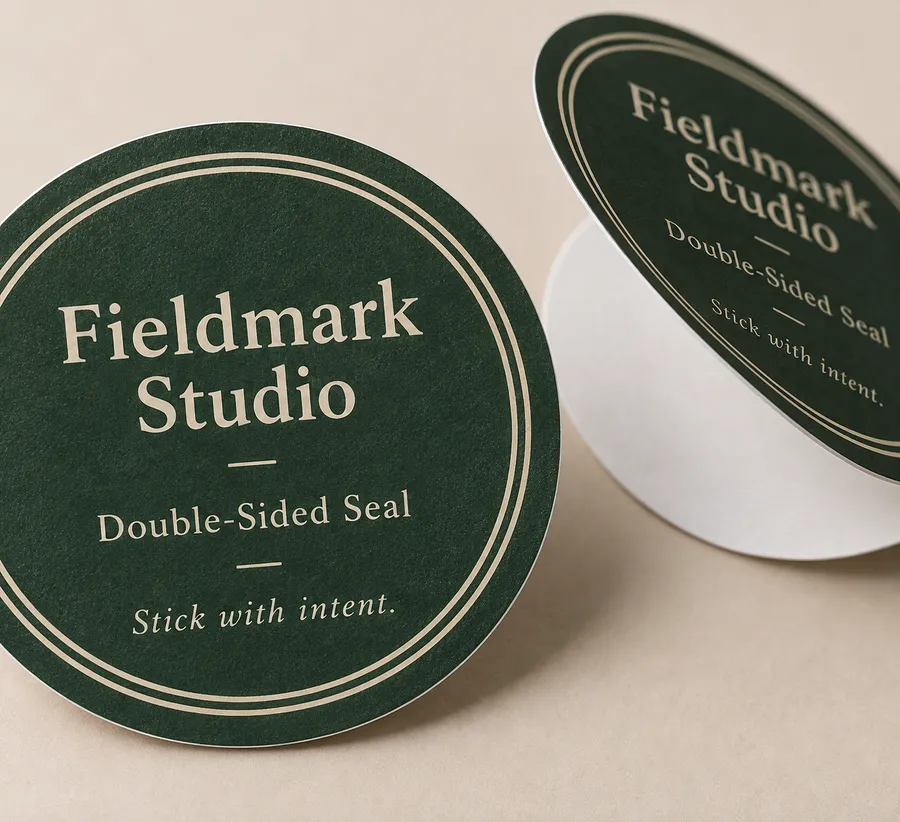
The format is useful when a mark or message needs a planned front and reverse view, or when a two-part application brings printed faces together. Share the viewing direction, receiving surface, adhesive exposure, and application sequence so the sticker can be reviewed as a physical piece rather than two unrelated artworks.
A two-sided seal can cross a carton flap, tissue wrap, or pouch closure when the outside mark and the reverse view both have a job.
A planned front and reverse face can support artwork viewed through a clear window or panel, subject to the actual substrate review.
One face can address the recipient while the reverse carries a packer note, variant detail, or second message in a defined unboxing sequence.
A two-face piece can present a front mark and reverse information when it is handed out or applied during a campaign or event workflow.
Both faces should be reviewed with the cut, viewing direction, stock, adhesive arrangement, and receiving surface so a finish supports the real application.
A useful brief connects both faces to the surface and the operator's movement. These inputs let the proof show the cut, orientation, liner, and finish in the order the sticker will actually be handled.
Label face 1 and face 2, then state whether they align, mirror, rotate, or remain offset after application.
Identify the carton, window, insert, pouch, wrap, or other surface, including any seam, curve, coating, or texture.
Explain which side stays on the liner first, when adhesive is exposed, and how the operator positions the piece.
The order starts with the two-face artwork and application route, then confirms the physical construction, digital proof, and production path.
Provide face 1 and face 2 artwork, product copy, preferred color direction, and any clear zone around the cut or seam.
Provide finished width and height, widest point, quantity, receiving surface, viewing direction, and application method.
State which side stays on the liner first, when adhesive is exposed, and whether the faces align, mirror, rotate, or offset.
Discuss face-stock direction, adhesive arrangement, print coverage, finish placement, and liner presentation for the actual use.
Check both faces, orientation, cut path, visible border, surface context, liner side, and selected finish before approval.
Need help with structure, materials, or production planning? See how we manufacture custom packaging.
A sample kit ships for a $44.99 USD charge credited toward your first order, useful when you need to compare face alignment, liner handling, printed surface, or finish direction before a larger run.
Shipping charge: $44.99. Credited toward your first order.
Request a Sample KitFind clear answers about fit, materials, and ordering below.
A double-sided sticker is planned around two printed faces or a two-part adhesive application. The proof checks the reading order, orientation, liner presentation, receiving surface, and point where each face becomes visible.
Share face 1 and face 2 artwork, finished width and height, widest point, quantity, receiving surface, viewing direction, application sequence, and any material or finish preference.
Yes, that relationship can be specified. State whether the faces should align, mirror, rotate, or remain offset, and show which side is read first so the digital proof reflects the intended application.
They can be considered for package seals, transparent-panel messaging, layered inserts, and event or campaign details when the surface and viewing direction are defined. The final construction remains subject to application review.
Matte Lamination, Gloss Lamination, Spot UV, Foil Stamping, and Embossing/Debossing are category finish directions. The selected treatment remains subject to both-face artwork, stock, cut, and application review.
The standard fulfillment path starts at 50 units, with production beginning from 7 business days after digital proof approval. Free US shipping is included on the standard fulfillment path.
Yes. A sample kit can be requested to compare the printed faces, liner handling, or finish before a larger order. Sample-kit shipping is $44.99 and is credited toward the first order.
Orders start at 50 units and scale up to 500,000 for bulk runs, with pricing from $0.30 per unit on larger quantities. Standard production is from 7 business days after digital proof approval.
Compare nearby products and request the format that best fits your next run.
Available product
Available product
Available product
Specify both faces
Send face 1 and face 2 artwork, finished size, quantity, receiving surface, viewing direction, liner sequence, and finish preference to request a quote that reflects the physical job.
Add your product details to see a quote summary.