Honey Variety Sets
A coordinated group of honey varieties presented with a shared outer design and an interior layout for the actual jar assortment.

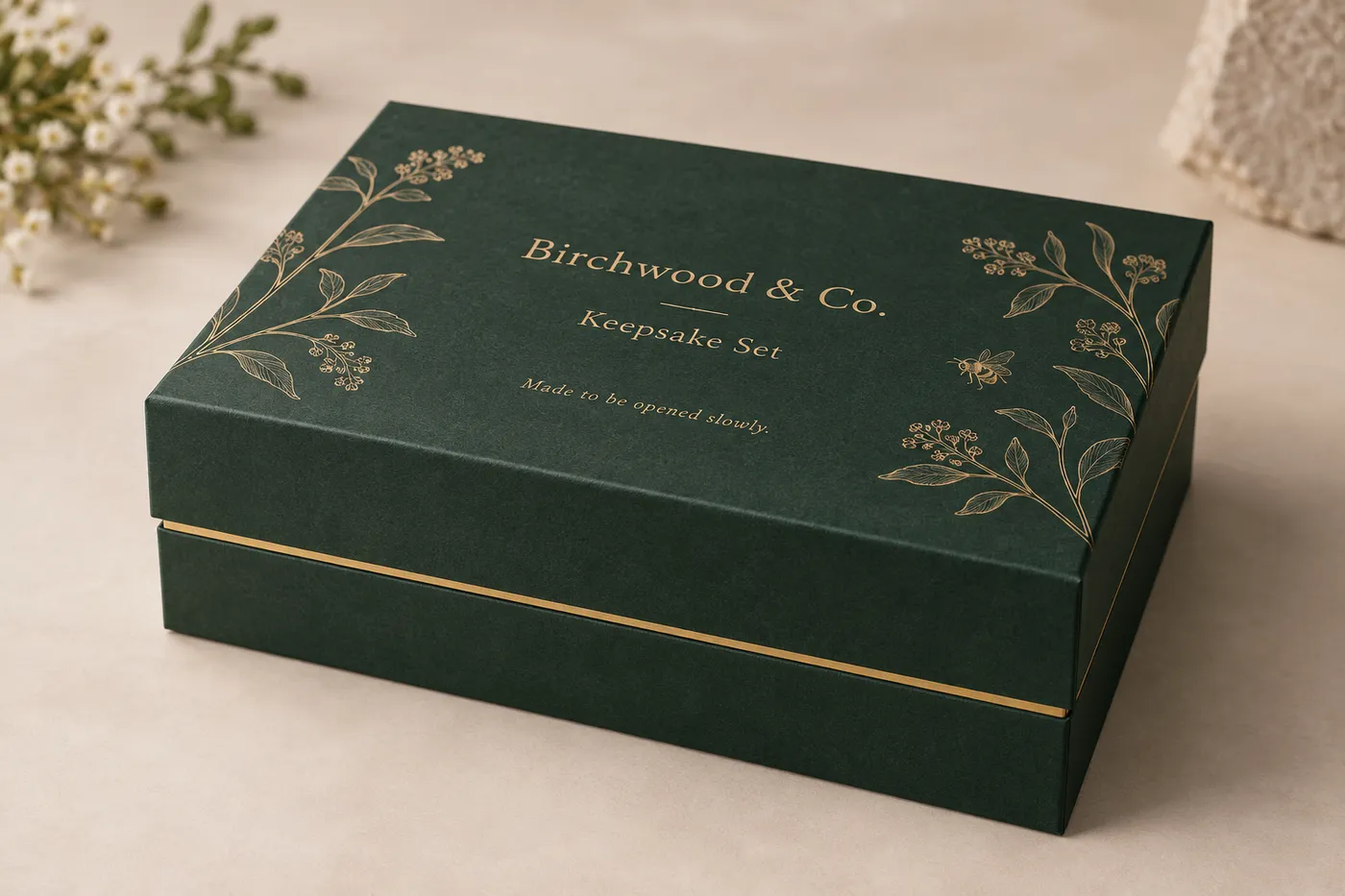
Closed custom honey gift set box with a deep green printed lid and honey-gold accents
Gift Boxes
Honey Gift Sets built around the real jar count, jar footprint, and presentation style, with a custom printed outer box and an interior layout that keeps multiple honey products arranged as one considered gift.
Last updated
Working quote
Product brief
Honey gift sets are usually planned around a group of jars or other honey containers that need to arrive and open as one presentation. The outer box is only one part of the decision. The jar count, the footprint of each container, lid height, label orientation, and the way the set will be handed over all affect the box structure and its internal layout. A box sized to one jar does not answer the same problem as a multi-jar assortment.
Start with the actual packed products rather than a stock box size. Record the length, width, height, lid shape, and filled weight of every container. If the set combines different honey varieties, note which jars are taller or wider and whether their labels need to face the same direction. Those details determine whether a repeated divider pattern is appropriate or whether the interior needs a more tailored arrangement. Allowance for the product's actual clearance is reviewed in the dieline, so the jars are not left loose in one open cavity or pressed against the printed panels.
A rigid lift-off-lid box gives a honey assortment a defined base and lid and keeps the package presentational after it has been opened. It can suit a curated set where the box remains part of the gifting moment. A folding carton can be the better route when flat storage, efficient assembly, or a lighter presentation matters more. Neither structure should be chosen from the product name alone. The final choice follows the jar geometry, the number of components, the desired reveal, and the expected handling route.
For several jars, the inside needs an intentional plan before the outside panels are finalized. A paperboard divider or fitted tray can separate the containers and create a repeatable reveal when the lid opens. The support decision depends on jar shape, filled weight, orientation, clearance, and whether the set includes an accessory such as a tasting spoon or a small card. If the set includes components with different footprints, the layout should show those differences rather than forcing every cavity to match.
SBS Paperboard gives the printed exterior a clean surface for a detailed honey label, a harvest illustration, or a restrained brand system. Kraft Paperboard brings a more natural paper character and can support an intentionally earthy direction. The material choice is reviewed with the box structure, the interior support, the printed coverage, and the surface finish. A pale SBS direction may keep small type and warm color fields crisp, while kraft can make the substrate itself part of the visual language. The appropriate choice is the one that works with the actual artwork and the intended presentation.
The box can be fully enclosed or planned with a die-cut window when showing the jar labels before opening is part of the presentation. A window changes the available printed area and the way the interior is seen, so it belongs in the structural conversation rather than being added after the dieline. Artwork should show the front panel, side panels, lid, and any area where the window or divider changes the composition.
Foil stamping can highlight a selected wordmark, varietal name, or small line detail, subject to artwork and surface review. Embossing or debossing can create a tactile change on a logo or botanical motif, with the depth and board choice reviewed together. Spot UV can add a localized sheen to an approved area, while matte or gloss lamination changes the surface character of the printed exterior. These options are not interchangeable decorations. They should be chosen after the brand hierarchy, label readability, and the visible parts of the honey set are understood.
A useful print brief identifies the main brand name, the honey or varietal name, any flavor or origin language, and the panels that need the strongest contrast. It also identifies whether jar labels will remain visible through a window or whether the outside box carries the full product explanation. That information helps the proof review stay tied to the actual unboxing sequence.
The standard fulfillment path starts at 50 units. Production begins from 7 business days after digital proof approval, and the page remains quote-only because no product-specific unit price has been confirmed. A sample kit carries a $44.99 shipping charge credited toward the first order, which can help when the open-box presentation, board feel, or printed surface needs an in-person check.
For a useful quote, send the jar count, filled dimensions, approximate weight, lid and label orientation, preferred box structure, desired interior support, quantity, delivery destination, and artwork status. Include a photo or sketch when the containers have unusual shoulders, handles, or mixed heights. If the set includes a spoon, card, or other accessory, list its finished size and position in the reveal. The quote can then address the outer footprint, divider or tray approach, material direction, print coverage, finish choices, and proof sequence together.
After the structure is scoped, review the dieline against the real product information and confirm the artwork on every visible panel. Production follows proof approval. The finished honey gift sets are then prepared for dispatch with the standard fulfillment path and free US shipping included.
Proof points
The specification ties the box structure, jar arrangement, board direction, and printed exterior to the finished honey set rather than treating every assortment as the same package.
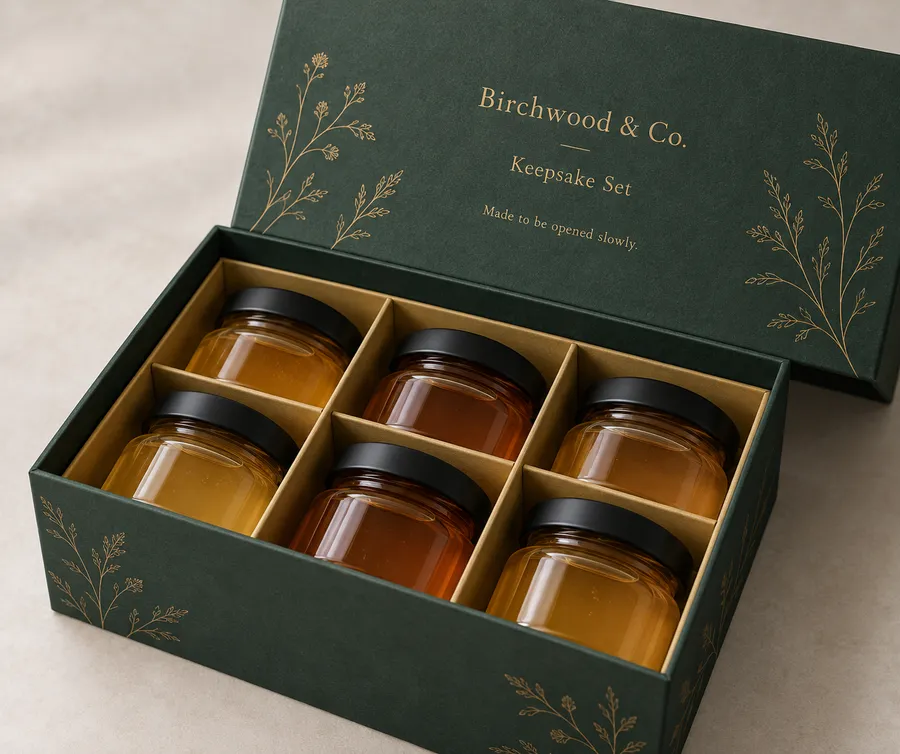
Sizing follows the real jar count, individual footprint, lid height, label direction, and any accessory included in the set. The outer panels and interior divider or tray are then reviewed together so the opened package presents the jars in an intentional arrangement.
A coordinated group of honey varieties presented with a shared outer design and an interior layout for the actual jar assortment.
A custom printed package for holiday, host, wedding, or celebration gifting where the box becomes part of the handoff.
A single gift-set presentation for online orders that need the jar arrangement and exterior artwork to work together.
A structured set for a shelf or counter presentation, with a window or enclosed reveal chosen around the label and brand direction.
The printed exterior can carry the honey brand, varietal names, harvest or origin language, and a restrained motif, with finishing reviewed against the final artwork and board surface.
The most useful starting brief combines filled product dimensions, weight, orientation, quantity, artwork status, and the way the set will be handled after assembly.
Share the jar count, dimensions, lid shape, and label direction so the interior arrangement can be scoped around the real set.
Compare a fitted tray or paperboard divider against the jar geometry, clearance, accessories, and desired reveal.
Check board feel, surface finish, printed color, and the open-box presentation before committing to a full run.
The route from quote request to production starts with the actual jar arrangement, then confirms the structure, artwork, material, finish, and proof.
Provide the jar count, filled dimensions, approximate weight, lid shape, label direction, and any accessory included in the set.
Discuss a rigid lift-off-lid box or folding carton, plus the interior divider, tray, or window approach.
Send the brand artwork, jar or varietal names, panel priorities, and preferred material and finish direction.
Check the jar fit, cavity positions, panel orientation, window placement, and printed artwork before approval.
Confirm the reviewed specification and digital proof before production begins.
Need help with structure, materials, or production planning? See how we manufacture custom packaging.
Check the board feel, printed surface, and open-box arrangement before a full run; sample-kit shipping is $44.99 and is credited toward the first order.
Shipping charge: $44.99. Credited toward your first order.
Request a Sample KitFind clear answers about fit, materials, and ordering below.
Sizing starts with the filled dimensions, lid shape, label direction, and approximate weight of every jar in the set. The outer box and interior divider or tray are then reviewed together so the arrangement has appropriate clearance.
Yes. Mixed jar footprints can be planned into a custom interior layout, although the cavity arrangement needs to reflect the actual differences instead of repeating one generic slot.
SBS Paperboard and Kraft Paperboard are the material directions to review for this category. The choice is considered with the structure, printed coverage, artwork, and selected finish.
A die-cut window can be considered when the label reveal is part of the presentation. A fully enclosed box keeps the product reveal inside the lid opening instead.
Standard orders start at 50 units. Production begins from 7 business days after digital proof approval, and free US shipping is included on the standard fulfillment path.
Orders start at 50 units and scale up to 500,000 for bulk runs, with pricing from $0.33 per unit on larger quantities. Standard production is from 7 business days after digital proof approval.
Common uses include honey variety sets, seasonal gifting, direct-to-consumer bundles, and retail gift programs. The final specification is set by the packed product and how it will be handled.
Compare nearby products and request the format that best fits your next run.
Available product
Available product
Available product
Available product
Get Started
Send the jar count, filled dimensions, preferred structure, interior support needs, quantity, destination, and artwork status to request a quote.
Add your product details to see a quote summary.