Tea tasting collections
Arrange several blend formats as one guided presentation when the recipient should compare labels, notes, or brewing directions as the box opens.

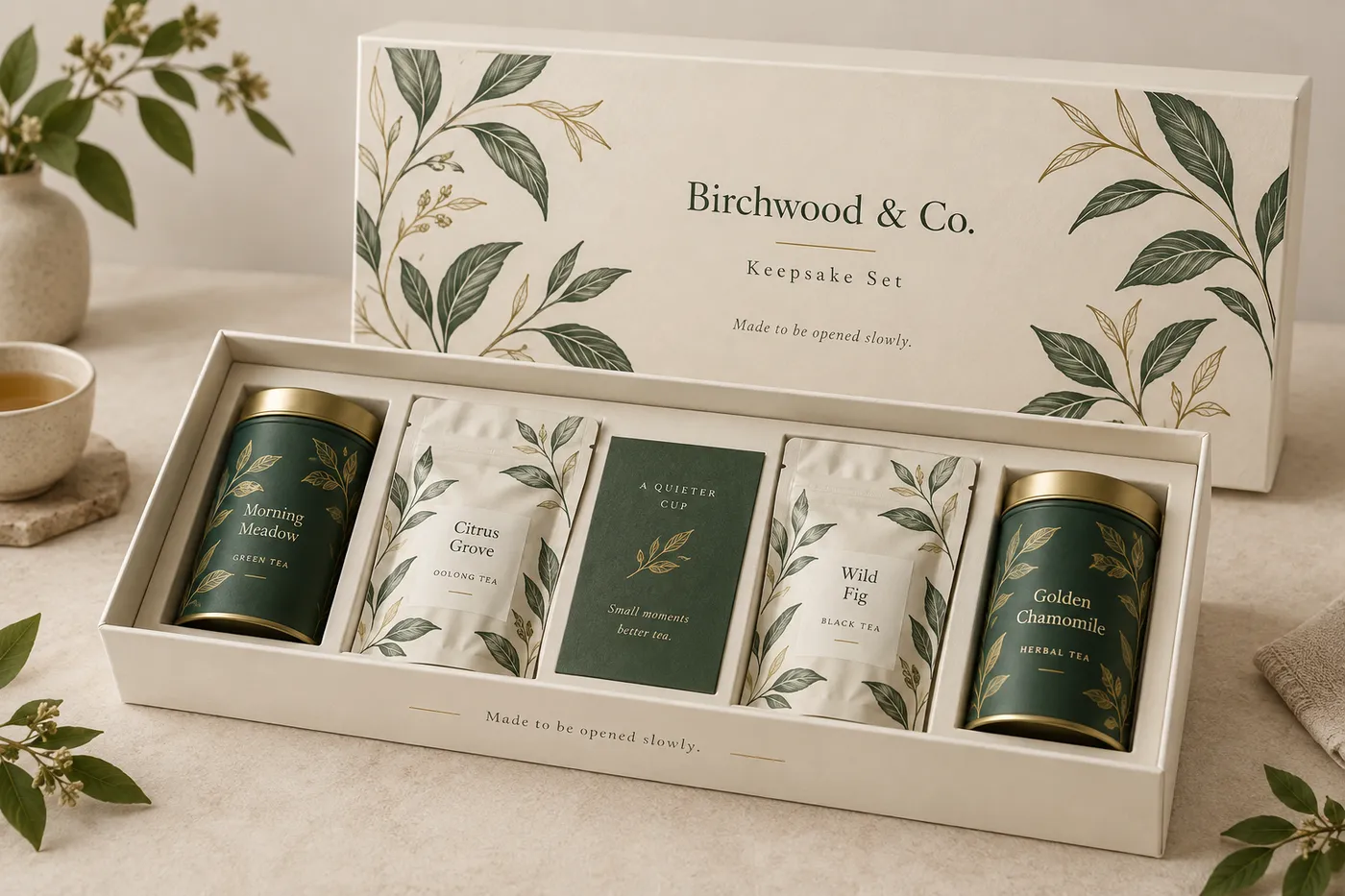
Open ivory tea gift box with tins and pouches separated in a fitted tray
Gift Boxes
Custom tea gift sets bring tea tins, stand-up pouches, and tasting materials into one coordinated presentation. A rigid two-piece box with a lift-off lid can frame the first reveal, while a fitted paperboard tray, printed panels, paperboard direction, and finish are planned around the actual tea assortment and how it will be handed over.
Last updated
Working quote
Product brief
Tea gift sets work best when the box brief starts with the contents as they will actually be packed. Tea tins, stand-up pouches, tasting cards, scoops, and other small accessories do not create the same loading pattern, even when they are all sold as a gift set. A row of matching tins presents differently from a mixed assortment of tins and flexible pouches. The first decision is therefore the arrangement: what should the recipient see immediately, which items should sit upright, and where should a tasting note or brand card appear?
For a quote, share the packed length, width, and height of each component, the widest points, the closure or seal shape, and the orientation intended inside the box. Note whether tea containers arrive already labeled, whether the pouches need a flat base, and whether a card or accessory travels inside the presentation. A simple placement sketch or photograph is useful when the set contains different formats. The specification should follow the real assortment rather than a generic stock-box assumption.
The standard fulfillment path starts at 50 units. That commercial starting point does not replace the product brief: the tea format, interior layout, chosen construction, printed coverage, finish, and order quantity still need to be scoped together. Pricing remains quote-only because those product-specific decisions determine the final specification.
A rigid two-piece box with a separate lift-off lid can suit a tea set where the opening sequence and a defined presentation are central to the handoff. The base and lid keep a clear shape while the recipient reveals the tea assortment, giving the top panel and inside lid distinct places for the collection name, brewing note, or short message. A folding carton can suit a different storage, assembly, or fulfillment direction. The right choice follows the tea formats, product weight, desired reveal, handling route, and available artwork rather than the word gift alone.
The outer format and opening direction should be considered with the tea arrangement. If the first view should show a complete tasting collection, the tray edge and top-facing labels need to align with the lid movement. If a pouch and tin should be lifted separately, the support and hand clearance need to be discussed before the outside footprint is settled. A different assortment or a materially different box size normally needs its own specification and dieline review even when the overall box style remains similar.
A tea gift set may use a fitted paperboard tray, divided positions, or another internal support direction when the component geometry, weight, orientation, fragility, outer structure, handling route, and desired reveal make defined placement useful. It may also use a shared cavity when the packed assortment and presentation brief support that approach. The decision belongs to the actual tea formats and opening sequence, not to a universal insert rule.
Describe which tin or pouch should lead the opening, whether labels need to face upward, and whether the recipient should see the full assortment at once. A tasting card can occupy part of the top layer or sit inside the lid, while a scoop or small accessory can change the useful interior layout. The proof should show how the tray or divider relates to the base, lid, and printed surfaces so the buyer can review the complete gift presentation rather than an empty box in isolation.
SBS Paperboard and Kraft Paperboard are the category's common material directions. SBS can suit a clean printed face for a controlled tea collection palette. Kraft Paperboard can suit a warmer paper character when natural tones are part of the visual brief. Material selection should be considered with the box span, lid relationship, interior support, print coverage, and handling route. An FSC-certified paper option is available when that specification matters to the buyer; that wording describes an offered material direction, not a blanket certification of every finished box.
Map artwork onto the assembled tea set instead of only onto a flat dieline. The lid, front panel, side panels, inside lid, tray edge, and any quiet area around folds or closures can each have a different role. A collection name can identify the set, flavor or blend labels can orient the recipient, and a tasting note can provide context after the first reveal. The primary identity should remain on the panel seen first, while secondary information can be placed where the opening makes it easy to read.
Foil Stamping can be considered for a collection name, small botanical linework, or a restrained border when the artwork and board support that treatment. Embossing/Debossing can be reviewed for a tactile mark or selected tea-leaf motif. Spot UV can create localized contrast on a printed panel. Matte Lamination and Gloss Lamination offer different surface directions for the finished tea gift box. Each option should be discussed with the artwork scale, lid geometry, board direction, and expected handling.
A digital proof is the useful checkpoint for reviewing those decisions together. Check that the blend names sit on the intended panels, the tray edge does not obscure important print, the lid opens in the planned direction, and the chosen finish is called out clearly. Dieline and proof review are included at no extra charge. Production begins from 7 business days after digital proof approval, and Free US shipping is included on the standard fulfillment path.
Send the packed dimensions of the tins and pouches, the component count, each component's orientation, the preferred rigid or folding direction if known, the interior arrangement, artwork status, material direction, print coverage, finish preferences, quantity, and delivery destination. Include the desired opening sequence: for example, whether the collection should read as one tasting set before individual labels are inspected, or whether a card should appear before the tea containers. That context helps the structure, tray, and artwork be reviewed as one system.
The sample-kit program can help when paper feel, printed surface, opening motion, or finish direction needs to be checked in hand. Sample-kit shipping is $44.99 and is credited toward the first order. Keep the quote brief specific about what is known and what remains open. The category supports both rigid and folding gift-box directions, but the final construction and internal support follow the actual tea assortment and intended presentation.
A useful tea gift-set specification connects the tea formats, tray or shared-cavity concept, first reveal, tasting-card placement, artwork map, and finish direction before production. With those decisions visible in the proof, the buyer can evaluate the package as a complete tea presentation rather than choosing an empty box separately from the assortment it needs to hold.
Proof points
The proof should show the relationship between the tea assortment, selected construction, interior support, printed panels, opening direction, and requested finish before production approval.
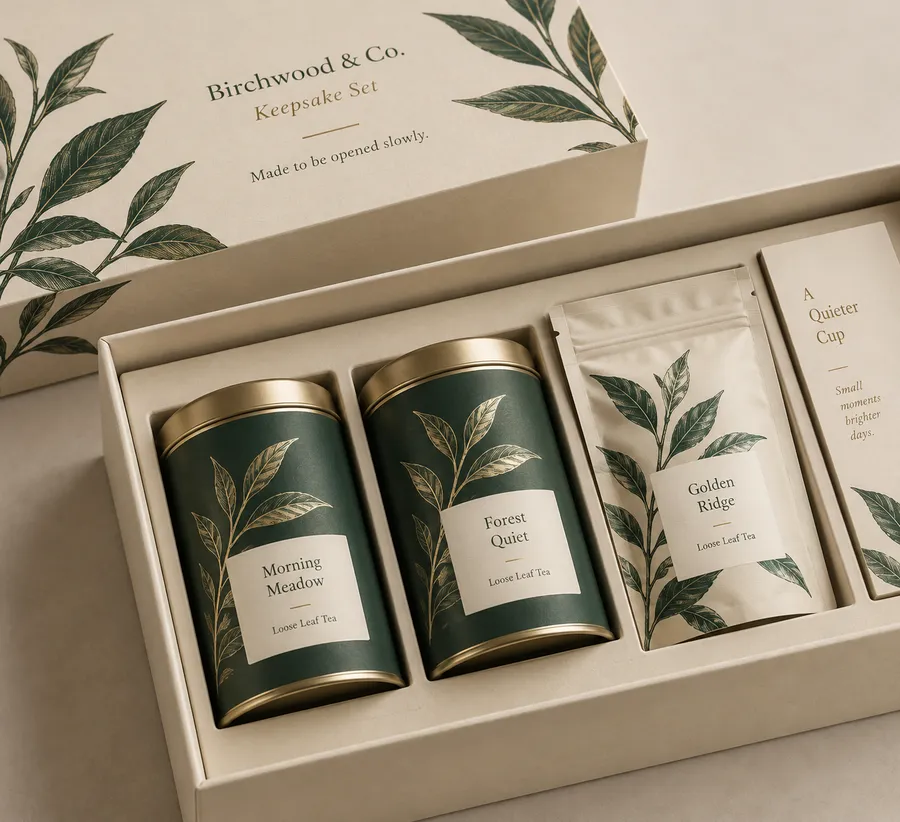
A tea gift set should be arranged from the packed tins, pouches, cards, and accessories that the recipient will actually receive. Define the first reveal, upright or flat orientation, label visibility, and any separated positions before the outer box and lid relationship are finalized.
Arrange several blend formats as one guided presentation when the recipient should compare labels, notes, or brewing directions as the box opens.
Use the lid, tray, and inside panel to organize a branded thank-you message around a coordinated tea assortment.
Plan occasion artwork and the first-facing blend together when a limited collection needs to read clearly before the individual containers are lifted.
Describe the handoff setting and any tasting card or accessory when the tea set is prepared for a welcome moment, celebration, or hosted occasion.
Custom printed tea gift boxes can place the collection name, blend labels, brewing notes, pattern, and occasion message on the lid, side panels, or interior surfaces. Keep the primary identity on the face seen first, then use the inside lid or tray edge where it supports the planned reveal. Artwork and finish choices remain subject to proof review.
A tray or divided layout is useful when the tea formats and opening sequence call for defined positions, while a shared cavity may suit a simpler assortment. The choice is reviewed against geometry, weight, orientation, fragility, structure, handling, clearance, and presentation together.
Share whether the set uses tins, stand-up pouches, flat packets, or a mix so the interior can be discussed around the real contact points and loading direction.
Identify the collection or blend that should face upward, and note whether a tasting card or brewing note sits above, beside, or inside the lid.
Mention hand packing, a larger shipper, event presentation, or retail handling when those conditions can change the support and surface priorities.
The order begins with the packed tea assortment and intended reveal, then moves through structure, interior support, artwork, proof, and production approval.
Provide each tea format, packed dimensions, component count, orientation, label visibility, and any tasting card, scoop, sleeve, or accessory inside.
Describe the preferred rigid or folding structure, first-facing blend, lid movement, and whether the set opens to separated positions or a shared interior.
Identify the SBS or kraft direction if known, then list exterior and interior print, artwork status, and finish choices for review.
Confirm the box proportions, support concept, lid direction, tea-container positions, print panels, and closure against the supplied assortment.
Check the assembled opening, blend labels, artwork placement, and finish callouts before production begins from 7 business days.
Need help with structure, materials, or production planning? See how we manufacture custom packaging.
Request a sample kit to inspect paperboard feel, printed surfaces, opening sequence, and possible tray directions before ordering. The kit has a $44.99 sample-kit shipping charge credited toward your first order.
Shipping charge: $44.99. Credited toward your first order.
Request a Sample KitFind clear answers about fit, materials, and ordering below.
A rigid two-piece box with a lift-off lid can suit a tea assortment where the opening moment and defined presentation matter. A folding paperboard format may suit a different storage, assembly, or fulfillment requirement. The choice should follow the tea formats, product weight, interior layout, handling route, and intended reveal.
Share the packed length, width, and height of the tins, pouches, cards, and accessories, together with closures, seals, sleeves, component count, orientation, and the intended reveal. Final clearance is confirmed during specification and dieline review rather than taken from a generic stock-box size.
That depends on the tea-container geometry, weight, orientation, fragility, outer structure, handling route, clearance, and presentation together. Support may be integrated into the paperboard structure, supplied as a fitted tray, or left as a shared cavity after the packed assortment and opening sequence have been reviewed.
Foil Stamping, Embossing/Debossing, Spot UV, Matte Lamination, and Gloss Lamination are category-listed directions to review with the selected paperboard and artwork. The proof review is the place to check the visible panel treatment, blend labels, and how selected details read on the chosen surface.
The standard minimum order is 50 units. Production starts from 7 business days after digital proof approval, and free US shipping is available on the standard fulfillment path. A product-specific unit price is established through the quote because no defensible comparable price is available in the supplied sources.
Orders start at 50 units and scale up to 500,000 for bulk runs, with pricing from $0.28 per unit on larger quantities. Standard production is from 7 business days after digital proof approval.
Yes. Free US shipping is included on the standard fulfillment path. Delivery timing and carrier details are confirmed when your quote is prepared.
Compare nearby products and request the format that best fits your next run.
Available product
Available product
Available product
Available product
Ready to scope the tea assortment?
Tell us which tea formats belong in the set, how each component is packed, and how the box should open. Easy Box Packaging can use that brief to discuss the structure, tray, material, print coverage, finish, and proof path for your custom tea gift sets.
Add your product details to see a quote summary.