
Jump to section10 sections
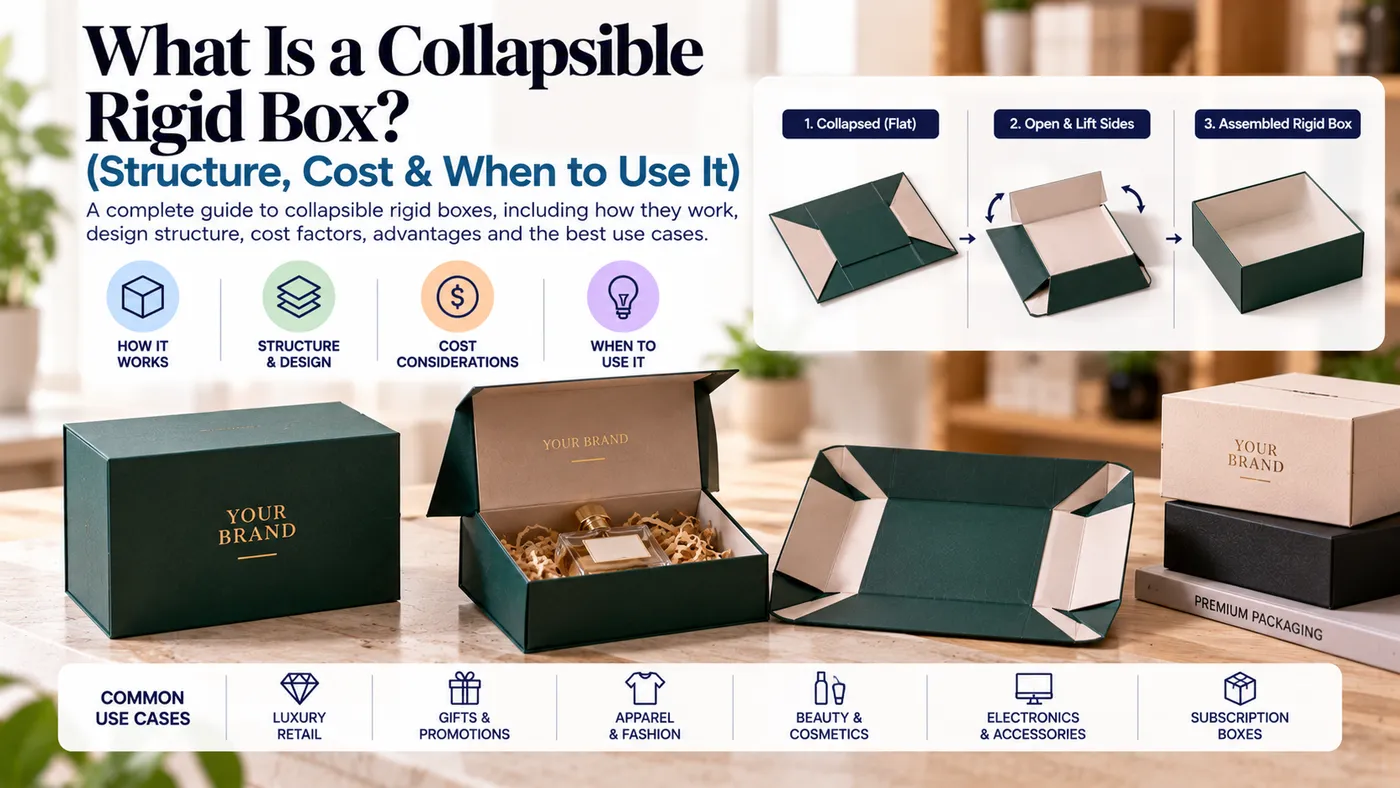
A collapsible rigid box is a rigid box made from wrapped greyboard (chipboard) that folds flat for storage and shipping. You set it up by hand into a shape-holding presentation box. The flat fold comes from scored joints, where a standard rigid box has glued, permanently formed walls. Closures vary, from magnets to adhesive strips. The trade-off is lower storage and freight volume against a short assembly step for every box.
Quick answer
- A collapsible rigid box has rigid walls and a lid joined by scored, wrapped joints, so it folds flat.
- It saves storage and inbound freight space. It does not shrink the parcel your customer receives.
- You give up some corner neatness and some freedom with deep fitted inserts.
- Unit cost, minimums and lead times vary by spec. Request a quote instead of trusting rules of thumb.
How a standard rigid box is built
A standard rigid box, often called a setup box, is built in the factory and arrives fully formed. Thick chipboard panels are cut, wrapped in printed paper, and glued at the corners into a permanent shape. It can't flatten. That is why a pallet of standard rigid boxes is mostly air.
This construction gives the strongest, cleanest corners. It's the format behind most luxury rigid box packaging. Want a lift-off or hinged lid with no assembly? Hinged lid rigid boxes are the closer match.
How a collapsible rigid box differs
A collapsible rigid box keeps the thick board and the wrapped finish. The change is in the joints. Wall panels connect along scored lines, held together by the wrap paper, so the box can flatten. The lid usually hinges at a spine edge. One US manufacturer lists greyboard from about 1.5 to 2.5 mm for its collapsible boxes, depending on size and weight.
Here's the common hinged-lid version, described as a sketch:
- Flat state: one base panel with four wall panels folded out from its edges. A lid panel attaches along the back spine.
- Lift the four walls until they stand square to the base.
- Engage the corners. Depending on the structure, that means lock tabs, a pre-applied adhesive strip, or a magnet.
- Drop in the insert, then the product.
- Swing the lid over on its spine. A magnet, snap or ribbon holds it shut.
Other versions use a lift-off lid or a shoulder, so confirm the opening route before artwork is final.
Trade names vary. "Foldable rigid box" and "fold-flat rigid box" mean the same thing. "Collapsible gift box" is the gifting version. For the wider vocabulary, see our packaging glossary.
Collapsing and magnetic closure are separate choices. A collapsible rigid box can have a magnet, a ribbon, or neither. Assembly methods also differ by maker. Some use pre-applied adhesive corners, others use locking sections. Ask which your structure uses.
The flat-pack advantage
Flat storage is the main reason to choose this format. Empty standard rigid boxes occupy full volume in a warehouse. Flat ones stack. For brands storing packaging at several sites, the saving is real.
Freight works the same way. Carriers bill the greater of actual weight or dimensional weight. FedEx describes dimensional weight as the space a package takes up relative to its weight. As of October 2026, it divides cubic inches by 139. A flat pack has far less cube on the way in.
Here's the part many guides skip. The saving applies to the inbound pallet and the shelf, not the outbound parcel. Once you assemble the box and place it in an outer shipper, that shipper sets the parcel's size. I tell brands to count the saving only where flat boxes actually travel. A collapsible rigid box that ships to customers already assembled saves you nothing on outbound freight.
Typical uses
A collapsible rigid box fits products where presentation matters and storage space is tight:
- High-end gifts. Compact gift sets and seasonal runs, stored flat until packing.
- Subscription boxes. A rigid reveal each month without a warehouse full of empty boxes.
- Influencer and PR mailers. Launch kits sent in small batches, assembled at pack-out.
- Cosmetics, stationery and accessories. Small products that sit in a printed insert.
- Multi-location retail. Boxes shipped flat to stores, then set up at the counter.
Easy Box Packaging's collapsible rigid boxes page lists compact gift sets, launch kits and direct-to-customer unboxing as uses. It also lists an order starting point of 50 units. Production runs from 7 business days after digital proof approval. Pricing stays quote-only.
What you give up
Every structure has costs. Be honest about these before you commit.
- Corner neatness. A pasted corner on a standard rigid box shows no seam. A folded joint can show a slight seam or gap. I've seen brands approve a flat proof, then notice the seam only on the assembled sample.
- Insert freedom. The insert has to drop in at pack-out or fold flat too. Deep, fitted foam is harder to pair with a flat fold.
- Assembly time. Someone sets up every box. Seconds per box becomes hours at volume.
- Heavy products. One manufacturer notes that heavy items suit a two-piece base better than a hinge. Test the joints with the real weight.
Collapsible rigid box vs standard rigid vs folding carton
Collapsible rigid box | Standard rigid box | Folding carton | |
|---|---|---|---|
Structure and feel | Thick wrapped board, scored joints | Thick wrapped board, glued corners | Thin paperboard, scored |
Ships and stores flat | Yes | No | Yes |
Relative unit cost | Medium to high | Medium to high | Lowest of the three |
Minimum order | Moderate (EBP lists 50 units) | Moderate, varies by maker | Typically lowest |
Corner finish | Folded joint, may show a seam | Pasted corner, no seam | Glued seam |
Unboxing | Rigid, premium | Rigid, premium | Lighter, functional |
Assembly | Required before packing | None | Required, quick |
Relative cost depends on size, finish and quantity. Collapsing adds engineering to each unit. Freight and storage savings can offset it. Ask for both versions in your quote and compare the total, not just the unit price. Our rigid boxes vs folding cartons guide covers the carton side. The sleeve box packaging guide covers another rigid-style format.
Which should you choose?
Choose a collapsible rigid box when you store packaging for weeks. It also suits boxes shipped to several locations, and subscription or PR sends. Choose a standard rigid box when you pack heavy products or want the cleanest corners. It also wins when storage isn't a problem. Choose a folding carton when price and pack speed matter more than weight in the hand.
My opinion: a collapsible rigid box earns its place on logistics, not looks. If flat storage doesn't save you real money, buy the standard one. Feel a sample first. Ask for an assembled sample, not just a flat mock-up.
What to send your packaging manufacturer
- Product dimensions, weight and component count
- Packed product orientation, and whether it needs a loose or fitted insert
- Target folded footprint and stack height
- Quantity, and where the boxes will be stored and assembled
- Closure preference: magnet, ribbon, snap or none
- Artwork status, print coverage and finish
- Destination and required date
Key takeaway
A collapsible rigid box gives you rigid-box feel with flat storage and freight. You pay for it in assembly time and slightly less polished corners.
Specs, minimums and structures vary by manufacturer. Results vary by product and handling, so test a sample before production.