
Jump to section10 sections
- Quick answer
- Custom box size guide, step one: measure the product as it ships
- Internal vs external box dimensions
- How much clearance to add
- Insert allowance
- Custom box dimensions: worked examples
- Shipping vs retail packaging dimensions
- Common measurement mistakes
- What to send your packaging manufacturer
- Key takeaway
A custom box size guide comes down to one habit. Measure the product exactly as it ships. Add clearance and any insert thickness. Then send the manufacturer interior dimensions in length × width × depth order. Interior size is what your product needs. Exterior size is what carriers and shelves see. Rigid items usually need about 1/8 to 1/4 inch of clearance per dimension.
Quick answer
- Send interior dimensions as L × W × D. Length is the longer side of the opening.
- Measure the product as packed, with cap, pump, wrap and tissue. Round up.
- Add clearance first, then add insert thickness on top of it.
- Exterior size equals interior size plus board thickness on both sides of each dimension.
- Check exterior size before you approve the quote, because carriers price on the outside.
Custom box size guide, step one: measure the product as it ships
Use a rigid ruler, not a soft tape. Tapes sag and add error. Stand the product on its most stable side. Measure the longest point in each direction, then round up to the next quarter inch. A box that's a sixteenth too tight won't close, no matter how hard you press the lid.
Measure the packed unit, not the bare item. That means the bottle cap, the serum pump and the candle's shrink wrap. I'd measure three units from different batches and use the largest. Caps and labels drift between production lots, and that's how a perfect box turns tight on a reorder.
Irregular products follow the carrier rule. UPS tells shippers to measure irregularly shaped packages as if they sat in a rectangular box. Use the extreme points. A tapered bottle gets its widest point. A kit gets its assembled footprint, trays and dividers included. Soft goods get measured folded, resting in their natural shape.
Internal vs external box dimensions
Every serious custom box size guide starts with interior size, because manufacturers quote interior size by convention. The FEFCO international case code expresses dimensions as internal dimensions, length × breadth × height. It defines length as the longer dimension at the opening. So tell the manufacturer which side opens. Don't assume the longest edge of your product is the length.
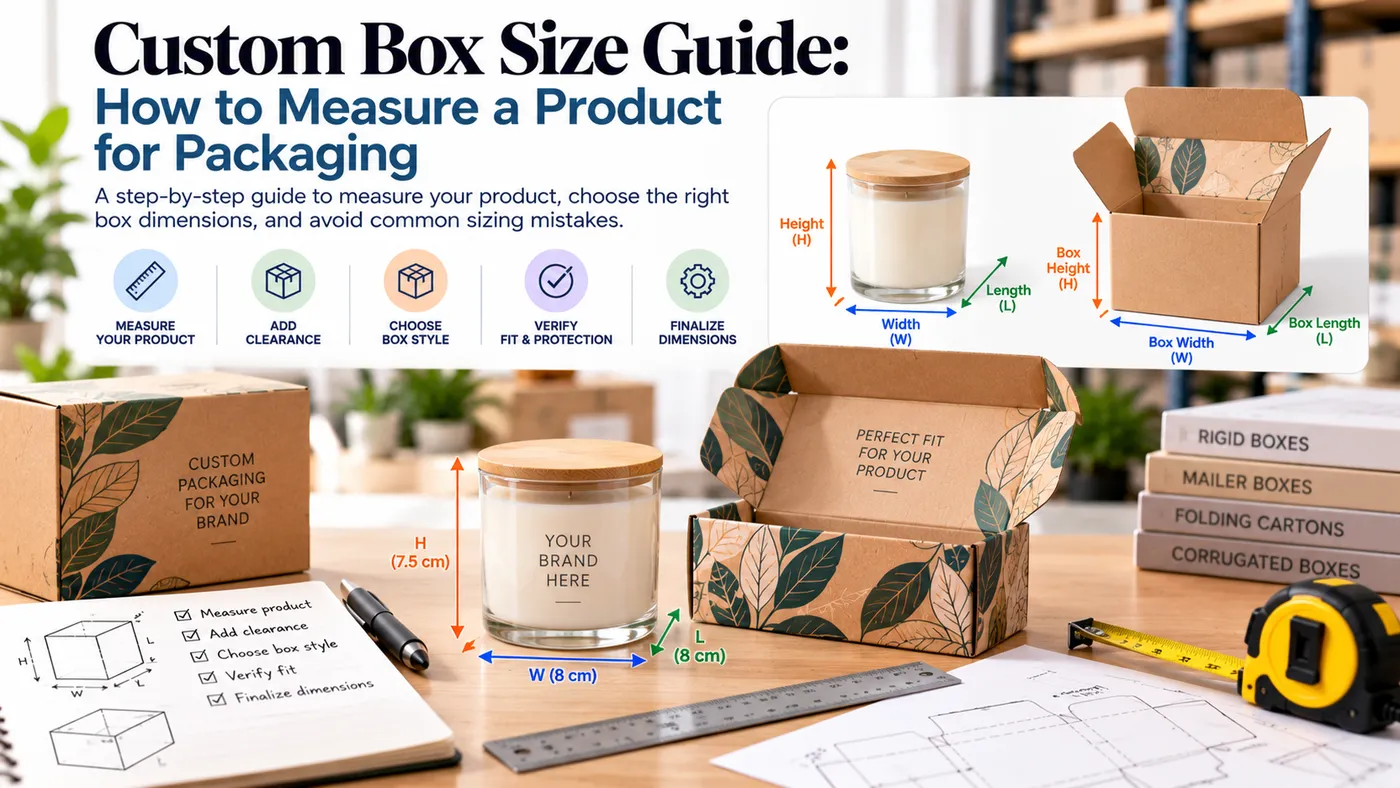
Here's a quick sketch to picture it. Set the open box in front of you with the opening facing up. The longer opening edge is length. The shorter one is width. Depth runs from the floor to the rim.
Exterior size is interior size plus the board thickness twice per dimension, once for each wall. Paperboard is measured in points, and one point is 0.001 inch, as our GSM vs PT guide explains. Corrugated adds more, and double-wall adds more than single-wall. Our how to measure a box guide gives the corrugated rules of thumb and the lid-seating check.
Two-piece boxes need two depths. The FEFCO code lists lid height separately for telescope-style boxes. Send the base depth and the lid depth, never one number. The same code also measures from the centre of each crease with material thickness in mind. So ask which reference your quote uses.
How much clearance to add
Product type | Typical clearance | Why |
|---|---|---|
Rigid goods (jars, bottles, electronics) | 1/8 to 1/4 in per dimension | Slides in without binding |
Soft goods (folded apparel) | About 1/2 in on length and width | Folds spring back |
Anything wrapped in tissue or a card | Up to 1/2 in extra depth | Wrap has real thickness |
Shipping carton with cushioning | 1 to 2 in of void | Room for dunnage |
Use this table as the clearance step of your custom box size guide. These are typical figures from our own size guides, not a standard. Your manufacturer's tolerance has the final say, so ask for it in writing.
Insert allowance
Skip the flat insert allowance. Use the insert's real thickness on each side it occupies. A cardboard cradle, a pulp tray and a foam block all differ. Our box insert types guide compares them.
Watch for double counting. If the cavity grips the product, the cavity gets the fit allowance. The box interior then equals the insert's outside size plus a small gap. Don't add full clearance on top of a snug cavity.
A physical sample settles this fast. Packaging samples catch tolerance and lid-seating problems before a full run.
Custom box dimensions: worked examples
This custom box size guide uses hypothetical numbers to show the arithmetic. They're examples only. Don't copy them for your own product. Round every result up to the next quarter inch before you send it.
Example | Measured as packed (L × W × D, in) | Allowance added | Interior to request (in) |
|---|---|---|---|
Candle jar with lid | 3.0 × 3.0 × 3.5 | 1/4 clearance each way | 3.25 × 3.25 × 3.75 |
Cosmetic bottle with pump | 1.6 × 1.6 × 5.0 | 1/4 clearance, plus a 1/8 cradle each side on L and W | 2.1 × 2.1 × 5.25 |
Folded apparel | 11 × 9 × 1.5 | 1/2 on L and W, 1/2 tissue on depth | 11.5 × 9.5 × 2.0 |
Subscription set (three jars, two dividers) | 7.7 × 2.5 × 3.0 | 1/4 clearance, rounded up | 8.0 × 2.75 × 3.25 |
Take the apparel mailer. Our published single-wall rule is about 1/8 inch per side. The exterior then comes to roughly 11.75 × 9.75 × 2.25 inches. That's the size a carrier sees.
The candle needs one more line on the quote. A rigid box needs its lid depth specified, so request the base and the lid as a pair. For the subscription set, the dividers are counted in the measured length, so they're never added twice.
Shipping vs retail packaging dimensions
Any custom box size guide has to separate retail from shipping. A retail box is sized to the product and the shelf. A shipping box is sized to protect the product and to meet carrier rules. UPS rounds each dimension up and bills the greater of actual and dimensional weight. So an extra inch of air can raise the price of every order. Our shipping box sizes guide covers dimensional weight, and the wider box size guide lists standard footprints.
For presentation, rigid boxes can be sized tight to the product. Let a corrugated shipper carry the protection. I prefer that split over one oversized box doing both jobs.
Fit and cushioning get proven in transit testing. ISTA is a nonprofit working to reduce product damage in distribution through better package design.
Common measurement mistakes
- Sending exterior numbers when the quote assumes interior.
- Measuring the bare product and forgetting the cap, pump or wrap.
- Giving one depth for a two-piece box.
- Stacking clearance, insert and tissue allowances without checking the total.
- Rounding down instead of up.
- Skipping a physical sample on a new shape.
What to send your packaging manufacturer
- Product dimensions as packed, L × W × D in inches, with the opening side marked.
- Product weight, and unit count per box.
- Whether your numbers are interior or exterior.
- Packaging format: rigid, folding carton, mailer or shipper.
- Insert requirements, plus any tissue or wrap.
- Material preference, printing needs and finishing needs.
- Artwork status, quantity, destination and required date.
- A photo of the product beside a ruler.
Send the list above with your measurements, and your custom box size guide numbers are ready to quote. Our manufacturing page shows what we make. The packaging glossary defines the terms on this page.
Key takeaway
A custom box size guide is only as good as the measurement behind it. Use the packed product. Quote interior dimensions, add allowances in order, and check the exterior size before you approve. A box sized this way fits on the first run.
Tolerances vary by manufacturer and material, so confirm them on your quote.