
Jump to section11 sections
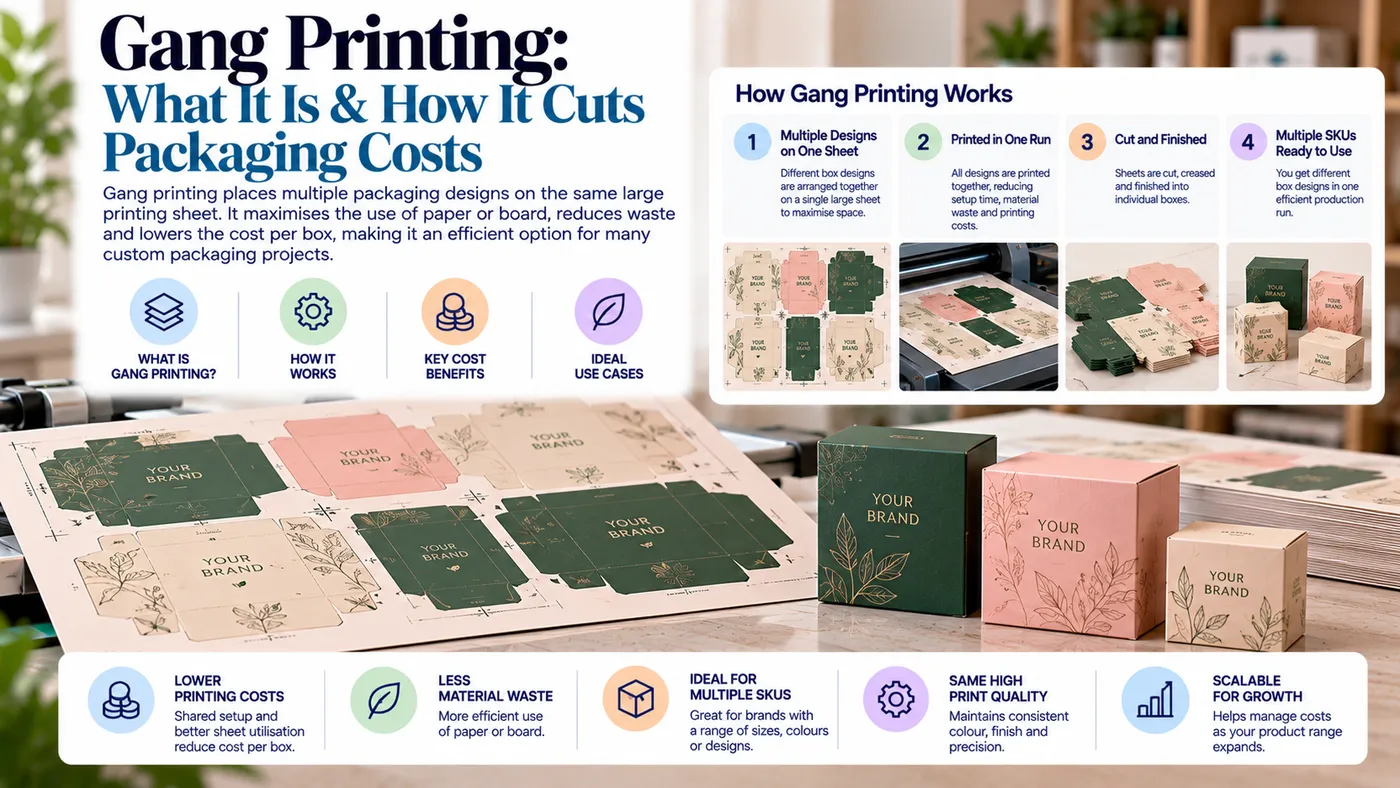
Gang printing, also called gang run printing, puts several different jobs on one large press sheet. Every job on that sheet shares the plates, press setup, and paper cost. The sheet is then cut apart. That sharing is how short-run packaging can get closer to long-run unit pricing. The price you pay is less control over color, stock, and timing.
Quick answer
- Gang printing prints multiple jobs together on one sheet. They're cut apart afterward.
- It saves money because setup cost is split across every job on the sheet.
- It works best for standard stocks, standard sizes, and CMYK artwork.
- You give up mid-run color adjustment, custom stock, and a flexible schedule.
- Ask your printer whether your job is a gang run before you approve a quote.
How gang printing works
A press doesn't print one box at a time. It prints a large sheet, and that sheet holds many copies of a flat layout. Normally those copies are all one design.
In a gang run, the sheet holds different designs side by side. Your carton artwork sits next to someone else's. Prepress arranges the pieces to use as much of the sheet as possible. That arrangement step is called imposition.
The sheet then prints once, using the same four process plates for every job on it. Afterward it goes to cutting or die cutting, and each job is separated. Our guide to print proofs covers what you check before that point.
Wikipedia's gang run printing entry describes the same pattern. Gang runs are generally used with sheet-fed presses and CMYK process color jobs. Digital printing has almost no setup to share. So gang printing matters mainly on sheet-fed offset.
The cost logic, without invented prices
Every printed job carries a fixed cost and a variable cost. Fixed cost is plates, press makeready, and prepress time. Variable cost is paper and ink per sheet.
Here's the math. Your cost per unit is roughly setup cost divided by units, plus the per-unit material cost. Spread setup over 500 boxes and each box carries a lot of it. Spread it over 5,000 and each box carries a tenth as much.
Gang printing attacks the first number. Instead of your job paying the whole setup, it pays a share. If five jobs fill a sheet, each can carry roughly a fifth of the setup. That's a simplified picture, and a printer's actual pricing logic will differ.
I won't put dollar figures on this. Pricing depends on stock, size, and the printer. Our post on short-run vs long-run packaging explains the crossover point. Packaging price breaks shows how quantity tiers work.
Who benefits from gang printing
Gang printing suits brands that need small quantities of printed paperboard without paying for dedicated offset setup. Typical examples:
- A startup launching a first candle or skincare line.
- A seasonal gift set printed in a few hundred units.
- A bakery or coffee roaster testing two or three flavor variants.
- A brand that needs several SKUs, each in small quantity.
It helps less when color is critical. It also falls short for unusual stocks and firm ship dates.
What you give up
Gang printing is cheaper because it's less custom. Know these trade-offs before you choose gang printing.
No mid-run color adjustment. An operator can't tweak ink for your job alone. Heavy solids from a neighbor can pull ink balance and cause ghosting. Wikipedia lists lack of color control as a core drawback.
Color is matched to the gang. The press is balanced for the whole sheet. Your brand blue may land a bit off. One printer's help page warns that gang-run reprints can vary 10% to 15% in color. That's one vendor's tolerance, not an industry rule.
One stock for everything. Every job on the sheet shares the same paper. You can't mix a kraft board with a coated white one.
Spot colors and special effects are harder. Wikipedia notes custom spot colors, varnishes, and coatings are harder to get. See our CMYK vs RGB vs Pantone guide before you rely on a brand color.
Timing follows the batch. Your job waits until enough other jobs fill the sheet. Custom quantities are also harder to fit.
Reprints can differ. The next gang won't have the same neighbors, so color balance shifts.
Gang run vs dedicated run
Factor | Gang run | Dedicated run |
|---|---|---|
Setup cost | Shared across jobs | Carried by your job alone |
Best quantity | Small to mid | Mid to large |
Color control | Balanced for the whole sheet | Tuned to your job |
Stock choice | One stock for all jobs | Your pick |
Spot color and special coatings | Limited | Available |
Schedule | Tied to batching | Tied to your job |
Proof type | Usually digital or hard-copy | Press proof possible |
I've seen brands pick a gang run for a cosmetic carton. Then a brand-critical teal came back slightly warm. For that job, a dedicated run is worth paying for.
Where gang printing fits next to offset and digital
Offset is plate-based, so setup cost is real. That's why gang printing exists. Digital skips plates, so a short run is already cheap to set up. Our offset vs digital printing guide covers that split in detail.
Small brands usually weigh three options. They are a digital short run, a gang run if offered, or a dedicated offset run. Our packaging printing methods overview lays out the full list.
Which should you choose?
Choose a gang run if you're price-sensitive and your quantity is modest. Your art should be standard CMYK on a common stock. Choose a dedicated run if exact color, custom stock, or a fixed launch date matters more than savings.
In my opinion, gang printing is a fair trade for secondary SKUs and test runs. It's a poor trade for your hero product's box.
Regulated products need extra care. The FDA's 21 CFR 211.122 restricts gang-printed drug labeling unless it's differentiated.
Questions to ask your printer
- Is my job a gang run, or does it print alone?
- Is the stock the same one I specified?
- What's the expected turnaround, and does it depend on batching?
- Can I see a hard-copy proof, and does it cost extra?
- How will reprints be color-matched?
Easy Box Packaging offers digital and offset printing. We can walk you through which fits your quantity. Our low MOQ packaging page shows how small orders work. Ask for samples with packaging samples explained as a guide.
For a broader term list, see the packaging glossary.
What to send your printer
- Box style, dimensions, and quantity per design.
- Whether you have one design or several SKUs.
- Artwork status and whether it's CMYK or uses Pantone colors.
- Stock preference and any finish, like lamination or foil.
- Your required date.
- How color-critical the job is.
Key takeaway
Gang printing trades control for cost by sharing one press sheet and one setup across jobs. Use gang printing when the box is standard and the budget is tight. Skip it when color or timing can't flex.
Gang printing economics vary by printer, stock, and quantity, so confirm details in your quote.