
Jump to section10 sections
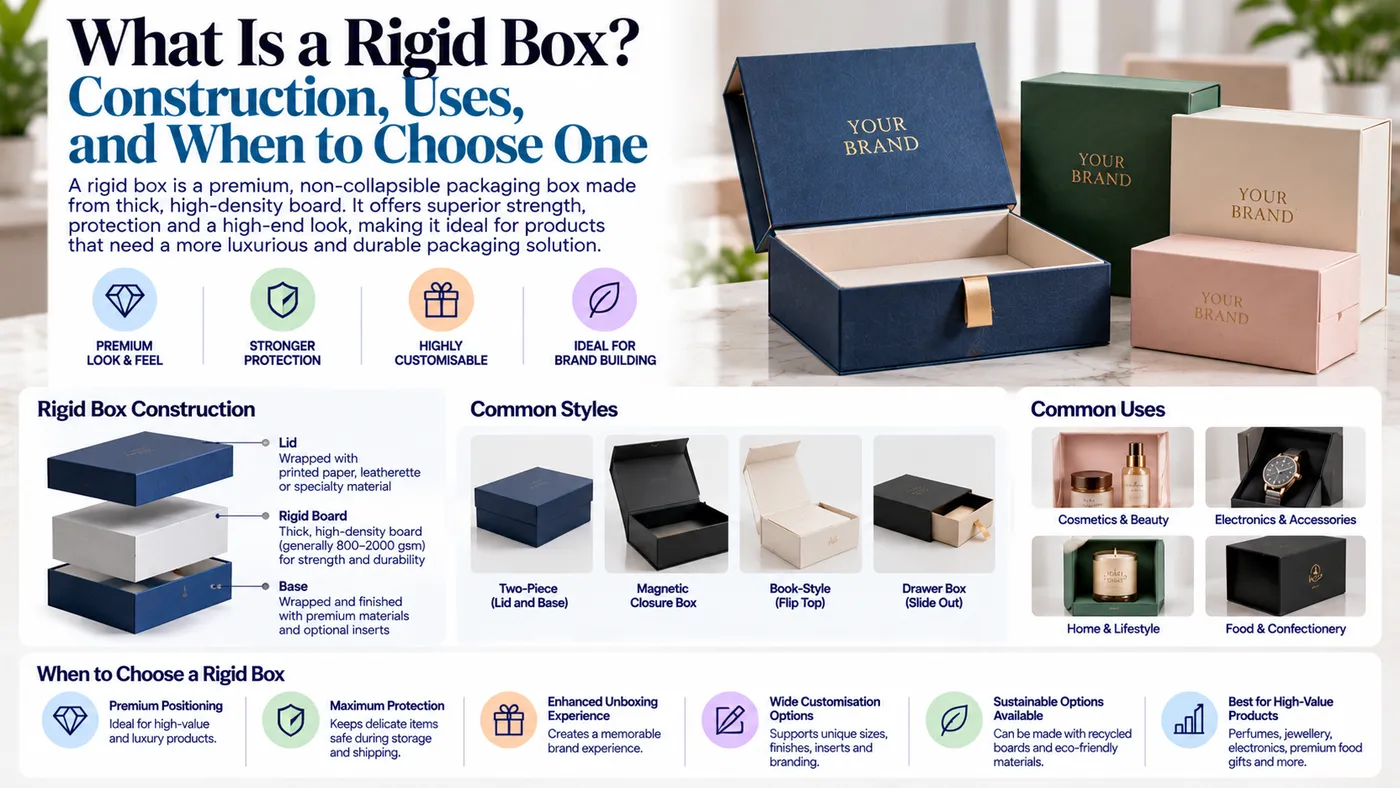
What is a rigid box? A rigid box, also called a set-up box, is pre-assembled secondary packaging. It has a thick greyboard core, commonly 1.5–3 mm, covered with printed paper. Unlike a folding carton, it arrives fully formed, with a separate lid and base. Nobody assembles it at the fill line. It feels solid in the hand and usually closes by friction.
Quick answer
- A rigid box is a greyboard shell wrapped in printed paper. It's built in the factory and ships fully formed.
- Common greyboard thickness is 1.5–3 mm. Folding carton paperboard starts around 0.3 mm.
- The lid and base are separate pieces. A friction fit is standard, and magnets or ribbons are upgrades.
- Choose a rigid box for premium products, kept boxes, or brands where unboxing matters.
- Choose a folding carton for high volume, tight unit costs, or purely functional boxes.
What is a rigid box?
A rigid box is secondary packaging. It holds the product's own container, tube, bottle or pouch, and presents it. The trade name is "set-up box," because it's set up at the factory instead of by your packers. Our packaging glossary defines the related terms.
The structure comes from the board, not from folds. Thick greyboard panels are cut, glued at the corners and wrapped in paper. That's why a rigid box can't be knocked flat and holds its shape under a hand. For the material itself, see our guide to chipboard.
Here's how the lid and base work, as a text sketch:
- The base is an open tray with four walls, wrapped inside and out.
- The lid is a second, shallow tray, slightly larger, turned upside down.
- The lid slides over the base walls and rests on the shoulders or sits flush.
- A snug fit holds it shut. Friction does the work, so the lid lifts straight off.
Hinged versions attach the lid along the back edge. Both styles still count as rigid, because the board carries the load.
Rigid box construction: the layers
So what is a rigid box made of? Every rigid box is a stack of parts. Each one is a decision you'll make in a quote.
- Greyboard core. A dense board pressed from recycled fibre. Thickness usually runs 1.5–3 mm. Small cosmetic boxes sit at the thin end, and heavy products need more.
- Printed paper wrap. Artwork is printed on paper, often laminated, then glued around the board. Easy Box Packaging prints digitally and offset. Foil, embossing and soft finishes go on the wrap before it's applied.
- Separate lid and base. Two parts, sized to each other. Hinged, shoulder and lift-off styles all start here.
- Closure. Friction fit is the default. Magnets and ribbon pulls are optional upgrades.
- Interior insert. Thermoformed trays, foam or card hold the product in place. Insert choice changes the feel more than most buyers expect.
Easy Box Packaging lists its rigid boxes in two-piece, shoulder, hinged-lid and collapsible styles.
Rigid box vs folding carton
This table shows what is a rigid box in practice, next to a carton. Our rigid boxes vs folding cartons guide covers the cost decision in depth.
Rigid box | Folding carton | |
|---|---|---|
Core material | Greyboard, 1.5–3 mm | Paperboard, from about 0.3 mm (12 pt) |
Assembly | None, arrives set up | Folded and closed at the fill line |
Structure | Glued corners, thick board | Scored folds, tuck or glue closures |
Storage and freight | Ships full-size | Ships and stores flat |
Feel | Solid, weighty | Light, flexible |
Cost per unit | Higher | Lower |
Presentation | Kept, gifted, unboxed | Shelf-ready, functional |
Typical minimum | Easy Box Packaging lists rigid boxes from 50 units | Varies by maker |
Insert | Fitted tray, foam or card | Card insert or divider |
As EcoEnclose explains, a point is one thousandth of an inch, so 12 pt is 0.3 mm. Paperboard generally means 12 pt or thicker. Cost gaps depend on size, finish and quantity. Request a quote instead of trusting rules of thumb.
What rigid boxes are used for
What is a rigid box used for? It suits products where the box is part of the sale. Common uses include:
- Supplement starter kits. A bottle, sachets and a guide in one tray. See custom supplement box kits.
- Physician samples and healthcare kits. Multi-component sets that need to arrive organized. See healthcare rigid kit boxes.
- Premium wellness lines. Gift-ready sets where shelf presence and keepsake value matter.
- Candle gift sets. A jar, a snuffer and a card in a shoulder box.
- Luxury cosmetics and skincare. Sets where a heavier hand feel signals the price.
I've seen supplement brands start with a rigid box for a launch kit. They then moved their everyday retail line to a folding carton. That split is common, and it works.
When to choose a rigid box
Once you know what is a rigid box, the choice is simple. Choose one when at least one of these is true:
- The price is premium. A heavy, wrapped box supports a premium price.
- The customer keeps the box. Gift and keepsake packaging earns a second life.
- The kit has several parts. A fitted tray keeps components organized.
- Unboxing is part of the brand. The reveal is the marketing.
Choose a folding carton for high volume, tight unit costs, or boxes thrown away in seconds. My opinion: a rigid box is a presentation tool, so don't use one where nobody will notice it. If you're unsure, compare both in your quote.
Rigid box lid styles
Lid style changes how the box opens and how much board shows. Anyone asking what is a rigid box should also ask which lid it has. These are common styles, and names vary by maker.
- Full-overlap lid. The lid covers the base walls completely. It's the classic look, and the seam sits at the base.
- Partial-overlap lid. The lid covers part of the base wall and leaves a visible band of base.
- Two-piece flat gift style. A shallow lid and base, often for flat products such as apparel or stationery.
- Drawer or slide tray and sleeve. The tray slides out of a sleeve. See our guide to sleeve box packaging.
- Hinged lid. The lid attaches along the back edge and swings open.
Ask for the opening route to be shown on the proof.
Are rigid boxes recyclable?
It depends on the build. Greyboard is a recycled-fibre core and can go into paper recycling. The extras are the problem. PPWR Connect's June 2026 guide on set-up boxes flags film lamination, magnets, foam, polyester ribbon and heavy foil as contaminants. It adds that wrapped boxes can be built as paper-only. Sources disagree on magnets, and local rules vary. Ask your manufacturer about aqueous coatings, paper pulls and removable parts.
What to send your packaging manufacturer
- Product dimensions, weight and component count
- Quantity and destination
- Preferred structure: lift-off lid, shoulder, hinged or drawer
- Closure preference: friction, magnet or ribbon
- Artwork status, print coverage and finish
- Insert needs: tray, foam, card or none
- Whether you want a physical sample first (see packaging samples)
- Required date
Key takeaway
What is a rigid box? It's a thick greyboard shell wrapped in printed paper that arrives set up. Choose it when the box is part of the product experience. Use a folding carton when cost and volume decide.
Specs, minimums and recyclability vary by maker and market. Test a sample before production.