Bakery counter service
Use a printed paperboard or grease-resistant kraft direction for pastries, cookies, or bread handed directly to a customer.

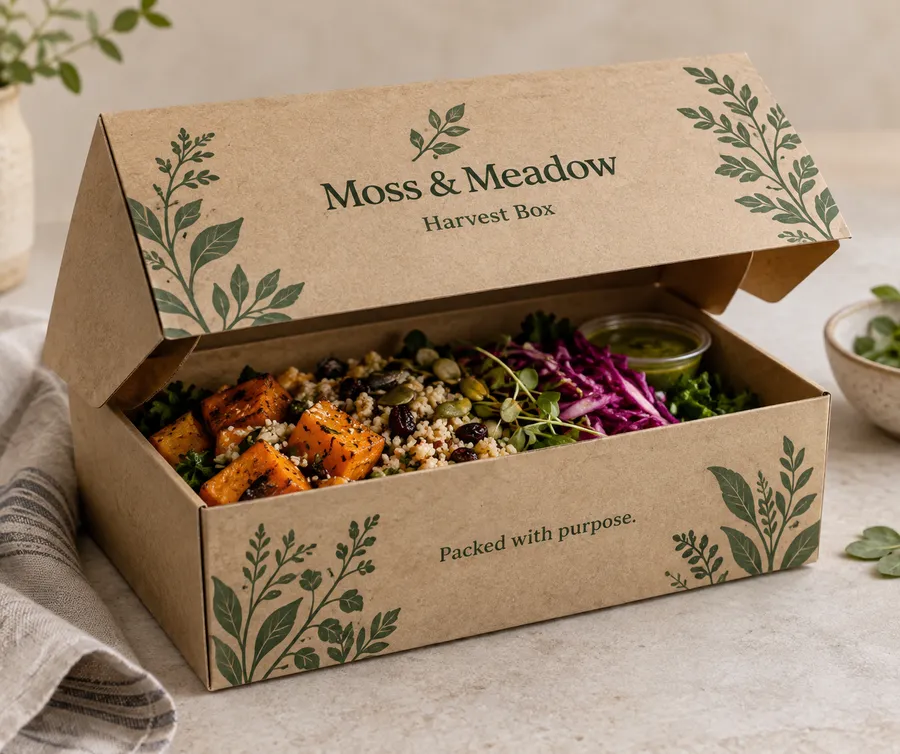
Natural kraft eco-friendly food box with a prepared meal, green printed front, and partly open lid.
Eco-Friendly Boxes
Paper-based food boxes give cafés, bakeries, meal brands, and prepared-food teams a printed paper or board pack chosen around the actual food. Share the packed dimensions, heat and grease conditions, serving route, quantity, artwork, and disposal context so the structure and material direction can be reviewed without treating a broad label as a performance guarantee.
Last updated
Working quote
Product brief
Printed food boxes work best when the food, handoff, and disposal route are specified together. A folding kraft box can suit a bakery item or takeaway portion that needs a printed exterior and a practical opening. A heavier corrugated mailer may make sense for a subscription shipment that travels through several handling points. Neither construction is automatically the right material choice: the packed weight, warmth, moisture, grease, portion count, and local disposal facilities change the brief.
Start with the moment after packing. Is the box handed over at a counter, placed in a delivery bag, displayed on a shelf, or shipped inside a parcel? Note whether the food needs ventilation, whether sauce or oil can reach the paper, and which panel must carry ingredients, reheating notes, or the brand message. This keeps the disposal conversation tied to the package's real job rather than a vague promise.
Measure the packed food in the orientation it will enter the box. Record finished length, width, height, weight, portion count, lids or toppings, and any liner or wrap that remains inside. For a sandwich or pastry, include the tallest topping and the widest corner; for a meal tray, include compartments and the direction the customer should open. If the box will be nested in a delivery bag or shipped, include the outer route and handling context.
Usable interior space is affected by folds, seams, a tuck flap, a window, or an internal support. Do not infer an allowance from a stock size. A different portion count or a taller lid can require a different dieline even when the box style looks similar. The assembled proof should show the food or a representative pack so the opening, printed panels, and any contact area can be reviewed together.
Kraft Paperboard provides a natural board direction for printed takeaway packaging; SBS Paperboard offers a smooth surface when small type or color-led artwork needs a cleaner face; Corrugated Board can be considered for a more structural shipping pack; and Grease-Resistant Kraft Paper may be relevant when the food creates a paper-contact concern. These are category-supported directions, not a claim about certification, municipal collection, or every food-contact condition.
Ask what happens after use. A laminate, foil, barrier, or attached insert can change the disposal conversation, so the final material and finish should be checked against the intended local route. If the food is hot or oily, describe that condition rather than selecting a board from a broad label alone.
A tuck-top folding carton can keep a portion contained for a counter handoff, while a lock-bottom or tray-style construction may help when loading speed and a stable base matter. A corrugated mailer can be considered when the food product is packed with other items and needs a shipping-oriented outer structure. Windowed presentation, ventilation, and access should be weighed against the printed surface and the way the box is stacked.
Internal support depends on the food container's geometry, weight, orientation, fragility, outer structure, and the presentation the customer should see. Support may be integrated into the paperboard or supplied as a separate insert; it is not a one-variable decision. Explain whether the box travels empty to a kitchen, loaded to a customer, or inside a second shipper before a structure is selected.
Put the product name and key food information on the panel that remains readable after loading. Keep ingredients, allergen notes, reheating instructions, and disposal guidance clear of scores, seams, and the opening cut. Matte Lamination can be considered for a low-glare surface, while Spot UV, Embossing/Debossing, or Foil Stamping can mark a selected logo or line of artwork. Each finish can change the surface and disposal discussion, so placement and stock should be reviewed together.
Use a digital proof to check the assembled reading order rather than judging a flat artwork file alone. The pictured print is an example of artwork placement. Production artwork should use the buyer-approved food name, required information, and any substantiated disposal wording.
Send the packed dimensions, portion count, weight, heat and grease conditions, serving or shipping route, preferred construction, material direction, print coverage, finish request, quantity, artwork status, and delivery destination. A photograph or physical sample helps when the food container is tapered, compartmented, or supplied with a lid. Explain whether the box is filled at a kitchen, handed over at a counter, or mailed in an outer carton.
The standard fulfillment path starts at 50 units, and production is from 7 business days after digital proof approval. Free US shipping is available on that path. Pricing remains quote-only because the final footprint, construction, barrier or finish decision, print coverage, and quantity set the specification. A sample kit has a $44.99 USD shipping charge credited toward the first order when comparing paper and finish direction in hand.
A responsible food-pack brief joins the packed item, serving moment, material question, printed information, and disposal context. When those details are supplied together, Easy Box Packaging can review a quote-ready dieline and proof without inventing a certification, a universal barrier claim, or a fixed stock-size promise.
Proof points
The proof should connect the printed box to the packed food so opening, contact areas, information hierarchy, and material direction can be reviewed together.
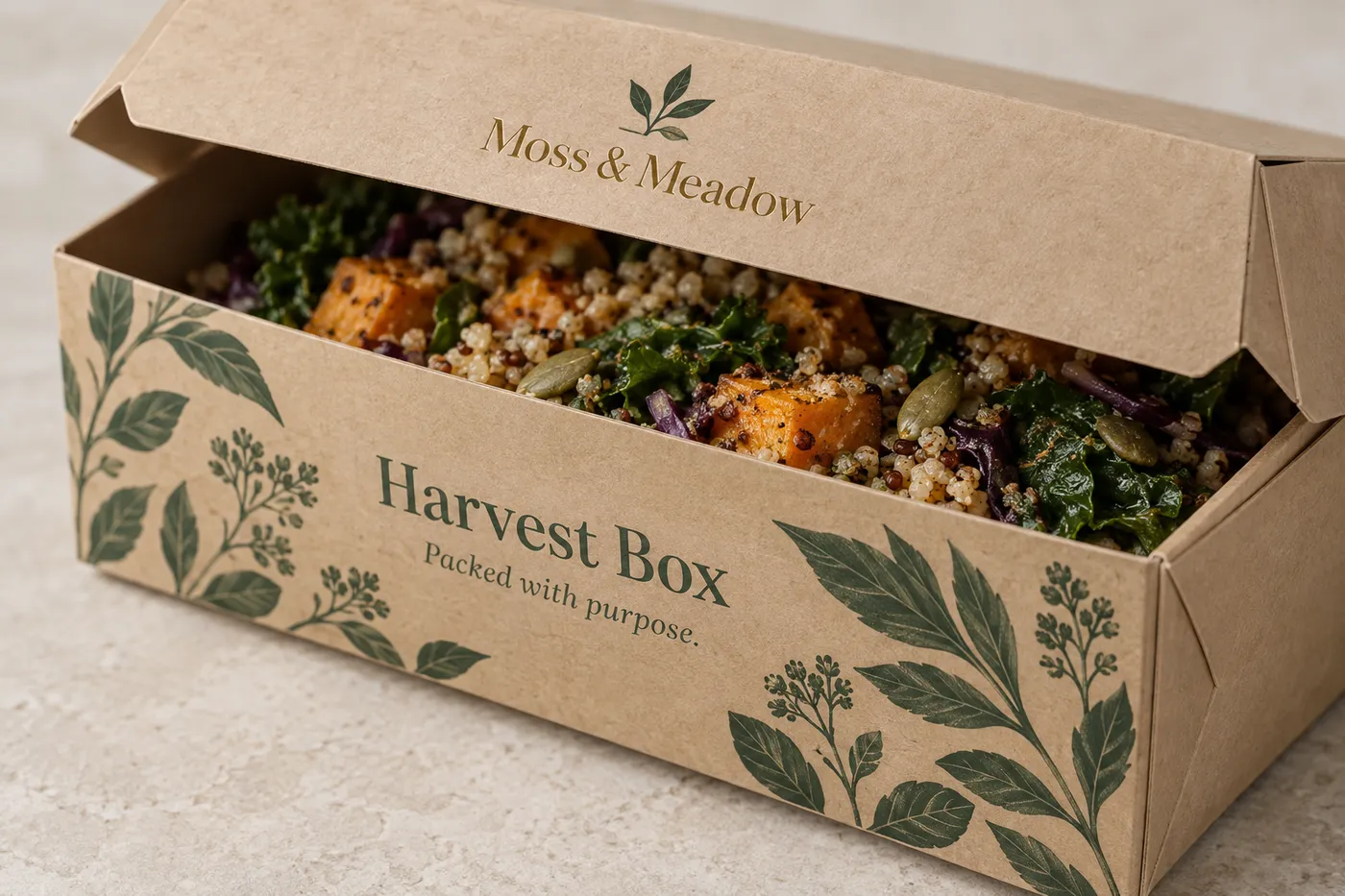
The food's packed footprint, heat, grease, portion count, opening direction, board choice, printed information, and delivery route determine whether a folding carton, kraft box, tray, or corrugated mailer is a sensible direction. Share those variables before treating an environmental claim as settled.
Use a printed paperboard or grease-resistant kraft direction for pastries, cookies, or bread handed directly to a customer.
Plan the opening, portion footprint, heat, sauce, and information panel for a meal leaving a café or kitchen.
Consider a corrugated outer mailer when multiple snack packs travel through a parcel route and arrive for home opening.
Coordinate a visible printed face, food information, and a considered opening when the pack sits on a shelf or enters a gift order.
The lid, front, sides, base, and visible interior form one printed system. Map the artwork on the assembled box so food information, opening direction, folds, and any disposal wording remain legible.
A focused brief keeps the material decision connected to what the customer receives, carries, and disposes of after the meal.
Provide finished dimensions, weight, portion count, tallest topping, liner or wrap, heat, moisture, and grease conditions.
Identify counter handoff, delivery bag, shelf display, subscription parcel, or outer-carton shipping and the panel customers must read.
State the preferred paper or board direction, disposal setting, print coverage, finish request, and any substantiated environmental wording.
A quote is easier to evaluate when the food, route, construction, material question, printed information, and disposal context are described together.
Provide dimensions, weight, portion count, toppings, liner or container, heat, moisture, grease, and photographs or a physical sample.
Identify counter handoff, delivery, shelf, subscription parcel, or outer-carton shipping and the panel customers should see first.
State a starting preference for Kraft Paperboard, SBS Paperboard, Corrugated Board, or Grease-Resistant Kraft Paper, plus print and finish requests if known.
Confirm fit, opening, food information, artwork orientation, finish placement, and disposal wording before digital proof approval.
Need help with structure, materials, or production planning? See how we manufacture custom packaging.
Request a sample kit to compare paperboard and corrugated surfaces, print treatment, and opening feel. The $44.99 USD shipping charge is credited toward your first order.
Shipping charge: $44.99. Credited toward your first order.
Request a Sample KitFind clear answers about fit, materials, and ordering below.
Share the packed food or container dimensions, weight, portion count, heat and grease conditions, route, preferred structure, material direction, print coverage, finish, quantity, disposal context, and delivery destination. Photos or a physical sample can clarify an unusual shape.
Describe the actual heat, moisture, sauce, and grease conditions so the structure and paper direction can be reviewed. Do not assume a generic environmental label proves a barrier or food-contact result.
Category-supported directions include Kraft Paperboard, SBS Paperboard, Corrugated Board, and Grease-Resistant Kraft Paper. The suitable choice depends on the food, route, print surface, and disposal setting.
No single label answers that question. Local collection rules, coatings, attached components, food residue, and the final stock all affect the disposal route, so any certification wording should be substantiated for the chosen specification.
Production is from 7 business days after digital proof approval on the standard path. Orders start at 50 units, and free US shipping is available on that path.
Your final unit price is confirmed in a quote because the food footprint, construction, material, print coverage, finish, route, and quantity determine the project specification.
Orders start at 50 units and scale up to 500,000 for bulk runs, with pricing from $0.17 per unit on larger quantities. Standard production is from 7 business days after digital proof approval.
Compare nearby products and request the format that best fits your next run.
Available product
Available product
Available product
Available product
Plan the food pack
Send the packed food details, serving route, heat and grease conditions, material direction, artwork status, quantity, disposal context, and destination. Easy Box Packaging can then review the structure and printed surfaces as one quote-ready specification.
Add your product details to see a quote summary.