
Jump to section10 sections
- Quick answer
- What knock down flat packaging means
- How a KDF carton is built
- How knock down flat packaging differs from set-up rigid boxes
- The economics of knock down flat packaging
- Assembly considerations for your pack line
- Knock down flat packaging vs collapsible rigid vs standard rigid
- Which should you choose?
- What to send your packaging manufacturer
- Key takeaway
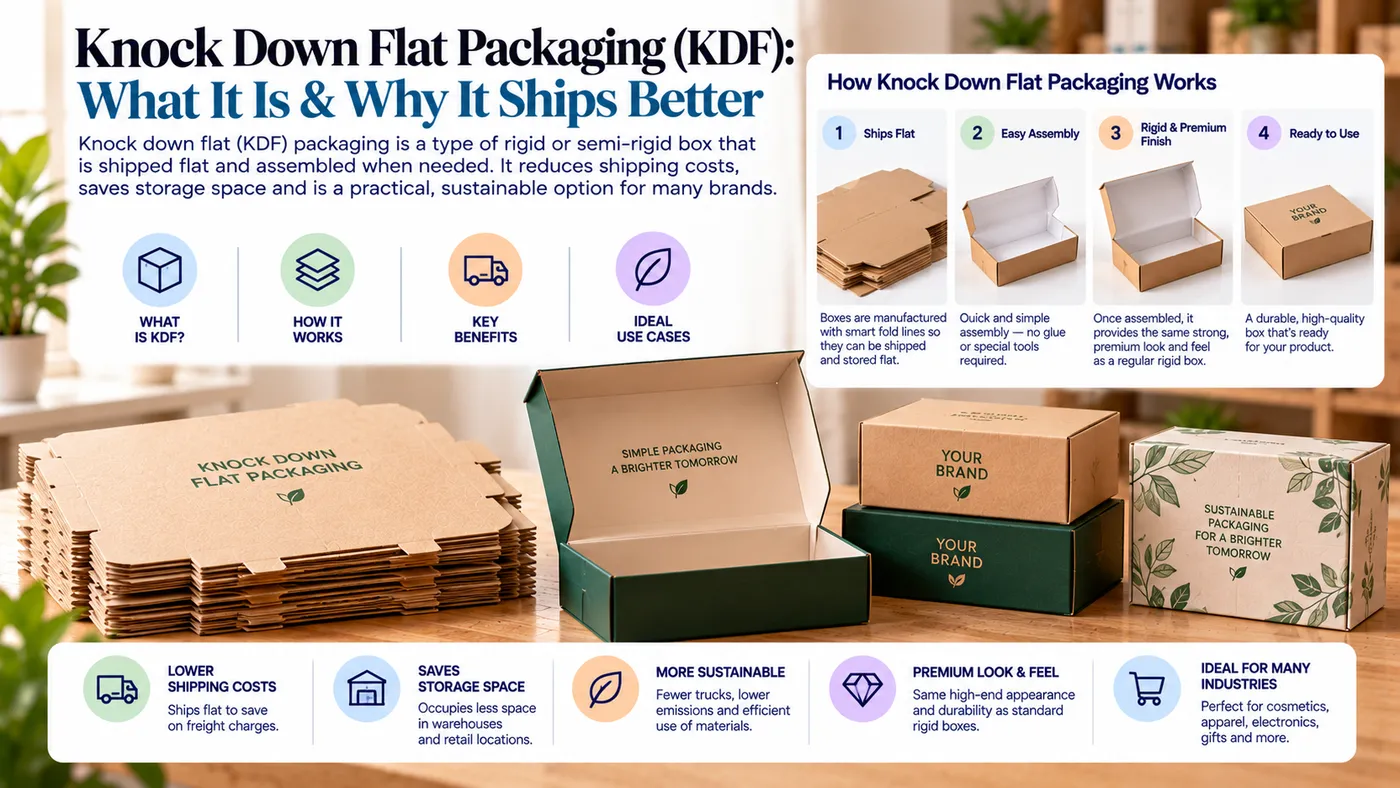
Knock down flat packaging (KDF) ships and stores flat, then gets erected by the packer or the customer. Folding cartons are the classic example. They arrive as printed, die-cut, scored blanks. The side seam is often already glued, so they open into shape in seconds. Set-up rigid boxes arrive fully formed instead. KDF trades a few seconds of assembly for far less freight and storage space.
Quick answer
- KDF stands for "knocked down flat." The packaging is built to fold flat and open into shape later.
- Folding cartons and corrugated mailers are the most common KDF formats. Set-up rigid boxes are not.
- The savings come from cube: more units per pallet, per shelf and per inbound truck.
- The cost is labor. Someone has to erect every unit before it's filled.
- Pricing depends on size, board and quantity, so request a quote instead of trusting rules of thumb.
What knock down flat packaging means
Knock down flat packaging is a box that arrives collapsed. The term comes from "knocked down flat," and patent literature describes flat carton blanks as commonly called KDF. Some people write "knock-down" with a hyphen, and some say "flat-pack." For wider vocabulary, see our packaging glossary.
Here's the plain-English version. A KDF box is a box that lives as a flat sheet until someone needs it. It was cut and creased at the factory. It gets its three-dimensional shape at the pack line, the fulfillment bench, or the customer's hands.
Terms vary by supplier. Some use "KDF" only for cartons that are glued flat before shipping. Others use it for any flat blank. Ask your manufacturer which they mean when you request a quote.
How a KDF carton is built
A KDF carton starts as a sheet of paperboard or corrugated board. A steel-rule die cuts the outline and presses in the fold lines. Our guides to die cutting and scoring, creasing and perforation cover those two steps. A flat template, called a dieline, maps every cut and fold.
Gluing comes next, and it varies by style:
- Side-seam glued. One glue flap is pasted at the factory. The carton ships as a flat tube and opens like a sleeve.
- Auto-bottom (crash-lock). The bottom flaps are pre-glued too. The base snaps into place when you open the tube. See our auto bottom box styles guide.
- Unglued blank. The packer folds and locks everything with tabs or tape. These ship flattest but take longest to set up.
Here's the sketch of a side-seam knock down flat packaging carton with a tuck top:
- Flat state: a collapsed tube, two panels thick, with the seam already glued.
- Squeeze two opposite edges. The tube pops open into a rectangle.
- Fold the bottom flaps inward and lock them, or let a pre-glued bottom snap down.
- Drop in the product.
- Fold the top flap over and tuck its tab into the front slot.
Setup takes seconds once your packer has done a few. The packer's first dozen are always slower.
How knock down flat packaging differs from set-up rigid boxes
A set-up rigid box is built at the factory from thick, wrapped chipboard. Its corners are pasted into a permanent shape. It never goes flat, so you pay to store and ship the air inside. You can read the materials side in our chipboard guide.
KDF is the opposite approach. The box ships as a flat unit, and the shape appears later. That's the fundamental difference: a rigid box arrives assembled, while a KDF box arrives collapsed.
Is "most folding cartons are KDF" true? Mostly. Folding cartons are printed, die-cut, folded and glued before being shipped flat, according to one folding-carton supplier's glossary. But a few styles, like tray-and-lid designs, can ship pre-erected. So the safe wording is: most folding cartons ship KDF, and some don't.
A collapsible rigid box sits between the two. It has rigid walls but folds flat on scored joints. It's a rigid-box format with KDF logistics, not a folding carton. Compare it with rigid boxes vs folding cartons if you're still choosing.
The economics of knock down flat packaging
The cost logic is about space, not material. Flat cartons stack tightly. A pallet of flat blanks holds many more units than a pallet of erected boxes. That lowers freight per unit on the inbound shipment and storage cost per unit in your warehouse. Both savings come from cube, so they grow with volume.
The saving has limits. Once the box is erected and packed, it ships at its full size. Carriers bill by the greater of actual or dimensional weight, as FedEx explains. So KDF helps your inbound freight and storage. It doesn't shrink your outbound parcel.
Here's what to compare in a quote:
- Unit price for KDF versus a pre-assembled option
- Inbound freight and pallet count
- Storage space, if you hold packaging for weeks
- Assembly labor, which you pay for in minutes per unit
I tell brands to add up all four. A cheaper carton that costs more labor can lose.
Assembly considerations for your pack line
Assembly is the hidden line item in knock down flat packaging. Before you order, think through these points:
- Hand or machine. Hand erecting suits short runs and small teams. Higher volumes often use carton-erecting machines, which need cartons built to the machine's spec.
- Bench layout. Put the flat stack within reach, and set up one erecting spot per packer.
- Style choice. Auto-bottom styles open faster than tab-locked ones. Faster styles cost more to engineer, so ask for both.
- Board and grain. Stiffer board resists opening. Test a hundred units, not three.
- Storage. Keep flat stacks dry and flat. Warped blanks fight you at the bench. I've seen a damp warehouse turn a good carton run into a slow one.
If a 3PL packs for you, confirm it can erect your carton style. Do that before the first shipment arrives.
Knock down flat packaging vs collapsible rigid vs standard rigid
KDF folding carton | Collapsible rigid box | Standard rigid box | |
|---|---|---|---|
Arrives | Flat, often pre-glued | Flat, scored joints | Fully assembled |
Shipping and storage cost | Lowest | Low | Highest |
Assembly | Seconds per unit, hand or machine | Longer, always by hand | None |
Unboxing feel | Light, functional, printable | Rigid, premium | Rigid, premium |
Per-unit cost | Usually lowest | Medium to high | Medium to high |
Best for | Retail, food, cosmetics, supplements | Gift sets, subscriptions | Luxury, heavy items |
This table compares formats in general terms. Real numbers depend on size, finish and quantity. Ask for all three formats in the same quote.
Which should you choose?
Choose knock down flat packaging when volume is high or storage is tight. It also suits cartons shipped to several sites. It's the default for retail cartons, candle and cosmetic boxes, supplements and food packaging. Mailer-style formats, such as ecommerce mailer boxes, also arrive flat.
Choose a collapsible rigid box when you want a rigid feel but need flat freight. See our collapsible rigid boxes page. Choose a standard rigid box when presentation matters more than logistics.
My opinion: at high monthly volume, KDF almost always wins on total cost. If you pack fifty gift sets, buy the nice rigid box. Browse custom printed product boxes to see typical carton styles.
What to send your packaging manufacturer
- Product dimensions, weight and quantity per carton
- Preferred style: tuck end, auto-bottom, mailer or other
- Whether you pack by hand or machine
- Annual volume and where cartons will be stored
- Artwork status, print method and finish
- Destination and required date
Key takeaway
Knock down flat packaging saves freight and storage by shipping boxes flat. You pay for it in assembly time, so cost the whole chain before choosing.
Formats, suppliers and terminology vary, so confirm details with your manufacturer before you order.