
Jump to section9 sections
- How a magnetic closure box is built
- Magnet strength and lid snap
- Structural variants of the magnetic closure box
- When magnets cause problems
- Magnetic closure box cost vs standard rigid
- Magnetic closure vs snap vs ribbon pull
- Which should you choose?
- What to send your packaging manufacturer
- Key takeaway
A magnetic closure box is a rigid box with small magnets built into the lid and base. The lid pulls shut and holds itself closed, so you need no tape, tuck flap or ribbon. The snap is a deliberate unboxing signal. It suits cosmetics, electronics, jewelry and gift sets. Strong magnets cost more and need care around some cards and medical devices.
How a magnetic closure box is built
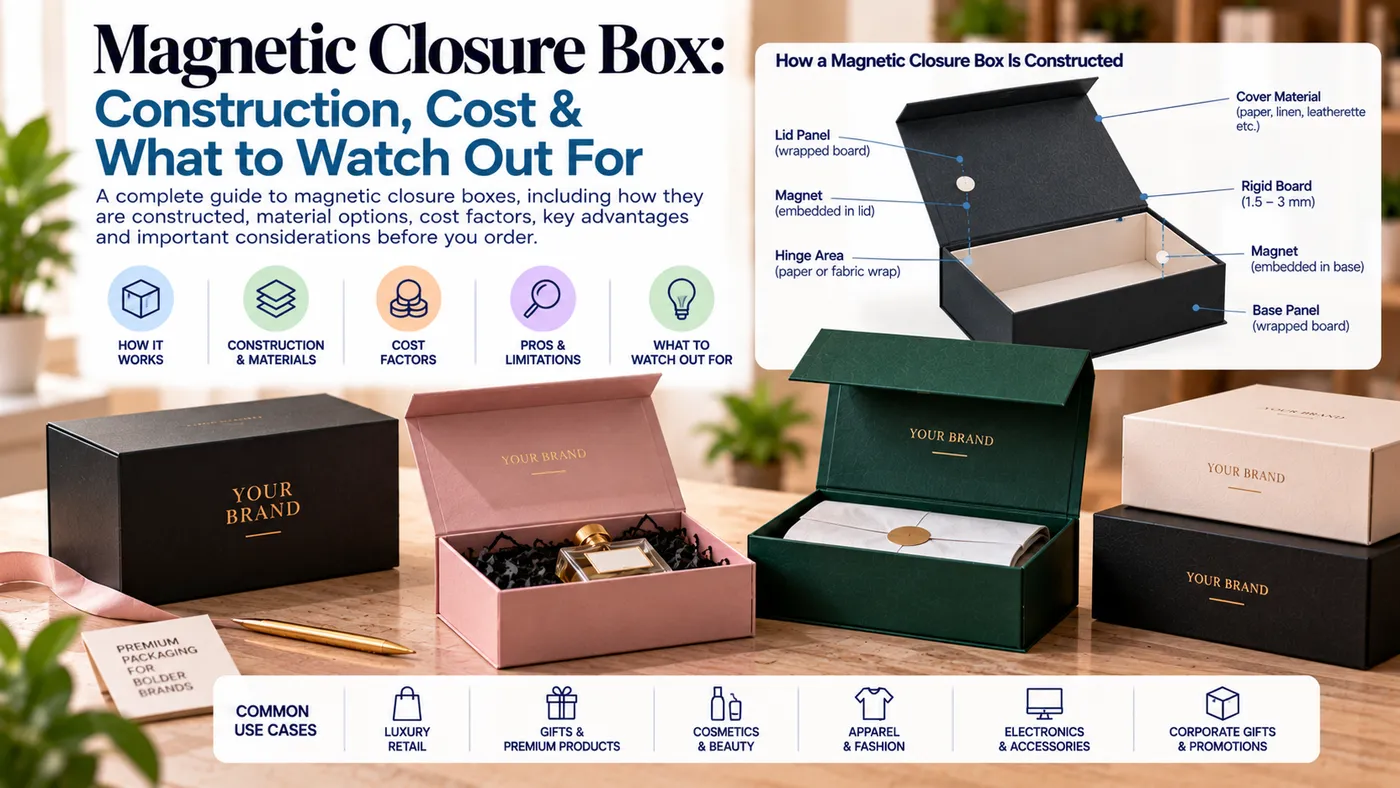
Every magnetic closure box starts as ordinary rigid construction. Thick chipboard is cut and scored. Small recesses are made where the magnets will sit. Each magnet goes into its pocket and is glued. Then the printed wrap paper covers everything. This is how the magnet is embedded.
That order matters. The wrap hides the hardware, so the customer sees clean paper and feels a snap. No metal shows. It is the common way these boxes are made, though makers vary in the details.
Two things follow from this. First, the magnets sit behind board and paper, and every layer weakens the pull. Second, you can't judge the closure from a bare magnet. Judge it on a wrapped sample.
Neodymium is the usual magnet type. It's a strong permanent magnet, which is why a tiny disc can hold a lid. For other terms, see our packaging glossary.
Magnet strength and lid snap
Magnet strength sets the feel of a magnetic closure box. Here's the trade-off in plain terms.
- Too weak: the lid drifts open in a stack or a courier bag.
- Too strong: the lid fights the customer, and fingernails lift the edge.
- Just right: the lid closes with a light pull. It stays shut when you lift the box by the base.
Strength depends on the size and number of magnets, plus the gap through board and wrap. It also depends on where they sit. I won't quote pull-force numbers. Published numbers describe bare magnets under test conditions, not a wrapped box. I've seen brands approve a flat proof, then find the lid too stiff on the first wrapped sample. Ask your maker to confirm closure on a physical sample, with your real product inside.
Structural variants of the magnetic closure box
A magnetic closure box can use several rigid structures. Here are the three most common.
Book-style box. The lid hinges on the back spine, like a book cover. Magnets sit on the front edge of the lid and base.
Hinged lid box. This is close to book-style, with a hinged lid on a deeper base. Easy Box Packaging's hinged lid rigid boxes page says the closure is reviewed at quote stage.
Lift-off lid box. A separate lid sits over the base, like our two-piece rigid box. Magnets around the rim hold the lid in place.
Here is how a book-style magnetic closure box closes, as a sketch.
- The lid swings down on its back spine.
- In the last inch, the front-edge magnets in the lid and base pull toward each other.
- The lid lands flat with a soft snap.
- To open, you lift the front edge, and the magnets release.
Collapsible rigid boxes can also use magnets. Collapsing and magnetic closure are separate choices.
When magnets cause problems
Most customers never notice the magnets in a magnetic closure box. A few situations deserve a plan.
Implanted medical devices. The FDA recommends keeping certain phones and smart watches at least 6 inches (15 cm) from implanted devices like pacemakers. Those products contain strong magnets. As of its page dated May 2021, the FDA believed the risk to patients was low. That guidance covers phones and watches, not packaging. If your customers may include people with implants, ask your maker about magnet size and position. Don't give medical advice on the box. Point people to their doctor.
Magnetic stripe cards. K&J Magnetics, a neodymium magnet supplier, reports that a neodymium magnet touching a card stripe can erase it. Its conservative rule: keep 1 inch from a credit card. Keep 5 to 6 inches from low-coercivity cards, such as hotel keys or gift cards. RFID chips aren't erased by permanent magnets. This one is easy to miss. A gift set often tucks a gift card inside the lid, right where the lid magnets sit. Keep the card slot away from the magnets, or use a chip or barcode card.
Electronics and other sensitive items. If the product holds a compass, a sensor or anything magnet-sensitive, ask its maker first. I haven't found a source I'd trust for numbers, so test with the real product.
Shipping. If boxes ship by air in volume, ask your carrier whether magnets in packaging need any declaration. Don't assume either way.
Magnetic closure box cost vs standard rigid
I won't quote prices, because Easy Box Packaging is quote-based. In relative terms, a magnetic closure box costs more than the same box with a plain lift-off lid. You pay for the magnets, for pocket-making and for the extra hand work. Larger boxes and more magnets add more.
A ribbon pull or a simple snap usually costs less than magnets. Ask for two quotes on rigid boxes: one with magnets and one without. Then compare the difference to the feel you gain. Pricing depends on size, finish and quantity.
Magnetic closure vs snap vs ribbon pull
Magnetic closure | Snap closure | Ribbon pull | |
|---|---|---|---|
Tactile experience | Soft pull, then a click | Press-fit click, firmer | Quiet, ceremonial lift |
Relative cost | Higher | Lower | Medium |
Consumer familiarity | High in premium and tech | High in everyday packs | High in gifting |
Shelf compatibility | Good, but check card and device sensitivity | Good | Good, ribbon can snag on stacked shelves |
Which should you choose?
Choose a magnetic closure box when the opening is part of the product. Jewelry, skincare sets, device accessories and corporate gifts all fit. Customers expect the sound.
Choose a ribbon pull when the box holds a loose lid and you want a quiet, classic reveal. Choose a plain lid or snap when budget is tight. Do the same if your customers carry cards or devices you can't risk.
My opinion: magnets are worth it only when you'll still look at the box in a year. A box that's thrown out in a week doesn't need one. For fitted trays, see box insert types. For the wider category, read luxury rigid box packaging.
What to send your packaging manufacturer
- Product dimensions and weight
- Whether the box holds cards, devices or medical items
- Structure: book-style, hinged or lift-off lid for your magnetic closure box
- Magnet count and position, as you imagine them
- Insert type and any card slot
- Quantity, artwork status and finish
- Destination, shipping method and required date
Order a physical sample first. The packaging samples guide explains what each sample type shows.
Key takeaway
A magnetic closure box gives the lid a snap that people remember. Judge it on a wrapped sample. Keep cards away from the magnets. Pay for it only where the unboxing matters.
Specs, minimums and structures vary by manufacturer. Test a sample before production.