
Jump to section9 sections
- Quick answer
- How a telescoping box works
- Full telescope vs partial telescope vs set-up box vs shoulder box
- How to size telescoping box lid depth
- Rigid vs corrugated telescoping box materials
- Common telescoping box uses
- Which telescoping box should you choose?
- What to send your packaging manufacturer
- Key takeaway
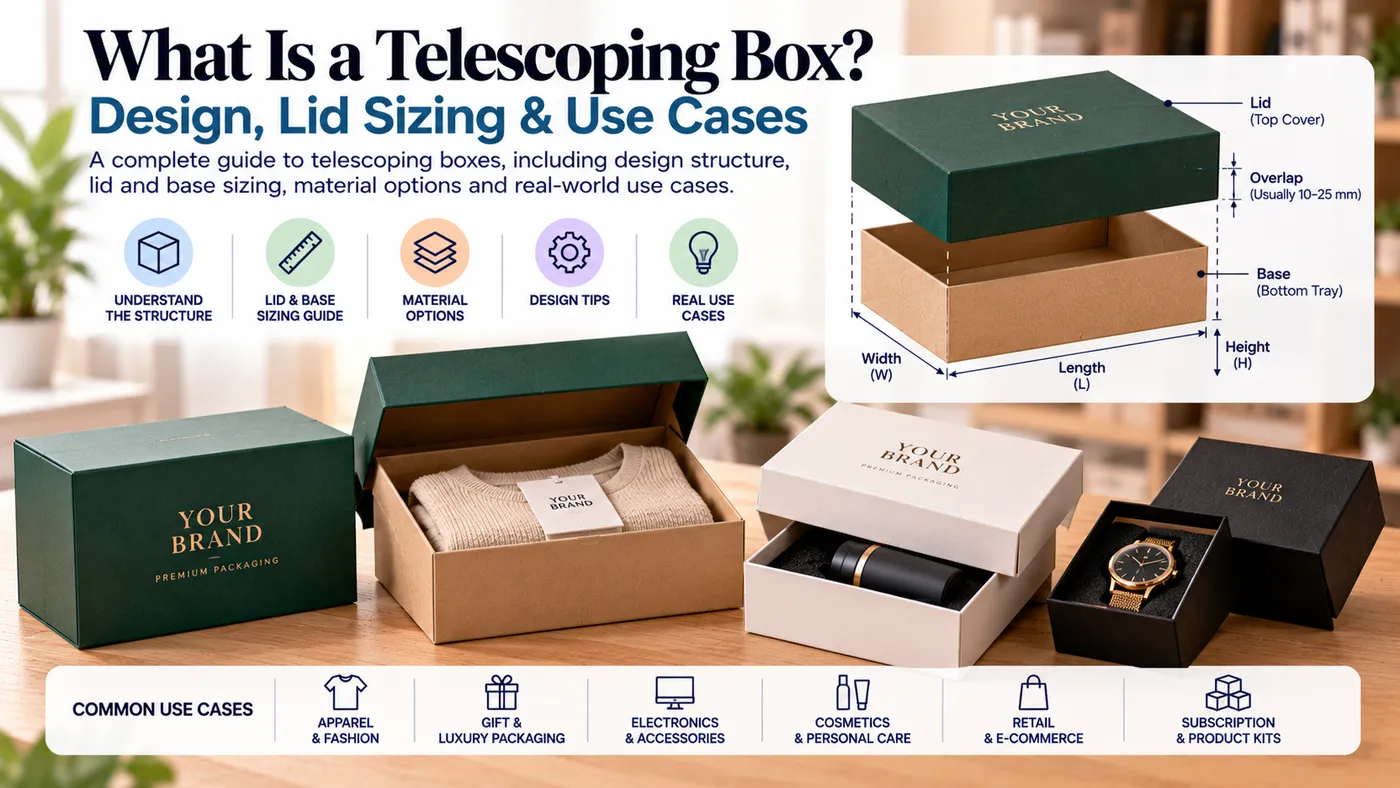
A telescoping box is a two-piece box. A separate lid slides down over the base, like a shoebox. The lid "telescopes" over the base to a set depth. A full telescope lid covers the whole base. A partial telescope lid covers only part of it. Lid depth is a design choice, not an industry standard.
Quick answer
- A telescoping box has a loose lid and base. No hinge, tab or flap joins them.
- Full telescope: the lid walls reach the bottom of the base. Partial telescope: a band of base stays visible.
- Lid depth is a design choice. One workshop suggests a third, half or three-quarters of tray depth.
- "Set-up box" describes how a rigid box is built. A telescoping box is one lid style within that family.
- Send lid depth as a fourth number: length × width × base height / lid depth.
How a telescoping box works
The base is an open tray. The lid is a slightly larger tray, turned upside down. It drops over the base and holds by friction. Nothing locks it, so the fit is everything.
FEFCO, the European corrugated trade body, files these designs in its 03 series. Its code defines telescope-type boxes by "a lid and/or bottom telescoping over the body." That text is written for corrugated. The idea carries straight over to rigid boxes.
Fit is the whole feel. Too tight and the lid scuffs the base walls on the way down. Too loose and it rattles or lifts in transit. I've seen deep lids on tight bases sink slowly as trapped air escapes. Some people love that. Others find the lid sticks. A finger notch or ribbon pull usually fixes it.
Full telescope vs partial telescope vs set-up box vs shoulder box
Here's how each lid seats, in words. These are the structural terms behind our packaging glossary.
Full telescope. Lift the lid straight up. Its walls run the full height of the base. Closed, you only see the lid. This suits shallow trays, such as folded apparel or flat accessories.
Partial telescope. The lid walls stop partway down. Below the lid edge, a band of base stays visible. Lid and base can carry different papers or colors. Brands use this for gift sets and candles.
Set-up box with a hinged lid. The lid's back edge is attached to the base by a paper hinge. It swings open like a book. Magnets or a ribbon often hold it shut. Because the lid never separates, it isn't a telescoping box.
Rigid shoulder box. The base carries an inner collar, called the neck or shoulder. The lid lifts off and drops back over it. It stops at a defined point, as our custom shoulder rigid boxes page describes.
Watch the naming. Many suppliers say "set-up box" for any rigid box built permanently at the factory. That includes telescoping styles. Ask one question: does the lid come off, or does it hinge?
Feature | Full telescope | Partial telescope | Set-up box (hinged lid) | Rigid shoulder box |
|---|---|---|---|---|
Lid attached? | No | No | Yes, by a hinge | No |
Lid covers | Whole base | Part of the base | Whole base | Inner neck, to a stop |
Base band visible | No | Yes | No | No |
Opening motion | Lift straight up | Lift straight up | Swings like a book | Lift to a defined stop |
Best for | Shallow, flat items | Gifts, two-tone looks | Repeat opening | Candles, bottles, fragrance |
Watch for | Trapped air, sticking | Scuffs on exposed base | Hinge alignment | Extra part, tight fit |
How to size telescoping box lid depth
The lid needs its own measurement. FEFCO's code gives lid height as a fourth number after a slash, for example 355 × 205 × 120/40 mm. Use the same habit for any telescoping box: length × width × base height / lid depth.
Now the depth itself. There's no standard. The Bodleian Libraries' box workshop recommends full lids only for shallow boxes. It lists a third, half or three quarters of tray depth as other options. That's one library workshop's guidance. Treat it as a starting range, not a rule.
Here's a worked example. Take a base 3 inches deep. That range gives a partial lid between 1 inch and 2.25 inches. A shallower lid looks lighter and shows more base. A deeper lid grips harder and hides more.
Three checks keep the lid honest:
- Measure the loaded base height, with inserts and tissue. Our how to measure a box guide shows the method.
- Add clearance to the interior first, as the box size guide explains.
- Ask for the lid-to-base gap in writing. It's a tolerance, so confirm it on a physical sample.
Rigid vs corrugated telescoping box materials
A rigid telescoping box uses a greyboard or chipboard core wrapped in printed paper. It holds its shape permanently and ships assembled. Our 2 piece rigid box page lists SBS, kraft or corrugated board as material directions.
A corrugated telescoping box is a different animal. It's die-cut flat and folded by the packer. The shoebox is the classic example. Packsize notes that tray flaps are hard to hold with glue or tape, so some designs use staples. Others use two half-slotted halves, which tape together more easily.
The trade-off is honest. Corrugated ships flat and usually costs less to build. Rigid gives you the weight, the wrapped surface and the slow lid seat. Exact pricing comes from a quote.
Common telescoping box uses
- Apparel. A full telescope handles a folded sweater without a hinge getting in the way.
- Shoes. The two-piece lid-and-base is still the default. Our shoe box dimensions guide covers sizing.
- Premium gifts. A partial telescope shows a contrasting base. Candles, cosmetics and hampers fit well.
- Shipping. Pack the box inside an outer carton or mailer. A loose lid can lift in transit, so plan a band or tape.
Which telescoping box should you choose?
- Shallow, flat product: choose a full telescope. A deep lid on a shallow base adds little.
- Gift set or candle: choose a partial telescope. The visible base band adds a second color.
- Repeat opening or a book-style reveal: choose a hinged set-up box.
- Bottle or fragrance that needs a framed opening: choose a shoulder box.
- Slide-out reveal instead of a lift: look at sleeve box packaging.
- Shipping direct to customers: use corrugated, or ship the rigid box inside a carton.
My opinion: most gift and candle brands should start with a partial telescope. It looks designed even with plain artwork, and the visible base band gives you a second surface to brand.
What to send your packaging manufacturer
- Packed product dimensions and weight, with any insert or tissue
- Base height and lid depth as two separate numbers
- Lid style: full telescope, partial telescope, hinged or shoulder
- Material: rigid greyboard or corrugated
- Quantity, artwork status, printing and finishing
- Whether the box ships alone or inside a carton
- Destination and required date
- A request for a physical sample, via our sample kit
Key takeaway
A telescoping box is a loose lid and base joined only by fit. Choose full or partial by how much base you want to show. Specify lid depth as its own number, and confirm the gap on a sample.
Lid depth ranges here are common guidance, not a standard. Confirm fit and tolerance on a sample first.