
Jump to section6 sections
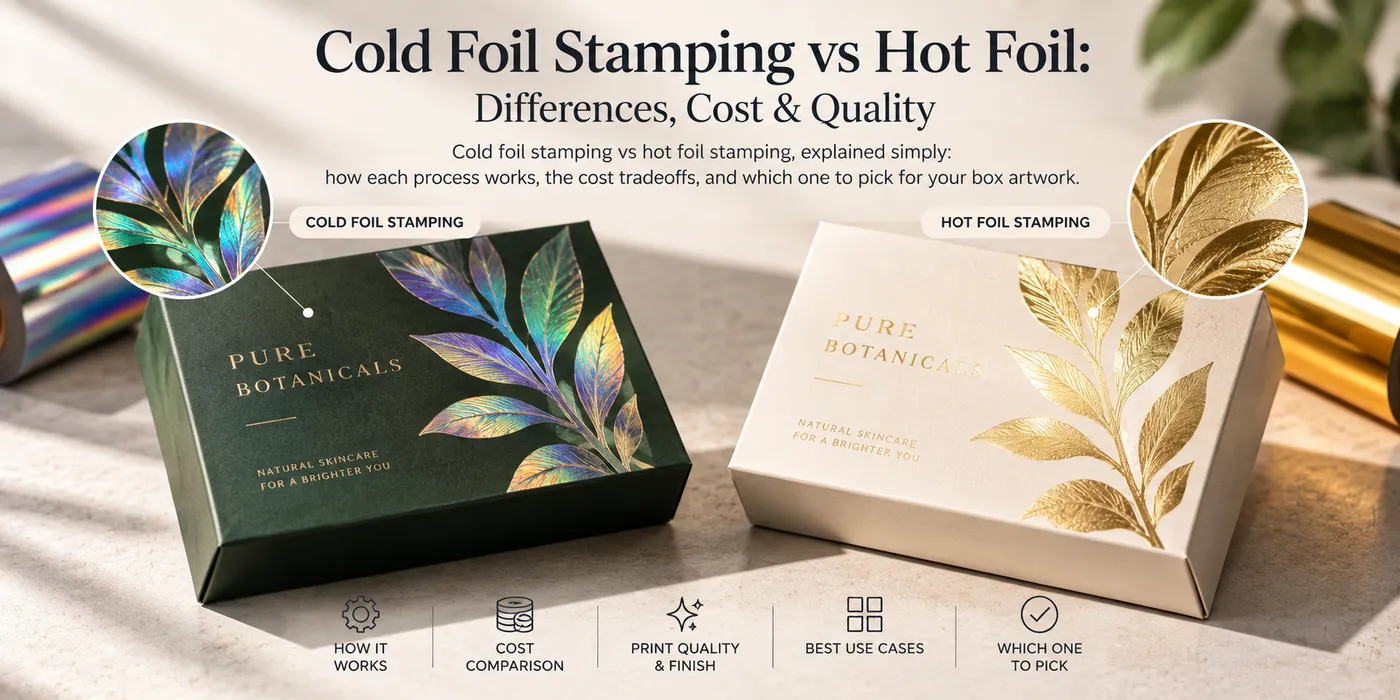
Hot foil stamping uses a heated die to press foil onto the substrate. The result is sharp, raised metallic lettering or art. Cold foil stamping works differently. It gets applied inline during printing, using a UV adhesive. The foil is laminated onto that adhesive, then cured in place. Cold foil stamping runs faster. It also costs less for full-coverage metallic areas. Hot foil keeps a slightly deeper, more three-dimensional punch.
This guide breaks down how each process works. We'll cover where they differ in look and feel. We'll also cover cost, and which one earns its price for your specific artwork. For the full list of finishing terms this one belongs to, see our packaging glossary.
How hot foil stamping works
Hot foil stamping is a die-based process. A custom metal die gets cut to match your logo or artwork. The press heats that die. It then presses the die against a foil ribbon sitting over your box panel.
Heat and pressure transfer the foil's metallic layer onto the paperboard. The die also compresses the fibers underneath it. That's why hot foil often has a subtle raised or recessed texture. This happens even without a separate embossing pass. For a deeper look at that related process, see our guide on embossing vs debossing.
Each design needs its own custom die. That tooling cost is fixed. It applies whether you're printing 500 boxes or 50,000. This is the main reason hot foil scales well for long runs. It also adds real cost to a short one.
How cold foil stamping works
Cold foil stamping skips the heated die completely. A UV-curable adhesive gets printed onto the substrate. It's applied in the exact shape of your artwork, as part of the regular print pass. Foil then gets laminated onto that wet adhesive. A UV light cures it in place.
Cold foil stamping runs inline with the press. It doesn't need a separate stamping station or a dedicated metal die. That keeps setup time and tooling cost down. It works especially well for designs with large metallic fields, rather than fine lettering.
The tradeoff shows up in registration accuracy. Cold foil stamping runs at full press speed. Static buildup or a tiny substrate shift can cause foil creep right at an edge. Hot foil's single, even press stroke doesn't have that problem. I've seen a cold foil job come back with soft, feathered edges on fine text. The artwork simply pushed cold foil stamping past what the process handles well.
Visual and tactile difference
Hot foil has a real tactile signature. Run a finger across it, and you'll feel a slight ridge or depression. That's where the die pressed in. The raised feel reads as premium, even in photos. Light catches that edge differently than it catches flat ink.
Cold foil stamping looks flatter. It reads more like a printed metallic ink. It still has a genuine metallic shine, just without the raised edge. For a full-coverage metallic background, most people can't tell the difference by eye. For a small logo or fine serif text, the gap becomes obvious fast.
Color and finish options matter here too. Both processes come in a range of foil colors beyond standard gold and silver. Holographic, pigment-color, and brushed-metal finishes are all options. Hot foil tends to hold a wider range of specialty effects. Its die press works well with thicker or textured foil stock. Cold foil stamping works best with standard metallic foils in an inline setup. A specialty effect may need a separate conversation with your printer before you commit to artwork.
Cost comparison
Cold foil stamping wins on cost for large coverage areas. There's no custom die involved. You're not paying tooling charges for a big metallic background or an all-over pattern. The adhesive-and-lamination process scales efficiently once it's set up on press.
Hot foil wins on cost for small, detailed coverage. A small logo stamp doesn't need much foil ribbon. The die cost also gets spread across the whole run. Picture a 50,000-unit order with one small logo. Hot foil's per-unit cost often comes in lower there. Cold foil stamping's inline setup overhead just doesn't pay off at that small a coverage area.
Neither format wins across the board. A cosmetics brand running a full metallic sleeve wants cold foil's lower large-area cost. Picture a jewelry brand stamping one small emblem on a rigid box instead. That brand usually gets sharper detail and better economics from hot foil. The lesson holds across most categories. Let the coverage area drive the choice, not a general preference for one process.
Cold foil stamping vs hot foil
Cold foil stamping | Hot foil | |
|---|---|---|
Detail resolution | Good for bold shapes, softer on fine text | Sharp, holds fine detail and serif lettering |
Cost for small coverage | Higher (adhesive setup still required) | Lower (die cost spreads across small area) |
Cost for large coverage | Lower (no die, inline process) | Higher (larger die, more stamping time) |
Lead time | Faster (no die-cutting step needed) | Slower (custom die must be cut first) |
Compatible substrates | Coated stocks; runs well inline with offset | Most paperboard and some coated plastics |
Which to choose?
Pick cold foil stamping when your artwork is a large metallic field. It's also the right call for a background pattern or a full-coverage design. Turnaround matters more than raised texture in those cases. There's no die to cut first, so lead times run shorter too.
Pick hot foil when the design leans on small, precise detail. Fine text, a small emblem, or a logo that needs to read sharp all favor hot foil. The raised texture also does real marketing work. Premium packaging like holographic foil finishes or a small-run luxury box both benefit from that tactile punch.
Some brands combine both processes on one box. A cold foil stamping background pairs with a hot-stamped logo on top. It costs more to coordinate both steps. But it captures cold foil's large-area economics and hot foil's sharp, tactile logo detail at once. We've worked through foil decisions like this for 10,000+ brands served. Request a custom quote for exact pricing on your own artwork and coverage area.
Paperboard, adhesive, and foil compatibility varies by substrate and supplier. That's according to FSEA, the industry association for foil stamping, embossing, and related decorative print processes. This is part of why a proof round matters. It matters most on a design that's never been foiled before.
One limitation worth naming: foil performance varies by substrate and press. Even the humidity on the day of the run plays a role. Results aren't identical across every supplier's equipment. Lead time also shifts with the choice. Hot foil needs a die cut first, which can add several days before the run even starts. Cold foil stamping skips that step, so it's often the faster path when a deadline is tight. A physical proof before a full production run is worth the time regardless, even on a repeat order. We recommend testing a sample before committing to a full run.