
Jump to section10 sections
- Why both numbers matter
- How wall thickness shapes inner vs outer dimensions packaging
- Reading a spec sheet: inner vs outer dimensions packaging in practice
- Converting between inner and outer dimensions
- When to use interior vs exterior dimensions
- The tolerance factor
- The rigid lid clearance problem
- Which should you choose?
- What to send your packaging manufacturer
- Key takeaway
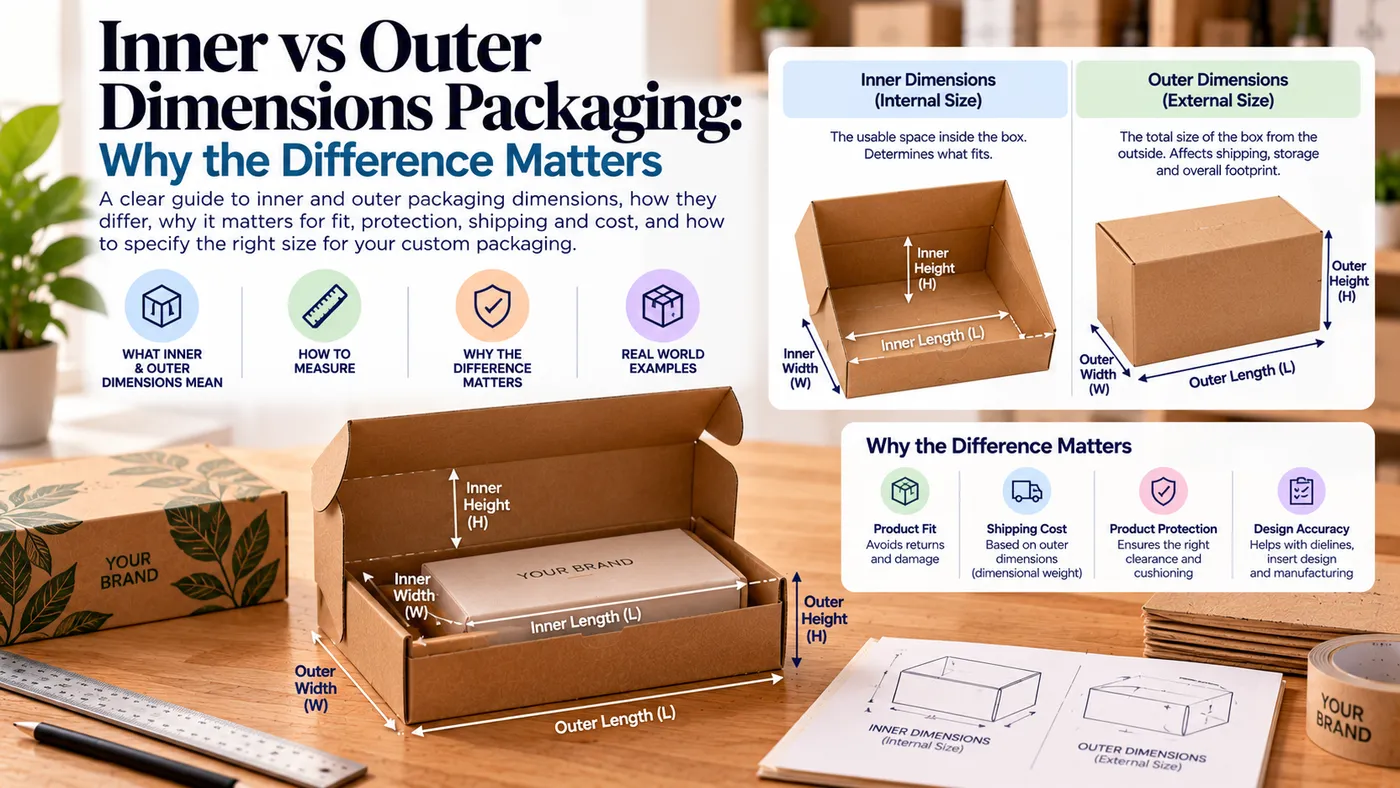
Inner vs outer dimensions packaging comes down to two sizes of one box. Inner (interior) dimensions are the usable space your product must fit inside. Outer (exterior) dimensions are the full size of the finished box, walls included. Quotes and spec sheets usually list inner size. Carriers, pallets and shelf slots care about outer size. The gap is about twice the board thickness on every dimension.
Why both numbers matter
Every box has two sizes, and mixing them up is a costly spec mistake. Your product lives inside the box. Your carrier, shelf and pallet live outside it.
Picture a picture frame. The opening is what the photo must fit. The outer edge is what the wall must hold. Same object, two measurements.
This article covers reading a spec sheet and converting between the two numbers. To take the measurements themselves, use our how to measure a box guide. Our packaging glossary defines the other terms here.
The vocabulary trips people up. Inner, inside, interior and internal mean the same thing. Outer, outside and exterior do too. Whenever you see inner vs outer dimensions packaging numbers, check which one a figure refers to.
How wall thickness shapes inner vs outer dimensions packaging
Exterior size is interior size plus one wall on each side of every dimension. So the gap is about twice the wall thickness. That wall depends on the material.
Folding cartons use paperboard measured in points. One point is 0.001 inch, so a 24-point board is 0.024 inch thick. Our GSM vs PT guide explains points.
Corrugated walls are the whole board, flute plus liners. Standard US single-wall board is 1/16 inch thick in E flute, 1/8 in B and 5/32 in C. Our corrugated flute types guide covers each letter.
Rigid boxes wrap paper around chipboard. Greyboard is sold by thickness, from about 0.8 mm to over 3 mm. Our chipboard guide covers the board itself.
Box type | Single wall or board thickness | Gap per dimension (2 walls) |
|---|---|---|
Folding carton, 24 pt | 0.024 in | About 0.05 in |
E flute corrugated | 1/16 in (1.6 mm) | About 1/8 in |
B flute corrugated | 1/8 in (3.2 mm) | About 1/4 in |
C flute corrugated | 5/32 in (4.0 mm) | About 5/16 in |
Rigid box | About 0.8 to 3+ mm chipboard, plus wrap | About 1.6 to 6+ mm, plus wrap |
Sources: Wikipedia's standard US flute table, and the University of Bologna's Packaging Design Innovation Lab for greyboard. Treat every figure as typical. Mills differ, so ask your maker for the actual board.
Reading a spec sheet: inner vs outer dimensions packaging in practice
By convention, boxes are specified by interior size. The FEFCO Recommendation 101 defines internal dimensions as length, breadth and height. Length is the longer dimension at the opening.
Here's the part most brand owners never hear. That standard measures between crease centers on the flat blank. It then subtracts one board thickness for length and breadth, and two for height. Interior size is often calculated, not measured with a ruler.
The subtraction isn't always one wall. Atlantic Packaging's guide for a C-flute carton subtracts 3/16 inch from length and width. It subtracts 3/8 from depth. Its B-flute row subtracts 1/8, 1/8 and 1/4 inch. Allowances depend on flute and box style, so two makers can read one blank differently.
Take their example carton. Center-to-center numbers of 12 3/16, 5 3/16 and 8 3/8 inches become a 12 × 5 × 8 interior. The allowance is larger than the board itself. So don't reverse-engineer a corrugated spec from wall thickness alone.
ASTM D2658 backs the same split. It says interior dimensions are critical when contents nearly fill the box. It adds that exterior dimensions matter for shipping platform area and stack height.
Ask every supplier one question: are your numbers inside dimensions? Packlane's help page states plainly that its sizes are inside measurements. Not every quote does.
Converting between inner and outer dimensions
For inner vs outer dimensions packaging conversions, add twice the wall to each dimension. Going from exterior to interior, subtract it. The hard part is knowing the wall.
Here's a hypothetical example. A retail slot is 6 inches wide, and you want an E flute mailer. The wall gap is about 1/8 inch. Allow another 1/8 inch for tolerance. The largest interior width you can request is about 5 3/4 inches. A 5.5-inch product then fits with 1/4 inch to spare.
For corrugated, ask the maker to confirm the exterior in writing. For rigid boxes, ask for wrap thickness too. A planning estimate is fine for budgeting. It isn't fine for a shelf slot.
When to use interior vs exterior dimensions
Use the number that matches the job:
- Product fit: interior. Candle jars, cosmetic bottles and bakery trays live inside.
- Shelf slot or retail fixture: exterior. Work backward to the largest interior that fits.
- Shipper or pallet plan: exterior. Outside size drives carton count and stacking.
- Insert design: interior. The insert's outside plus a small gap sets the box interior.
Decisions get easier once you give each number one job. Our box insert types guide shows how inserts change the interior.
The tolerance factor
Tolerance is the allowed wobble in a finished dimension. It changes how you read any inner vs outer dimensions packaging number. It's set per maker. Packlane states a tolerance of plus or minus 0.125 inch on all measurements. Other makers quote tighter or looser.
Tolerance stacks. The box varies, the insert varies and the product varies. Your clearance has to exceed the combined wobble. Otherwise some boxes in a run won't close.
ASTM D2658 checks this by sampling. It tests a production lot against the tolerance for each dimension, using at least five boxes. I've seen a lid that closed on the sample and bound on the full run. Get the tolerance in writing, then confirm it with packaging samples.
The rigid lid clearance problem
Rigid two-piece boxes add a trap to inner vs outer dimensions packaging math. The trade name is a lid-and-base box, or telescope box. In plain English, the base sits inside the lid like a hat on a head.
So the lid's inside must be larger than the base's outside. The sketch is simple. Lid interior equals base exterior plus a small clearance. Lid exterior then adds two lid walls on top.
Every wall here is chipboard plus wrap paper, so the lid is noticeably larger than the base. I couldn't find a published standard for the clearance. It's a design setting your manufacturer chooses. Too tight and the lid binds. Too loose and it rattles. Test a sample.
Give lid and base depths separately, because inserts raise the base. See our 2-piece rigid box range for lid-and-base styles.
Which should you choose?
Send interior dimensions for the quote, every time, and label them as interior. Most inner vs outer dimensions packaging errors start with an unlabeled number. Then calculate the exterior yourself. Check it against the carrier, the shelf and the pallet before you approve.
Corrugated work needs the same habit. If you only have score-to-score numbers, subtract the allowance first. Our custom corrugated mailer boxes are planned around the packed product, so send your product size.
What to send your packaging manufacturer
- Product dimensions as packed, with the opening side marked.
- Whether your numbers are interior or exterior.
- Any exterior limit: shelf slot, shipper size or pallet footprint.
- Board type and thickness, if you have a preference.
- Insert type, plus lid and base depth for two-piece boxes.
- The tolerance you need, in writing.
- Quantity, artwork status and required date.
Key takeaway
Inner vs outer dimensions packaging is a conversion, not a debate. Quote interior size, add twice the wall to find exterior size, and confirm the tolerance on a sample.
Thickness and tolerance figures are typical values from published sources. Your manufacturer's spec governs.