
Jump to section16 sections
- Quick answer
- Why fragile products break in transit
- Packaging fragile products: how much clearance is enough?
- Which insert material should you use?
- Packaging fragile products by type: glass, ceramics and more
- Candle jars
- Cosmetics
- Glass bottles
- Ceramics
- Electronics
- Gift sets
- Corner and edge protection
- When should you double box?
- How do you test packaging for fragile products?
- What to send your packaging manufacturer
- Key takeaway
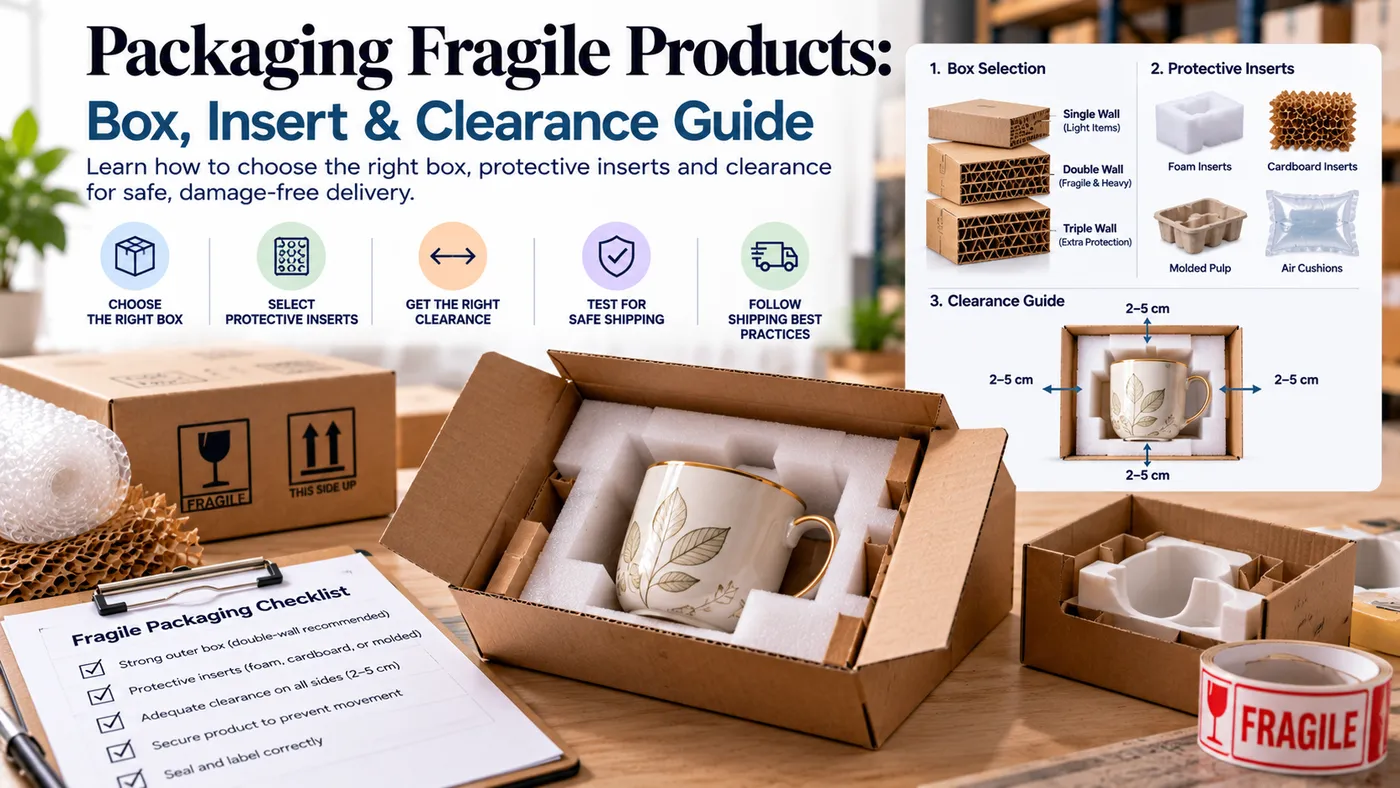
Packaging fragile products comes down to three decisions. Stop the product moving, keep it off the box walls, and absorb impact at corners and edges. Use a fitted insert, leave clearance on every side, and pick a corrugated outer box for the weight. FedEx's packing guide asks for 3 inches of cushioning around double-boxed fragile items.
Quick answer
- Movement breaks more products than weak boxes do. A fitted insert or tight void fill comes first.
- Keep every product away from the sides, corners, top and bottom. FedEx's guide says to center items for this reason.
- Match the insert to the product. Use partitions for glass, molded pulp for bottles, foam for electronics, and paperboard for light items.
- Parcel shipping needs a corrugated outer box. FedEx states that chipboard gift or shoe boxes must go inside one.
- Test the sealed pack with the real product before you commit to a full run.
Why fragile products break in transit
Parcels get dropped, stacked, tilted and vibrated. ISTA, the transit-testing body, notes that orientation isn't guaranteed in parcel delivery. A pack designed only for "this way up" fails once a courier lays it on its side.
Three things cause most damage. Movement lets the product hit the walls. Impact lands on corners and edges first. Compression from stacked parcels crushes weak outer boxes.
I've seen brands spend heavily on a beautiful lid and almost nothing on what holds the product still. The jar arrived chipped, and nobody remembered the lid.
Packaging fragile products: how much clearance is enough?
FedEx's packing guide says to double-box fragile items. It wants 3 inches of cushioning in and around the smaller box. Its box-in-box method wants an outer box at least 6 inches longer, wider and deeper. That's 3 inches per side.
Those figures suit loose cushioning like air-cellular wrap. A fitted insert works differently. It holds the product in a shaped pocket. The clearance lives in the insert walls, not loose fill.
My opinion: when packaging fragile products that are small, 3 inches on every side rarely makes sense. A tight, fitted pocket inside a sturdy corrugated shipper usually beats a loose product in a giant box. Either way, test it.
Measure the finished product with its lid, cap, pump and label in place. Our how to measure a box guide covers inside-dimension rules.
Which insert material should you use?
Insert | Best for | Watch out for |
|---|---|---|
Corrugated partitions | Glass bottles, jars, ceramics, multi-item sets | Gaps between cells and product need filling |
Molded pulp | Bottles, jars, round vessels | Fixed tooling suits larger runs |
Foam | Electronics, high-value items | Harder to recycle than paper options |
Paperboard (folded) | Light cosmetics, candles, gift sets | Thin walls add little shock absorption |
Our box insert types guide covers each material in depth. Our insert pages list paperboard and corrugated directions. If packaging fragile products like yours calls for foam or molded pulp, say so in your brief.
Packaging fragile products by type: glass, ceramics and more
The table below answers the buyer question: which insert and box for my product?
Product | Main risk | Recommended insert | Box style |
|---|---|---|---|
Candle jars | Rim chips, jar-to-jar contact, lid shifting | Fitted collar or partition cell | Folding carton inside a corrugated shipper |
Cosmetics | Cap or pump damage, leaks, scuffed labels | Paperboard cavity with cap clearance | Folding carton inside a mailer |
Glass bottles | Neck and shoulder breaks, bottle contact | Corrugated partitions or molded pulp | Corrugated shipper, bottles upright |
Ceramics | Chipped edges, handles, weight | Wrapped pieces with dividers | Double-wall corrugated, often double-boxed |
Electronics | Corner impact, loose accessories | Foam or die-cut corrugated cradle | Mailer or rigid box inside a shipper |
Gift sets | Heavy items crushing light ones | Tiered tray with separate pockets | Rigid box inside a corrugated shipper |
Candle jars
Glass jars chip at the rim and crack at the base. Give each jar its own cell, and keep lids from rubbing the carton. Our candle boxes with inserts are sized around the packed vessel.
Cosmetics
Droppers, pumps and caps are the weak points, not the bottle. Leave clearance above the closure so a lid press can't load it. FedEx also says to keep liquid bottles upright.
Glass bottles
Bottles touching bottles is the classic failure. Individual cells stop contact. Our custom bottle product inserts are fitted to bottle, cap and label.
Ceramics
When packaging fragile products like ceramics, remember that handles and spouts snap before bodies do. Wrap each piece, divide them, and use a double-wall outer box. Double boxing earns its cost here.
Electronics
Screens and corners need a cradle that grips the product without pressing on ports. Accessories get their own pocket so cables can't scratch anything. See our electronics packaging specs guide for more.
Gift sets
Sets mix weights. A heavy candle can crush a soap bar if they share a cavity. Give every item a position, and tell your manufacturer the packed order.
Corner and edge protection
Corners take the first hit in a drop. When packaging fragile products, keep them off those corners. An insert with walls between the product and the carton edge does that job.
A rigid box looks protective, but it's a presentation pack. For parcel shipping, put it in a corrugated outer. Our rigid boxes suit the inner retail pack. A corrugated mailer box suits the shipper.
The insider detail most guides skip: separate the two jobs. The insert holds the product still. The outer box provides clearance and crush strength. Asking one component to do both is where many packs go wrong.
When should you double box?
FedEx recommends double boxing fragile items and says to use double-wall boxes for heavier items. Double box heavy, high-value or ceramic products. Do the same for long routes with many handoffs.
The tradeoff is a bigger, heavier parcel. For small retail products, a fitted insert plus a strong mailer often does the job. For heavy glass, add the second box.
How do you test packaging for fragile products?
ISTA publishes recognized pre-shipment test procedures. Its 1-series are screening tests for early design. Procedure 3A covers parcel shipments of 150 lb or less, and 3L covers e-commerce retailer fulfillment. ISTA says to test with representative production samples and to retest whenever the product or package changes.
You don't need a lab to start packaging fragile products well. Pack the real product, seal the box, and then:
- Shake it and listen for movement.
- Drop it on a face, an edge and a corner from table height.
- Open it and inspect the product, label and closure.
- Ship one to yourself through your actual carrier.
This informal check isn't an ISTA test. Order a physical sample first. Our packaging samples explained guide shows what to check. See the ISTA selection guidance and ISTA test procedures for formal testing.
What to send your packaging manufacturer
- Product dimensions with lid, cap, pump and label included
- Product weight, packed weight and items per box
- Quantity and any reorder volume
- Packaging format: folding carton, rigid box, mailer or corrugated shipper
- Artwork status: finished, in progress or not started
- Material preference: paperboard, kraft or corrugated
- Printing and finishing requirements
- Insert needs: cavity shape, dividers, accessory pockets, foam or pulp
- Destination, carrier and any known breakage history
- Required delivery date
Our manufacturing page explains how we handle structure and sampling. The packaging glossary defines the terms used above.
Key takeaway
Packaging fragile products works when the insert holds the product still. The outer box supplies clearance and strength. Fit first, then box, then test the real product.
This guide gives general packing principles. We don't publish drop-test results for our products, so test your own packed product first.