
Jump to section10 sections
- Quick answer
- Mailer box vs shipping box vs poly mailer side by side
- Which is cheapest to ship?
- Which protects products best?
- When does a mailer box beat a shipping carton?
- Are poly mailers good enough?
- Which packaging gives the best unboxing?
- Product-type decision table
- What to send your packaging manufacturer
- Key takeaway
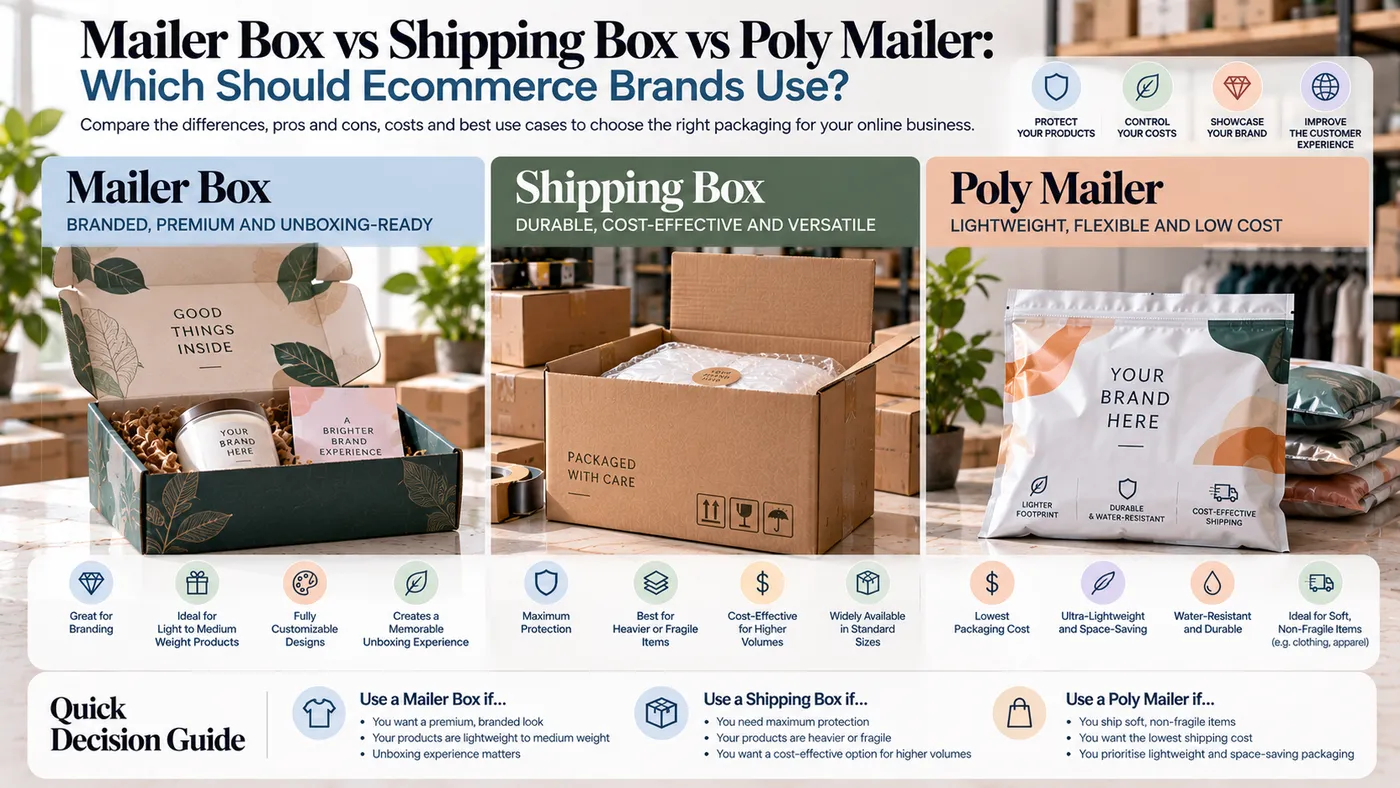
The mailer box vs shipping box decision comes down to fragility, weight and unboxing. Use a corrugated mailer box for light to medium products when the box is part of the experience. Use a shipping carton for heavy, fragile or multi-item orders. Use a poly mailer only for soft, non-fragile goods like folded apparel. There it's usually the cheapest to ship.
Quick answer
- Cheapest to ship: a poly mailer, because it's light and takes little space. Right-sizing matters as much as format.
- Best protection: a shipping carton with inserts, then a corrugated mailer, then a poly mailer.
- Best unboxing: a printed mailer box, then a plain carton with branded inserts.
- Poly mailers are good enough for soft goods. They fail on glass, sharp edges and sets.
Mailer box vs shipping box vs poly mailer side by side
A mailer box is a corrugated box with a hinged lid, usually printed inside and out. A shipping carton is a plain corrugated box with flaps. A poly mailer is a flexible plastic bag. Comparing mailers with rigid boxes? Read our mailer vs rigid vs folding carton guide.
Factor | Mailer box | Shipping carton | Poly mailer |
|---|---|---|---|
Fragility handled | Low to medium | Medium to high, with inserts | Non-fragile only |
Weight suited | Light to medium | Medium to heavy | Light |
Dimensional weight | Moderate, fixed footprint | Highest risk if oversized | Lowest, conforms to product |
Shipping cost | Mid | Mid to high | Lowest |
Protection | Good crush resistance | Best | No crush resistance |
Presentation | Strong, printed inside | Plain unless printed | Outside print only |
Returns | Reusable for returns | Reusable if undamaged | Often single-use |
Storage | Ships flat, bulkier built | Ships flat, bulky built | Smallest footprint |
Assembly | Folds up, often tape-free | Tape required | Peel and seal |
Sustainability | Fiber-based, check local recycling | Fiber-based, check local recycling | Film, store drop-off at best |
Which is cheapest to ship?
Usually the poly mailer. In the mailer box vs shipping box cost debate, the driver is dimensional weight, not material price.
Carriers bill the greater of actual weight or dimensional weight. FedEx describes dim weight as the space a package occupies relative to its weight. As of October 2026, FedEx says to round each side to the nearest whole inch and multiply them. Then divide by 139.
The USPS Domestic Mail Manual also divides by 139. That applies to Priority Mail parcels over 1 cubic foot, with each side rounded up. UPS also bills the greater of the two weights. Its support page doesn't publish a divisor, so check your rate guide.
A 16 × 12 × 8 inch carton is 1,536 cubic inches. At 139, that's about 11 pounds of dimensional weight, even if the candle inside weighs 3. A snug poly mailer for a sweater has almost no cube to bill.
Here's what many brands miss. Each side gets rounded to a whole inch. A box that's 0.4 inch too tall can bump the billed size. Ask your manufacturer for exterior dimensions, then design the height to land just under a whole inch.
In any mailer box vs shipping box cost comparison, add tape, labor and cushioning. Compare landed cost per order, not box price. Our shipping box sizes guide helps with sizing.
Which protects products best?
A shipping carton wins the mailer box vs shipping box protection contest for heavy, fragile or loose contents. It has thicker board, taller walls and room for inserts. A corrugated mailer box comes close for light products because folded walls and the lid add stiffness. A poly mailer resists scuffs and moisture. It doesn't resist crushing.
I've seen brands put a boxed jar in a poly mailer to save postage. They paid for it in replacements. If a product has glass, edges or a lid that can crack, use a carton. Our guide to why corrugated wins for ecommerce covers the exceptions. Packaging inserts for ecommerce covers cushioning.
Results vary by product and handling. Test a packed sample through a real shipment before a full run.
When does a mailer box beat a shipping carton?
Pick the mailer when the product is light and fits snugly. The box should be the first thing customers touch. It also wins when you'd rather skip a second outer carton. Many mailers ship flat and fold without tape.
Subscription kits are the classic fit. Our custom subscription box packaging guide goes deeper. For product detail, see custom mailer boxes and the mailer boxes catalog.
Pick the plain carton when the order is heavy, has several items, or needs separate cushioning. Branded tape and an insert card can still carry your brand. Browse retail shipping boxes for that route.
Are poly mailers good enough?
For the right product, yes. Beyond the mailer box vs shipping box choice, poly mailers suit folded apparel, fabric accessories and soft samples travel well in them. EBP's own poly mailer page says it's no substitute for a structured box. That applies to breakable or sharp-edged contents.
Sustainability needs care. How2Recycle says plastic bags, wraps and films aren't accepted in most US curbside or drop-off programs. Many qualify for store drop-off, including plastic mailers with a compatible label.
So don't print "recyclable" on a poly mailer unless the film carries that label. Our recyclable vs compostable guide explains the terms. If soft goods are your line, see custom poly mailers.
Which packaging gives the best unboxing?
In the mailer box vs shipping box unboxing contest, the printed mailer wins. The print sits inside the lid and the product is on display. A plain carton can match it with tissue, an insert card and a sleeve.
A poly mailer gives you outside print only. Put the effort into the label, the seal and one thoughtful item inside.
Product-type decision table
Use this table to settle the mailer box vs shipping box question by product.
Product | Best pick | Why | Avoid |
|---|---|---|---|
Apparel | Poly mailer | Soft, light, low dim weight | Oversized cartons |
Candles and jars | Carton or mailer, with insert | Glass and weight | Poly mailer |
Cosmetics | Mailer box with insert | Presentation, light weight | Loose bottles in a bag |
Books | Mailer box | Flat, corners protected | Poly mailer for gifts |
Electronics accessories | Mailer box or carton | Crush resistance, snug fit | Thin bags |
Subscription kits | Mailer box | Unboxing, multi-item layout | Plain bag |
Fragile gifts | Carton, insert, gift box inside | Maximum protection | Mailer alone for heavy glass |
What to send your packaging manufacturer
- Product dimensions and packed weight, including inserts
- Quantity and reorder pattern
- Format you're considering: mailer, carton or poly mailer
- Destination and carrier, so dimensional weight can be planned
- Artwork status and print areas: inside, outside or both
- Material preference, such as kraft or white corrugated
- Printing and finishing requirements
- Insert needs and fragility notes
- Required date
Not sure how we build orders? See our manufacturing page. A physical sample is the fastest fit check, so read about packaging samples first. Our packaging glossary defines the terms above.
Key takeaway
In a mailer box vs shipping box decision, pick the mailer for light, presentation-led orders. Pick the carton for heavy or fragile ones. Use poly mailers only for soft goods, and size every format to the inch.
Prices and minimums vary by specification, and carrier rules change, so confirm current terms with your carrier.