
Jump to section9 sections
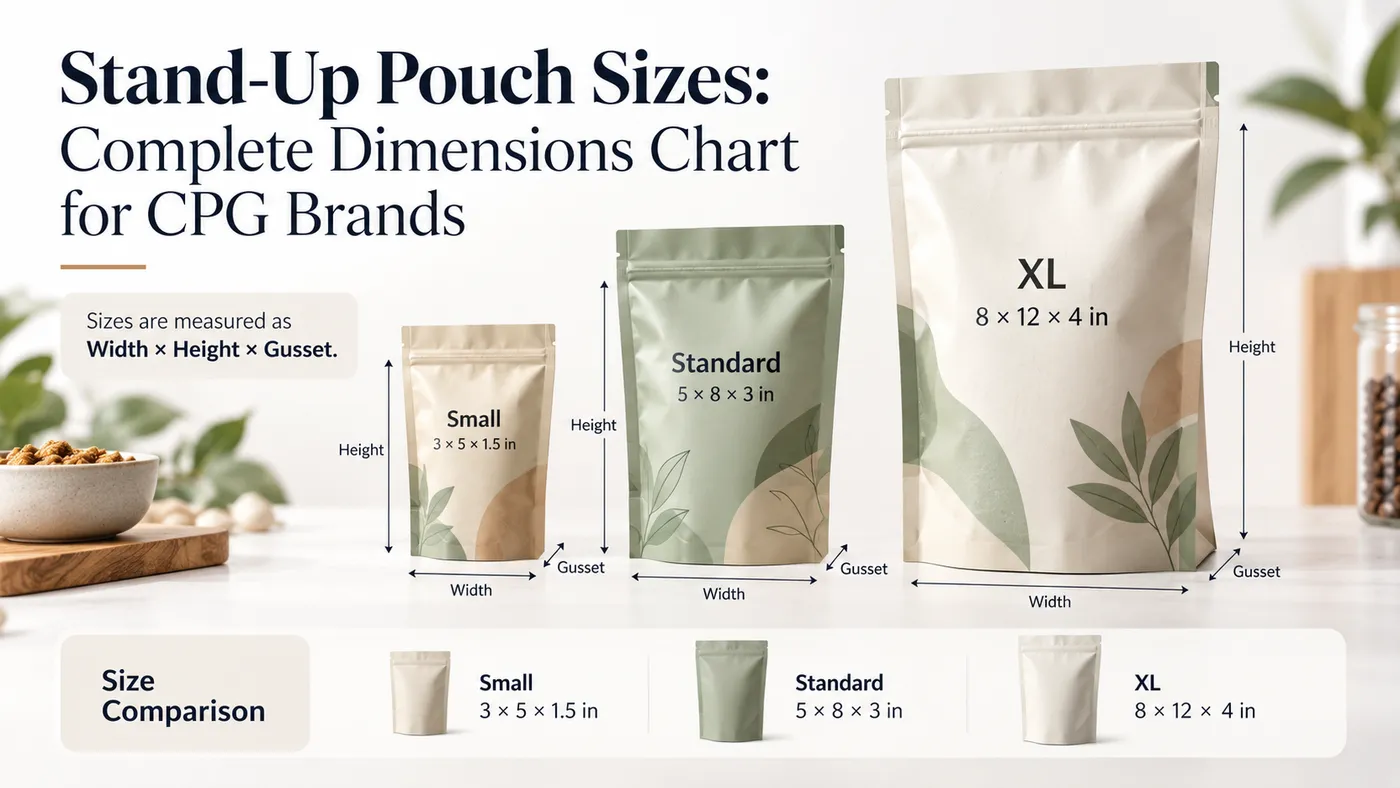
Stand-up pouch sizes are measured by three numbers: width, height, and gusset depth. A small stand-up pouch runs about 3×5×1.5 inches. A standard stand-up pouch, the size most CPG brands reach for first, runs about 5×8×3 inches. An XL stand-up pouch built for bulk product runs about 8×12×4 inches. This guide charts every common stand-up pouch size tier and explains what the gusset number actually does. Related reading: our coffee bag sizes chart, our snack pouch sizes chart, and the original mylar bag sizes guide. For everything else, our full box size guide covers the rest.
How Stand-Up Pouch Sizes Are Measured
Stand-up pouch sizes always come as three numbers: width, height, and gusset depth. Width and height are straightforward, the flat front panel's dimensions. Gusset depth is the number that confuses most first-time buyers. It's the folded bottom panel that unfolds when the bag is filled. That fold is what lets the pouch stand upright on a shelf at all.
A bigger gusset does more than add a little extra room. It changes the pouch's actual fill volume more than width or height changes alone. Two pouches with identical width and height but different gusset depths can hold noticeably different amounts of product. Always ask a supplier for all three numbers, never just two.
The Three Stand-Up Pouch Styles
A 3-side seal pouch is sealed on three sides, with the bottom gusset folding to let it stand. It's the most common and generally the most cost-effective stand-up pouch style. Material use stays lower, and production runs faster.
A 4-side seal pouch adds a seal across the bottom too. That extra seam cuts down on potential leak paths and holds its shape more consistently on a shelf. It costs a little more to produce. The tradeoff is worth it for liquids or anything prone to settling unevenly.
A K-seal, sometimes called a plow-bottom pouch, folds the bottom gusset into a K-shaped crease. That's a different fold than a simple round gusset. It stands flatter and more stable than a standard doypack fold. Brands chasing a premium shelf look often pick this style over a basic round-bottom gusset.
Stand-Up Pouch Sizes Chart
Size Tier | Dimensions (in) | Dimensions (cm) | Approx. Fill Volume | Typical Use |
|---|---|---|---|---|
Small | 3 × 5 × 1.5 | 7.6 × 12.7 × 3.8 | 2–4 oz | Samples, spice packets |
Medium | 4 × 6 × 2 | 10.2 × 15.2 × 5.1 | 4–6 oz | Snacks, single-serve coffee |
Standard | 5 × 8 × 3 | 12.7 × 20.3 × 7.6 | 8–16 oz | Coffee, snacks, pet treats |
Large | 6 × 10 × 3.5 | 15.2 × 25.4 × 8.9 | 1–2 lb | Kibble, bulk snacks |
XL | 8 × 12 × 4 | 20.3 × 30.5 × 10.2 | 3–5 lb | Bulk pet food, wholesale |
Standard is the size tier most CPG brands launch with. It fits a typical 8 to 16 ounce retail product. It doesn't look oversized or undersized on a shelf next to competitors.
Spouted Stand-Up Pouch Sizes
A spouted pouch uses the same body dimensions as a standard stand-up pouch. The difference is a plastic spout welded into the top or a top corner. It's sized to the product's pour or squeeze behavior. A thin liquid like a sauce or a baby food puree typically uses a smaller spout. A thicker product, like a nut butter, needs a wider spout opening to pour or squeeze out cleanly.
Spout placement and diameter matter more than the bag's own width and height once a pouch goes spouted. Confirm spout spec separately from body size when ordering, since the two numbers don't automatically scale together.
Retort Pouch Sizes
A retort pouch looks like a standard stand-up pouch from the outside, and it uses the same width/height/gusset sizing convention. What changes is the material. Retort pouches are built to survive high-heat sterilization, the process that makes shelf-stable wet food safe without refrigeration.
The material has to withstand that heat process. Retort pouches run slightly thicker than a standard mylar or film pouch of the same dimensions because of it. Confirm with your supplier that the specific film structure quoted is retort-rated. A standard barrier film in the same size won't hold up the same way. Our food packaging boxes line covers rigid formats too, for brands running both flexible and rigid packaging side by side.
How to Spec Your Stand-Up Pouch
A supplier needs five measurements to quote a stand-up pouch accurately. Width and height of the front panel come first. Gusset depth comes third, and it changes the fill volume more than either of the first two. Closure type comes fourth: resealable zipper, heat-seal-only, or a combination with a tear notch. Spout spec, if the product is a liquid or a pourable, comes fifth.
I've seen a brand skip the gusset number entirely. They just asked for "a 5 by 8 pouch." That supplier quoted a size. It held barely half the intended product once filled. All three body measurements matter, not just the two that are easiest to eyeball.
When a Standard Stand-Up Pouch Size Doesn't Fit
The five tiers above cover most CPG product lines. Not every brand fits neatly into small through XL, though. A product with an unusual density can need a size that doesn't exist on a standard chart. So can a co-packed multi-SKU order, or a brand chasing a specific shelf silhouette.
Standard sizes are the right starting point for almost every brand. The chart above should cover a normal product line's full range. When a specific product doesn't fit, EBP cuts mylar and stand-up pouches to any custom width, height, and gusset depth. Closure type and spout spec get built around the actual product, not the nearest standard slot.
Frequently Asked Questions
What is a standard stand-up pouch size? A standard stand-up pouch runs about 5×8×3 inches and holds roughly 8 to 16 ounces of product. It's the size most CPG brands launch a new product line with.
What does the gusset number mean on a stand-up pouch? Gusset depth is the folded bottom panel that unfolds when the bag is filled, letting it stand upright. It affects the pouch's actual fill volume more than width or height does on its own.
Is a retort pouch the same size as a regular stand-up pouch? Yes, retort pouches use the same width/height/gusset sizing convention. The difference is the film material, built to survive high-heat sterilization rather than standard barrier film.
The Bottom Line
Stand-up pouch sizes track three numbers: width, height, and gusset depth. They run from a small 3×5×1.5 inch sample bag up to an XL 8×12×4 inch bulk format. Give your supplier all three measurements plus closure type, and a spout spec if the product pours. Need custom dimensions or a specific barrier spec? Get a free quote — we run mylar and stand-up pouches in any size.