
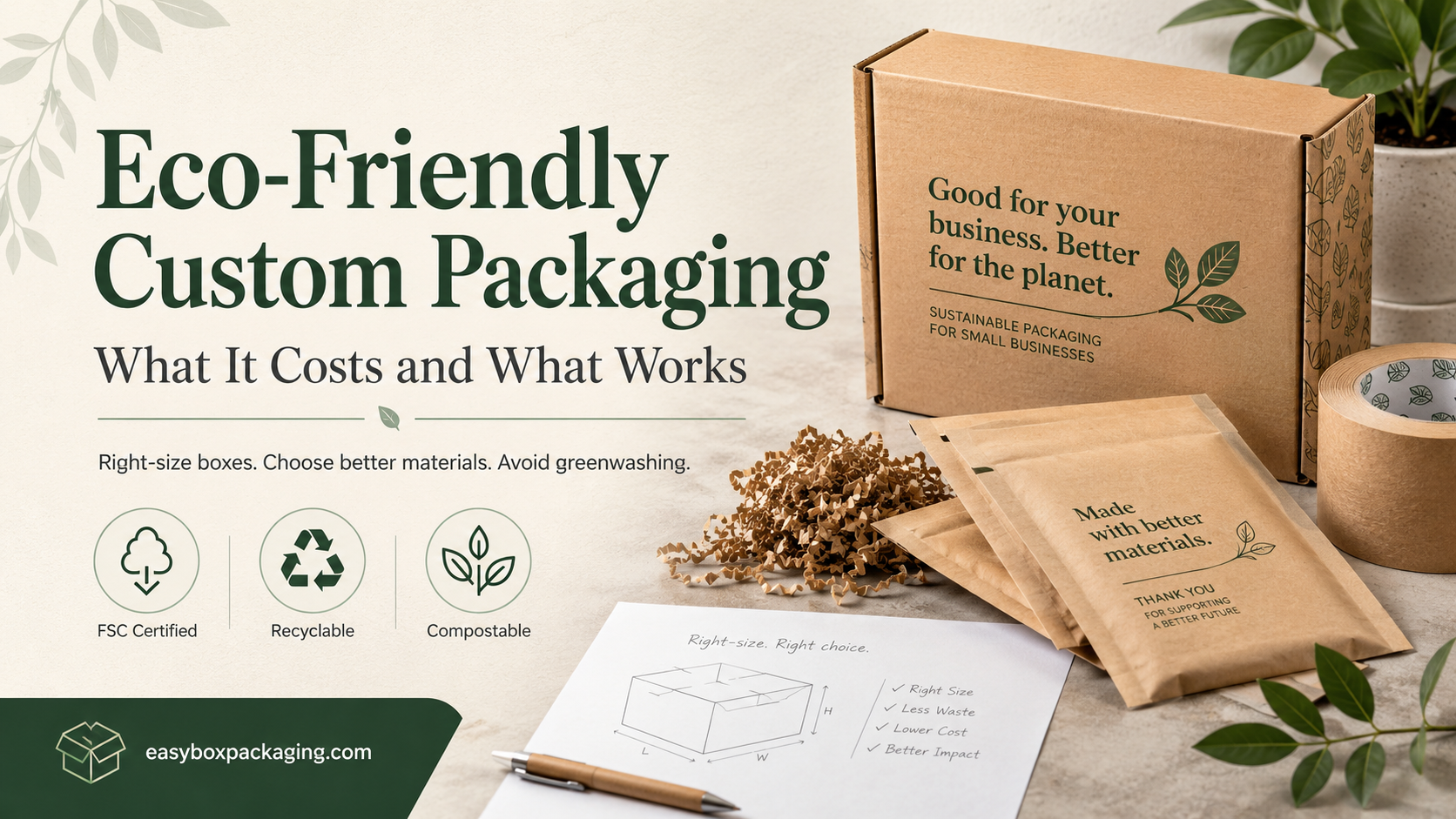
What “Eco-Friendly” Actually Costs (And What It Doesn’t)
Most brands expect eco-friendly custom packaging to be expensive. Some of it is. A lot of it isn’t.
The honest answer: switching to more sustainable packaging often costs you almost nothing if you start in the right place. Right-sizing your boxes — matching box dimensions to your actual product instead of using whatever stock size is cheapest — can often reduce material usage by 20% or more, and frequently your shipping costs alongside it. That’s not an eco upgrade with a price tag. That’s a free win hiding inside a sustainability decision.
Where real costs do appear is in specialty materials: certified compostable mailers, water-activated tape instead of plastic, soy-based inks on your custom print runs. These typically cost more per unit, especially at lower volumes. But the gap is smaller than most people expect, and it tends to close as your order volume grows.
This guide covers what actually changes when you go greener, which swaps are nearly cost-neutral, which ones genuinely cost more, and how to verify that your supplier’s “eco-friendly” claims mean something.
Right-Sizing: The Free Eco Win Most Brands Skip
Before you think about any material swap, look at your box dimensions.
Oversized boxes are the single most wasteful thing in most e-commerce packaging setups — and the most fixable. A box that’s two inches too wide on each side isn’t just wasting cardboard. It’s wasting filler material, adding unnecessary weight (which increases shipping cost and emissions), and reducing how many boxes fit on a pallet. The environmental cost of that extra air space is real, and so is the financial one.
You can do this right now without ordering a single new box. Measure your products, calculate the ideal fit with enough room for your fill material, and check whether your current box is meaningfully oversized. If it is, moving to a custom size through a supplier like Easy Box Packaging typically pays for itself in material and shipping savings within a few reorders.
Right-sizing is how sustainable packaging for small business actually makes financial sense. Not charity. Efficiency.
What you’ll learn:
- Which eco packaging swaps cost almost nothing (and which ones actually do cost more)
- How to verify your supplier’s certifications — not just take their word for it
- The greenwashing traps that catch small brands off guard
- What to say on your packaging that’s legally defensible
- How to phase in eco materials without disrupting your supply chain
Time to read: 10 minutes
What Eco-Friendly Actually Means in Packaging
Eco-friendly packaging isn’t one thing. It’s a spectrum, and understanding where different materials sit on that spectrum is how you avoid wasting money on certifications your customers can’t actually verify — or worse, making claims you can’t back up.
Recycled content means the material contains post-consumer recycled (PCR) material — the most common eco claim and the easiest to verify. Corrugated cardboard in the US already uses a high percentage of recycled fiber. PCR board is often equal to or slightly cheaper than virgin board at commercial volumes.
Recyclable means the material can be recycled. Not that it will be — that depends entirely on your customer’s local infrastructure. Standard corrugated boxes are widely recyclable. Poly mailers and mixed-material packaging often aren’t, even if they’re technically recyclable somewhere.
Compostable is the most complicated category. There’s a significant difference between BPI-certified industrial compostable and OK Compost HOME certified. Most brands don’t know it. Industrial compostable materials break down in facilities that operate at temperatures above 140°F. A backyard compost pile rarely hits those temperatures. Drop the same mailer in your compost bin at home, and it may still be sitting there years later. If you’re going the compostable route, be specific about which certification your product carries — because your customers will ask.
Biodegradable is largely a meaningless marketing term without a timeline or condition attached to it. The FTC Green Guides exist specifically to flag vague claims like this. If a supplier uses “biodegradable” without any certification, treat it as a red flag.
The Materials
FSC-Certified Corrugated
This is where most brands should start. FSC certification — verifiable at info.fsc.org — means the wood fiber in your corrugated boxes was sourced from responsibly managed forests. It’s a chain-of-custody standard. Not just a feel-good label.
The cost premium is typically 0–5% over non-certified corrugated, which is almost nothing once you’re at any real order volume. The certification is globally recognized, environmentally meaningful, and increasingly expected by retail buyers and environmentally conscious consumers.
And while you’re upgrading your corrugated, push for soy-based or water-based inks instead of petroleum-based. Most commercial printers already offer this — in many cases it’s the default. Color quality is comparable; environmental impact is meaningfully better. FSC-certified corrugated plus soy-based inks is the single strongest combination available without jumping to specialty materials.
FSC is the certification I’d push for. SFI (Sustainable Forestry Initiative) is fine, but it’s not the standard that most environmentally conscious customers recognise — and when your customer is scanning for proof, FSC is the one they know.
Recycled Kraft Mailers
The kraft mailer is having a moment. Natural brown kraft paper mailers, made with significant recycled content, typically run $0.20–$0.70/unit depending on size and order volume. That’s not meaningfully different from a standard poly mailer at scale. And they photograph better on social.
Kraft is curbside recyclable in most municipalities. That’s a real practical advantage over poly. The aesthetic of recycled custom boxes carries its own signal too — it reads as intentional rather than just cheap.
Compostable Mailers
These typically run $0.15–$0.60/unit. The spread is wide because the certification level matters enormously — an OK Compost HOME certified mailer costs more to produce than an industrial compostable one, because it has to meet stricter breakdown conditions.
The distinction matters because industrial composting facilities run at temperatures above 140°F to accelerate breakdown. A backyard pile rarely hits those temperatures. If you’re marketing these as “home compostable,” you need the OK Compost HOME certification to back that up — not just a vague “compostable” stamp on the box.
Paper Tape
Paper tape. Seriously. Switching from plastic packing tape to water-activated paper tape is the cheapest eco swap in the whole setup — typically $0.10–$0.25/roll — and it looks significantly better than plastic. It seals more securely on corrugated, it’s curbside recyclable with the box, and it signals care in a way plastic tape never does. Most brands sit on this one for way too long.
PCR Board
Post-consumer recycled board for rigid boxes and folding cartons is often equal to or slightly cheaper than virgin board depending on the supplier and spec. It’s not always visually distinguishable. If you’re ordering rigid gift boxes and you’re not already asking about PCR content, you may be paying for it anyway without getting to say so.
The Greenwashing Traps
I’ve seen brands put the recycling symbol on packaging that isn’t curbside recyclable in most cities. They didn’t mean to mislead anyone — they just didn’t know the symbol isn’t regulated. The “chasing arrows” icon technically just means the material is theoretically recyclable somewhere. Not that your customer’s bin pickup will take it.
Honestly, I think most small brands don’t greenwash intentionally — they just copy what they see bigger brands doing, and bigger brands have been getting away with vague eco claims for decades. But the FTC Green Guides have real teeth now, and regulators are paying closer attention to packaging claims than they were five years ago.
The things that’ll get you in trouble:
Calling something “biodegradable” without a timeline or specific conditions. Using “eco-friendly” as a general packaging descriptor without material evidence. Claiming recyclability for packaging that most municipal programs won’t accept. Printing a composting claim without specifying industrial vs. home-certified.
The things that are genuinely defensible: specific material certifications (FSC, BPI, OK Compost HOME), a stated percentage of recycled content with a verifiable source, and language like “recyclable where facilities exist” — which is honest and FTC-compliant.
Sound familiar? These are exactly the claims you’ll find on competitor packaging. The difference between the brand doing it right and the one creating liability is one honest conversation with their supplier about what they can actually verify.
How to Verify a Supplier’s Certifications
Don’t take the supplier’s word for it. FSC certificates are publicly searchable at info.fsc.org. BPI certification for compostable packaging has a searchable database at bpiworld.org. OK Compost HOME certification is issued by TÜV Austria and verifiable through their portal.
How do you know if a supplier is actually certified versus just claiming to be? Ask for the certification number. Ask which certifying body issued it. Search the database yourself. A legitimate supplier will hand you this immediately. One that hesitates or says “we’re working toward it” is telling you something important.
We’ve worked with 10,000+ brands across the full range of eco packaging specs, and the suppliers that cut corners on certification documentation tend to cut corners on other things too. Certification isn’t just a marketing checkbox — it’s a signal about how seriously the whole operation is run.
If you want help navigating the verification process, Easy Box Packaging’s team can walk you through certified material options and documentation before you commit to an order.
Where to Start Without Disrupting Your Supply Chain
The mistake most brands make when going green is trying to switch everything at once. New material, new supplier, new certification process — all simultaneously. That’s how you end up with a supply chain headache in the middle of a product launch. Not worth it.
Do it in phases. Right-size first — no new materials, no new suppliers, just smarter dimensions. Then swap to FSC-certified corrugated on your next box reorder, since the visual difference is negligible and the cost difference is minimal. Then look at your tape and infill on the following cycle. Each swap is small, reversible, and low-risk. The goal isn’t to overhaul everything simultaneously — it’s to build toward a complete set of green packaging materials over a few order cycles without the chaos.
We should be clear about our own position here: Easy Box Packaging benefits when you order packaging from us. That’s why we’ve tried to make this guide useful whether you order from us or not. The phased approach works with any supplier, and the certification verification steps are the same regardless of where you buy.
FAQ
Is eco-friendly packaging actually recyclable or is it just marketing?
It depends on the specific material and certification. FSC-certified corrugated and recycled kraft are genuinely, widely recyclable. Compostable mailers are only compostable under specific conditions — industrial or home, depending on the certification. “Biodegradable” without further qualification is mostly marketing.
Does eco packaging cost significantly more?
For FSC-certified corrugated and paper tape, the difference is minimal — typically 0–5% for the FSC upgrade. Compostable mailers do cost more than basic poly at equivalent volumes, typically $0.15–$0.60/unit. The gap narrows as volume increases.
Can I use the recycling symbol on my packaging?
The chasing arrows symbol isn’t regulated in the US — which sounds like freedom but is actually a liability trap. Using it on non-recyclable packaging exposes you to FTC action. Only use it on materials accepted by most curbside programs, or add a qualifier: “recyclable where facilities exist.”
What’s the difference between BPI certified and OK Compost HOME?
BPI certification indicates industrial compostability — the material breaks down in a commercial composting facility. OK Compost HOME certification, issued by TÜV Austria, means the material breaks down under home composting conditions (lower temperature, slower process). If you’re selling to consumers who compost at home, OK Compost HOME is the certification that matters.
Do I need to switch all my packaging at once?
No. A phased approach works well — right-size first, then swap materials one category at a time on natural reorder cycles. This avoids supply chain disruption and lets you test each material change before committing at full volume.
Pricing and MOQs vary by specification. Request a custom quote for accurate details. Worth testing material samples before committing to a full production run — what looks good on a spec sheet doesn’t always feel right in your hands.
If you’re looking at the bigger picture of how packaging decisions compound over time, our guide to custom mailer boxes covers structural options in more depth. And if you’ve ever wondered whether packaging choices affect whether customers come back, the repeat purchase connection is worth reading before your next reorder. Seven mistakes that quietly undercut the work — including eco choices that backfire — are covered in our unboxing mistakes roundup.
I think about this a lot: the brands getting eco packaging right aren’t the ones chasing the most impressive-sounding certification. They’re the ones who can actually explain what’s on the box, answer a customer’s question honestly, and back it up with a document. That’s the bar. It’s achievable. And most of your competitors aren’t there yet — which means getting there puts you in cleaner competitive territory than you’d expect.