
The Moment That Decides Whether They Come Back
Your customer’s order arrives. They pick it up off the doorstep, feel the weight of it, turn it over. That moment — before they’ve even pulled the tape — has already started working on them.
Here’s the short answer: yes, custom packaging repeat purchases are directly connected. Not in some vague brand-awareness way. In a concrete, measurable, psychological way. Research suggests that branded packaging influences repeat purchase decisions for a meaningful portion of consumers, and brands across beauty, subscription, and DTC apparel report some of the strongest loyalty lifts from packaging investments.
But the why is more interesting than the stat. And understanding the why is what’ll help you decide whether upgrading your packaging is worth it — or just another expense.
The Psychology of Opening a Box (Why It Stays With People)
There’s a real mechanism here, not just marketing intuition.
When your customer gets a delivery notification, their brain releases dopamine — the same reward chemical involved in anticipation of any pleasurable experience. By the time they’re physically holding the box, they’re already primed for a positive reaction. What happens next either confirms or deflates that anticipation.
This is sometimes called the “gift effect.” When packaging is thoughtfully designed — feels sturdy, looks intentional, opens with some friction and satisfaction — the brain encodes the experience as something given, not just something bought. That distinction matters. Gifts carry emotional weight. Transactions don’t.
And here’s the kicker: emotional memories are stickier than rational ones.
Your customer probably doesn’t remember the exact product page they bought from. They don’t remember the shipping confirmation email. But they remember how it felt to open the package. That feeling is what they’re reliving when they decide whether to buy again.
We’ve seen brands struggle with this disconnect constantly. The digital experience is polished, the product is genuinely great — and then a beige poly mailer shows up and the whole thing deflates. It’s not that customers consciously think “I’m disappointed in this packaging.” It’s subtler. The feeling of disappointment just… attaches to the brand.
What you’ll learn in this article:
- Why the unboxing moment builds long-term memory (and loyalty)
- What generic packaging is actually communicating to your customer
- Which product categories see the biggest retention lift from packaging
- What makes packaging shareable — and why that drives growth
- How to upgrade without destroying your margins
- How to tell if your packaging changes are actually working
What Generic Packaging Is Actually Telling Your Customer
A plain brown box isn’t neutral. That’s the thing most brands miss.
It doesn’t say nothing. It says: we thought about shipping costs. Which is fine — everyone thinks about shipping costs. But your customer doesn’t want to feel like a line item.
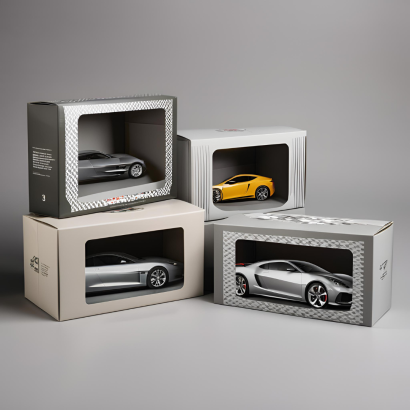
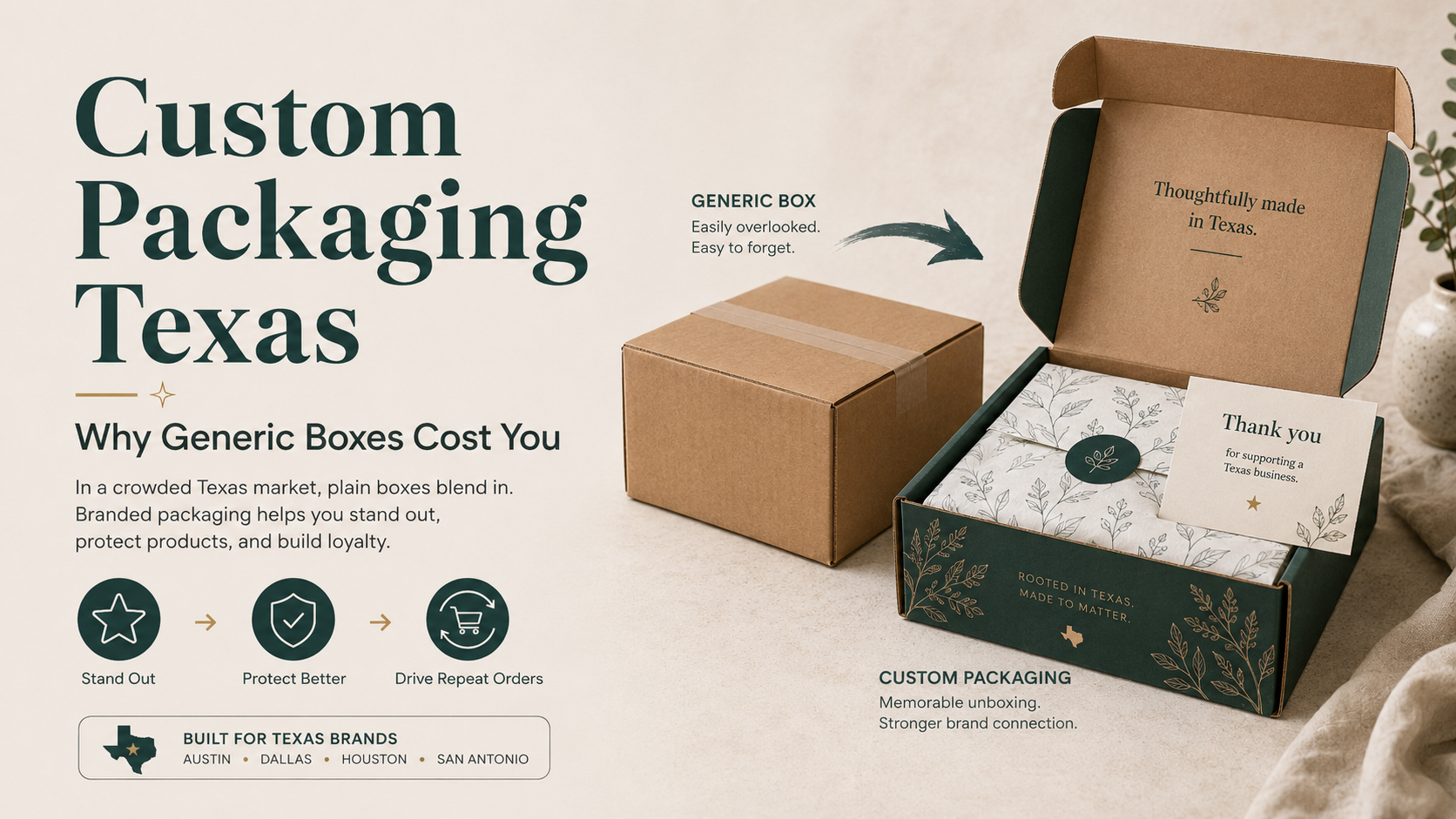
Compare that to a branded box. Even something simple — your color, your logo, a single printed line on the inside flap. That says: we thought about you getting this. That’s a different feeling entirely. And feelings drive decisions.
I’ll be direct — if your product arrives in a plain brown box and your competitor’s doesn’t, you’ve already lost the comparison. Not on product quality. Not on price. On the first physical impression, before they’ve even seen what’s inside.
So what does poor packaging actively cost you?
It creates a gap between expectation and reality. Your customer had a digital experience — clean website, smooth checkout, maybe a nice confirmation email — and then the physical delivery doesn’t match any of it. That gap breeds doubt. Doubt about quality. Doubt about whether they made the right choice.
It also forfeits the share moment. More on that in a bit.
And it makes retention harder to earn back through other channels. You can send all the win-back emails you want, but you’re fighting against a physical memory that said “this brand doesn’t really care.”
The Packaging-to-Loyalty Connection: Where It Shows Up Most
Not every category sees the same lift. We can’t give you a single number — the impact depends heavily on your product category and customer base. But some patterns are consistent.
Subscription boxes are probably the clearest case. The entire value proposition is the experience of receiving. If the box itself isn’t worth opening excitedly, you’ve already undermined the product before anyone sees it. The brands that retain subscribers longest tend to treat packaging as part of the product, not the container around it.
Subscription boxes live or die on this. I’ve seen brands with genuinely good products churn at rates that shouldn’t be possible — and when you look at what they shipped in, it’s usually a plain shipper. The box IS the subscription, not just the container.
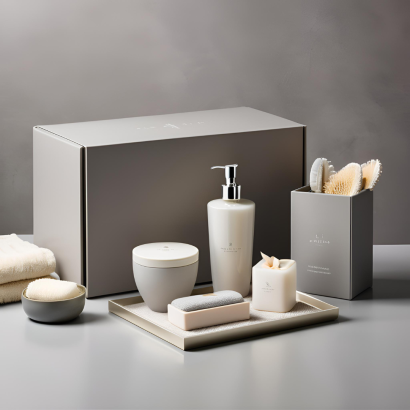
Beauty and skincare is another strong one. Beauty buyers are emotionally involved in their purchases — it’s personal, it’s identity-adjacent, and they share on social constantly. Premium packaging in this category doesn’t feel like a luxury; it feels like proof that the product inside is worth the price.
DTC apparel and gifts. When someone is buying a gift (even for themselves), they want the physical handover to feel special. A well-packaged gift item creates a moment. A plain poly mailer creates a chore.
The common thread? These are all categories where the experience of having matters as much as the product itself. If your product sits in that territory, packaging is doing real loyalty work whether you invest in it or not. The question is which direction that work points.
What Makes Packaging Share-Worthy (And Why That Matters for Growth)
Consumers who encounter packaging that feels genuinely different — unusual texture, a clever interior print, a handwritten-style note, tissue paper in a color they didn’t expect — reach for their phones. Research suggests that a significant portion of consumers are likely to share unboxing content on social media when packaging feels special or gift-like.
That’s word-of-mouth. At scale. For free.
And the math on this compounds fast. A shared unboxing post isn’t just an impression. It’s a trusted recommendation from a real person who already bought from you. That kind of social proof has a conversion rate that paid ads simply can’t touch.
So what makes packaging actually shareable?
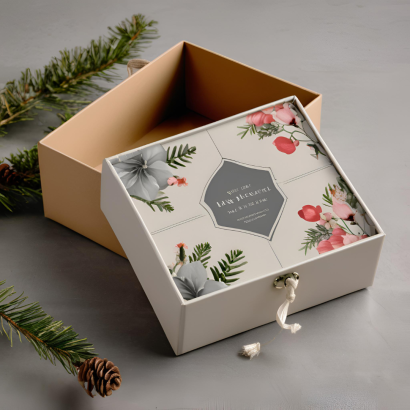
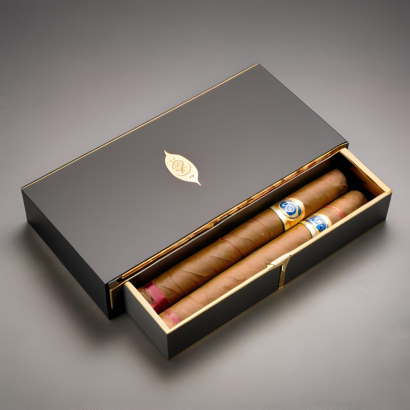
It’s rarely just the logo. It’s usually something unexpected. An interior print that only reveals itself when you open the lid. A message that’s clearly been written for the customer, not a demographic. Packaging that reuses beautifully — a rigid box someone genuinely wants to keep on their desk.
The texture matters too. We talk about this a lot. Soft-touch laminate on a mailer, a matte finish that feels different from every other box your customer handled that week — these tactile details register. They’re the difference between something your customer puts down and something they photograph.
How to Upgrade Packaging Without Destroying Your Margins
The honest answer is that packaging upgrades don’t have to be dramatic to be effective. You don’t need to go full Apple-unboxing-experience on your first run.
Start with structure before surface. A box that’s the right size for your product, that doesn’t rattle around with excess void fill, already communicates more care than a slightly-too-big plain box stuffed with packing peanuts. Sizing alone signals intentionality. This is also the cheapest lever — right-sizing your packaging often reduces material costs and dimensional weight fees simultaneously.
If you can’t afford full custom print runs yet, a branded tissue paper, a printed insert card, or even a sticker over the seal does something. It breaks the “this was packed by a robot” feeling without requiring a six-figure commitment to a print run.
The “I can’t afford it” framing is usually the wrong frame, by the way. The economics of custom packaging are almost always volume-dependent, and the mistake is comparing the cost of custom packaging to plain boxes without accounting for the retention value you’re building. If you’re at lower order volumes, there are suppliers (including us, when the spec fits) who work at smaller minimums. We offer custom mailer boxes with 100% FSC-certified corrugated — which also matters to a growing portion of customers who care where their packaging comes from. We’ve worked with 10,000+ brands across basically every category, so if you’re trying to figure out what spec makes sense for your margins, requesting a quote is usually the fastest way to get a real number rather than a guess.
Pricing and MOQs vary by specification. Request a custom quote for accurate details.
Measuring Whether Your Packaging Is Working
You can’t improve what you don’t track, and packaging ROI is genuinely tricky to isolate.
Repeat Purchase Rate (RPR) is your primary signal. If you’re seeing customers return for a second order at a higher rate after a packaging upgrade, that’s directional evidence it’s working. For most ecommerce businesses, a healthy RPR sits somewhere in the 20–40% range. If yours is significantly below that, packaging is worth examining alongside other retention factors.
After a packaging upgrade, look at qualitative signals too — do customer reviews start mentioning the packaging? Does your NPS tick up? Are you seeing organic unboxing content show up on Instagram or TikTok when you search your brand name? These are soft signals, but they’re real ones, and they tend to move together when the packaging change is landing.
Cohort comparison is where you get something concrete. If you can run a packaging test — same product, different packaging, comparable traffic periods — then compare the 90-day repeat purchase rate between cohorts. It’s not perfect science, but it gives you something real to work with. The honest uncertainty in the data is actually fine; you’re looking for directional consistency, not a controlled trial.
I’ve watched brands make a packaging upgrade and then immediately ask me if it’s working. The honest answer is: give it 90 days, measure RPR, and trust the direction of the data more than any single data point.
Honestly? Most brands don’t measure this rigorously. They make a packaging upgrade, feel good about it, and assume it’s working. That’s not the worst approach — but if you want to make a real case for the investment internally, even a rough cohort comparison beats nothing.
Results vary by product and handling. We recommend testing samples before full production.
FAQ
Does packaging actually affect whether someone buys again?
Research suggests it does — particularly for categories where the experience of receiving matters. Branded packaging creates positive emotional associations that influence whether a customer remembers your brand warmly when it’s time to reorder. It’s not a guarantee, but it’s a real factor in the retention picture.
Is it worth upgrading packaging when my margins are already thin?
It depends on your volume and category. At scale, custom packaging per-unit costs become competitive with generic alternatives — especially when you factor in the cost of customer acquisition. Retaining a customer is substantially cheaper than acquiring a new one. If thin margins are the issue, the question isn’t just “what does better packaging cost” — it’s “what does losing that customer cost.” For brands shipping out of California or Texas, regional suppliers can also reduce freight costs on packaging, which helps the math.
What specifically makes packaging worth sharing?
Surprise is the main driver. Texture people didn’t expect. An interior print that only appears when the box is open. A message that feels genuinely personal. Packaging that’s beautiful enough to keep or reuse. None of these require huge budgets — they require intentionality.
How do I measure if better packaging is helping retention?
Track your repeat purchase rate before and after. Look at NPS shifts. Monitor social mentions. If you can run a cohort test — same product, different packaging, similar traffic — compare 90-day repurchase rates. It’s not always clean data, but consistent directional signals across multiple metrics tell a real story.
Conclusion
Packaging isn’t a loyalty program. It won’t replace a great product, or honest customer service, or pricing that makes sense. But it’s the physical moment your brand has — the only one where your customer is holding something you made, feeling it, forming an impression that sticks.
Generic packaging doesn’t just fail to help. It quietly undermines everything else you’ve built. And upgrading doesn’t have to mean an expensive overhaul. It means being intentional about the moment your customer actually receives what they paid for.
I’d argue it’s the highest-leverage moment most brands aren’t thinking about. Not the ad. Not the email sequence. The moment your customer is actually holding something you made. That’s yours. Don’t waste it.