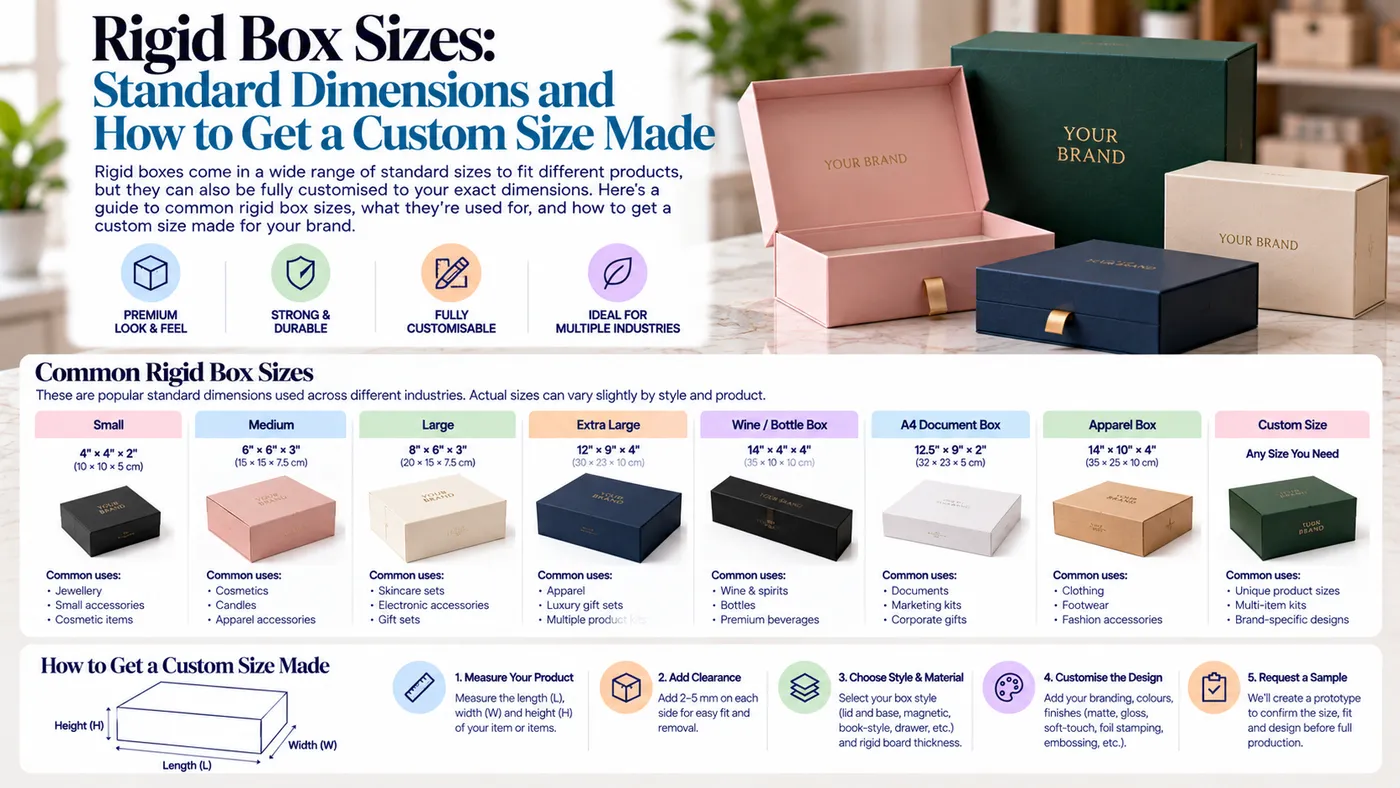
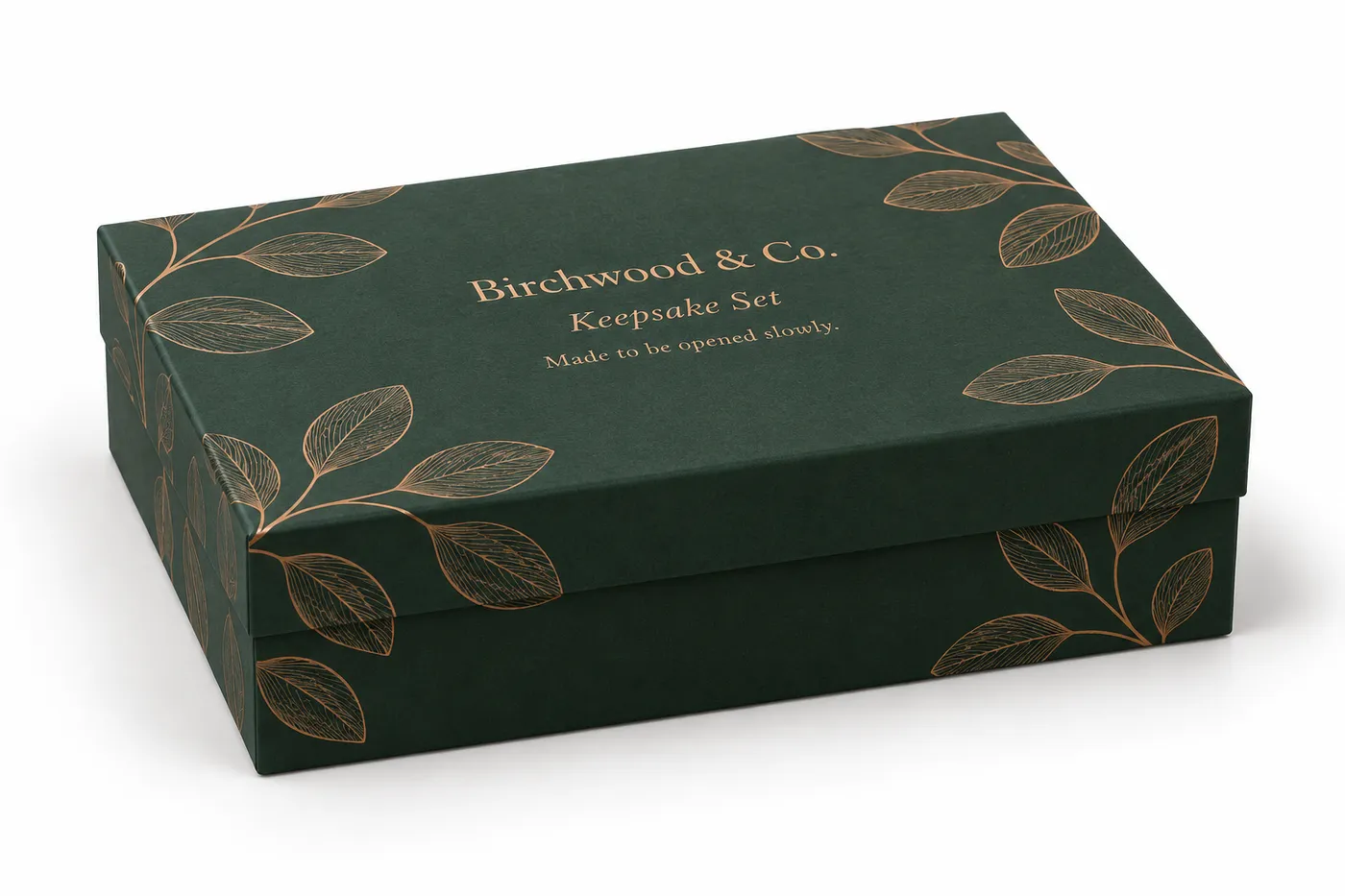
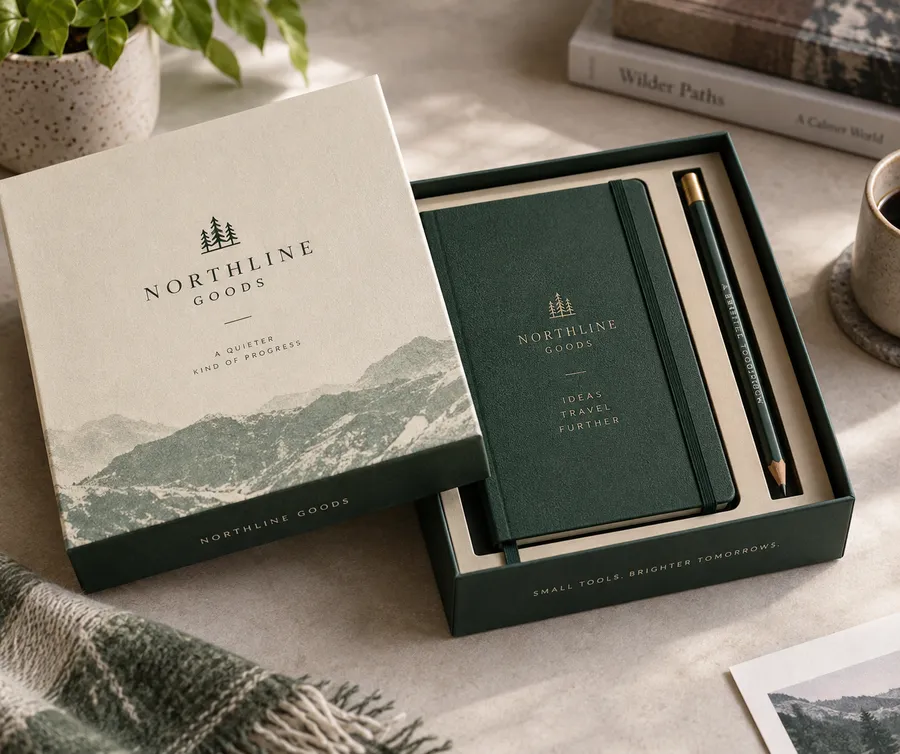
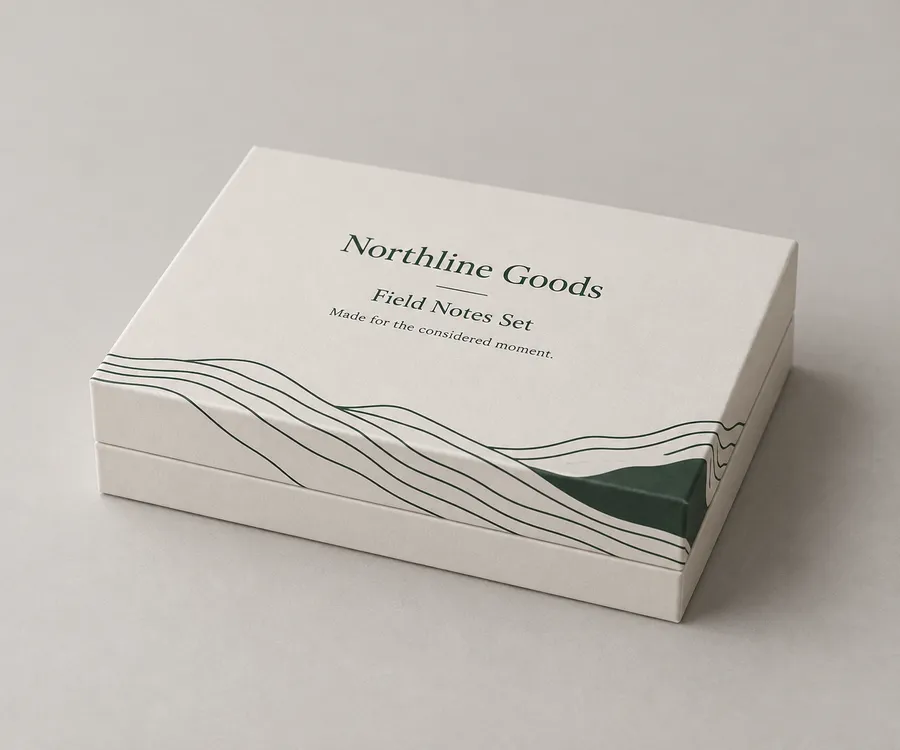
There is no industry-standard set of rigid box sizes. A rigid box is a set-up format built around one specific product, so nearly every order is custom-sized. The right dimensions come from measuring the filled, sealed product. Then you add insert allowance and choose a lid style. Ask "what does my product measure filled and sealed?" Don't ask "what sizes do you offer?"
Quick answer
Rigid box sizes are specified by inner cavity length × width × height, usually in millimeters.
Outer size adds board thickness per wall: about 4 mm per axis for 2 mm board.
Measure the product filled and sealed, with labels, caps and seals on.
Inserts, compartments and lid style change the final dimensions.
Easy Box Packaging rigid orders start from 50 units.
How rigid box sizes are measured
Makers specify rigid box sizes by the inner cavity: the space your product occupies. Length is the longer side of the opening. Height runs from the floor to the rim. Our packaging glossary defines the other terms.
Outer size is bigger. Each wall is chipboard plus wrap paper. Board thickness runs from about 0.8 mm to over 3 mm, per Bologna's Packaging Design Innovation Lab. QinPrinting pairs 2 mm board with smaller boxes and 3 mm with large ones. So a 2 mm wall adds about 4 mm per axis, plus a little for wrap.
The most common error is measuring the product empty or unassembled. Measure it as it will ship. A jar with its lid, label and shrink seal is bigger than the bare jar. A kit with its trays assembled is bigger than its parts. Our how to measure a box guide walks through the technique.
Common rigid box sizes by product type
Rigid box dimensions vary with the product, so any table here is a planning aid only. These bands are illustrative inner cavity sizes. They aren't a standard or an Easy Box Packaging size list.
Band
Inner L × W × H (mm)
Typical contents
Small
80–130 × 60–100 × 30–60
Single vial, dropper bottle, cosmetic item
Medium
150–220 × 100–160 × 50–90
Supplement starter kit, candle gift box, skincare duo
Large
240–320 × 150–200 × 80–120
Multi-component healthcare kit, device plus accessories
XL
330+ × 200+ × 120+
Subscription gift set, multi-vial kit, large candle set
Treat these as a starting sketch. Your product sets the real numbers.
What affects final rigid box dimensions
Five things move the final rigid box sizes of any project.
Primary container: the jar, bottle or pouch, measured filled and sealed.
Insert geometry: a thermoformed tray or foam block takes up space, so the cavity shrinks around it.
Board thickness: thicker board raises outer size and changes how the lid feels.
Compartments: each divider adds board thickness, and each compartment needs its own clearance.
Lid overlap style: the lid wall adds to outer size, and lid depth is quoted separately.
Inserts deserve a closer look. A snug cavity gets the fit allowance. The box interior then equals the insert's outside plus a small gap. Don't stack full clearance on top of a snug cavity. Our box insert types guide compares the options.
Standard vs Custom Sizes
There is no industry-standard rigid box size. Rigid boxes are a set-up format built to contain a specific product, so every rigid box is effectively custom-sized. Correct dimensions come from measuring the filled and sealed primary container. Then account for insert type and lid style.
That's why stock lists mislead. A "medium" from one maker won't match another's. Easy Box Packaging's small rigid boxes page says compact boxes avoid a nominal stock size. Our rigid boxes range is made to order from 50 units. We don't publish a surcharge rule, so ask for a quote on your dimensions.
I'd start every rigid project from the product, never from a size menu. A box chosen from a menu usually ends up either rattling or too tight.
Products that fit this guide
A few Easy Box Packaging products that fit what this article covers.
A rigid two-piece gift box with a lift-off lid for a single keepsake, bottle, or jar. Choose SBS or kraft paperboard, then size the base and any insert around the item so the finished presentation has the structure and finish the gift calls for.
A 2 piece rigid box uses a separate base and lift-off lid to give a single product or compact set a stable presentation. Share the packed footprint, height, weight, insert needs, opening direction, print coverage, and finish preference so the structure can be reviewed around the actual item.
Small rigid boxes give compact products a firm base-and-lid presentation without forcing a nominal stock size. The finished footprint is scoped around the packed item's length, width, height, weight, insert needs, opening sequence, printed panels, and shipping route.
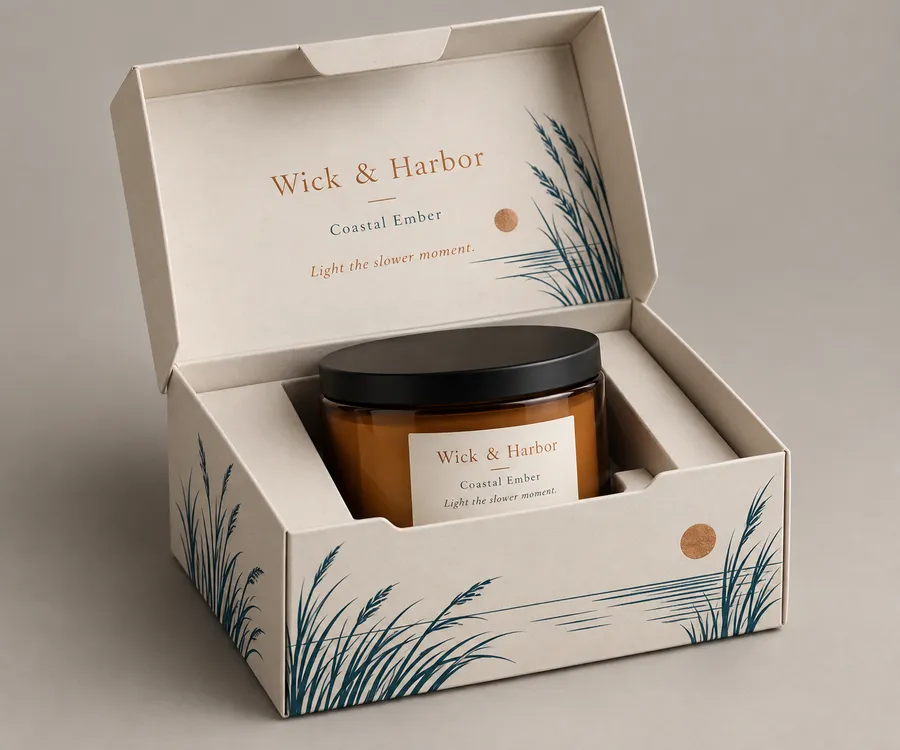
Rigid candle boxes use a sturdy two-piece base and lift-off lid to present a jar or tin with a deliberate opening moment. The box, insert, board, print, and finish are sized around the vessel's widest point and full height, including the lid. Share the packed dimensions, quantity, artwork direction, and shipping route for a quote-ready specification.
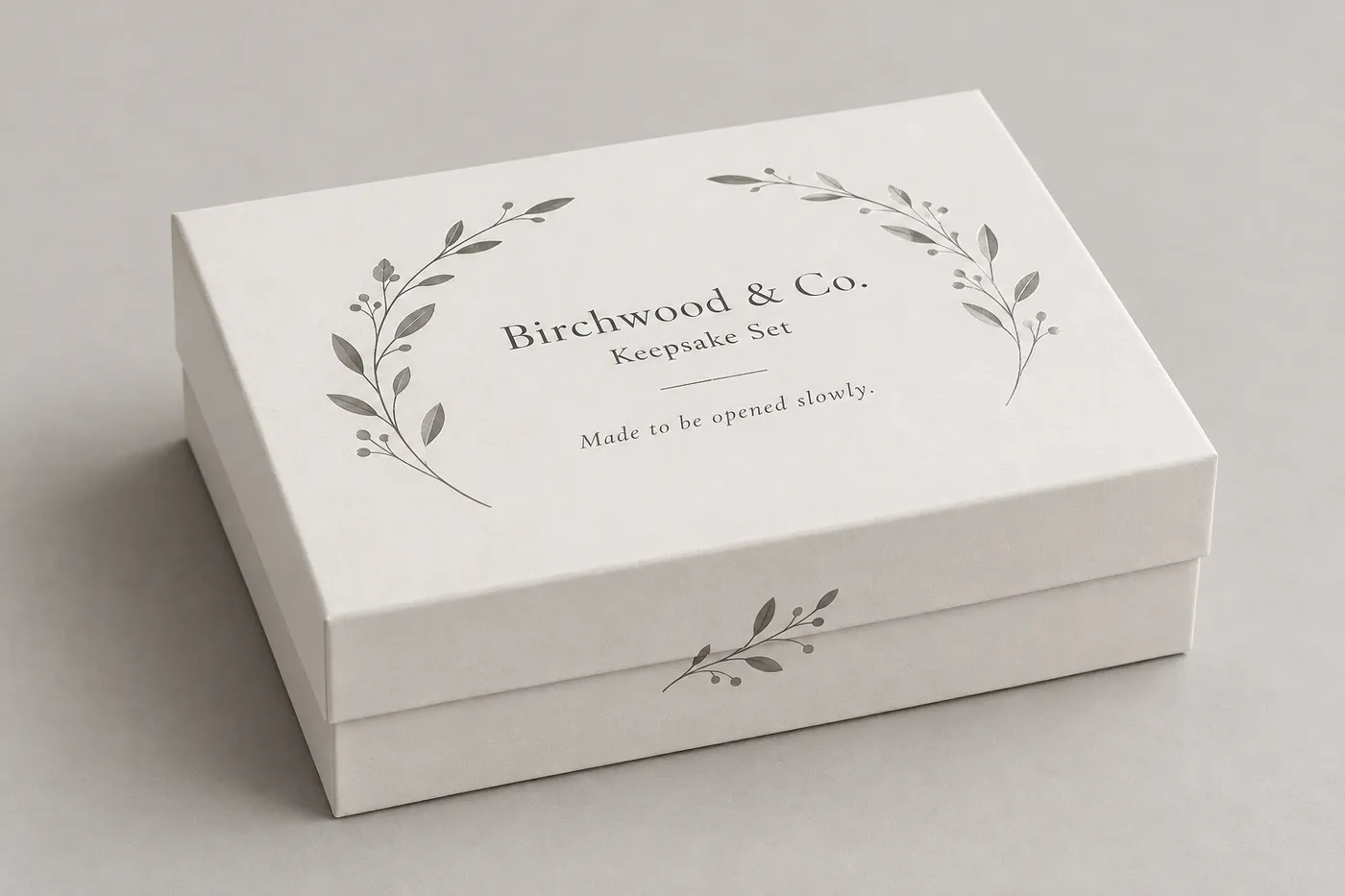
Custom white rigid gift boxes made to order around one keepsake, bottle, jar, or similarly presentation-led product. The separate base and lift-off lid hold a clean silhouette while your artwork, paperboard choice, finish, and optional insert are reviewed around the actual item inside.
Custom luxury candle boxes are printed around the real vessel, lid, and opening experience rather than a generic carton size. Choose a folding carton, sleeve, or more substantial base-and-lid direction, then coordinate the insert, board, artwork, and finish around a jar, tin, or gift set. The result is a composed pack for retail, gifting, or a careful unboxing.
Measure the filled, sealed container. Use a rigid ruler. Record length, width and height at the widest points, in millimeters.
Add clearance. Our size guides use about 1/8 to 1/4 inch (roughly 3 to 6 mm) per dimension. That's common guidance, not a standard. Tolerance varies by maker.
Confirm insert type and depth. Say whether the product sits in a tray, foam or pulp cradle. Add the insert's real thickness under the product.
Submit the brief. Send L × W × H in mm, photos of all four sides, and insert notes.
Measure three units from different batches and use the largest. Caps and labels drift between lots. I've seen a perfect fit turn tight on a reorder for exactly that reason.
Lid styles and how they change rigid box sizes
Lid style changes both the outer dimensions and how the box opens. Name it on the quote.
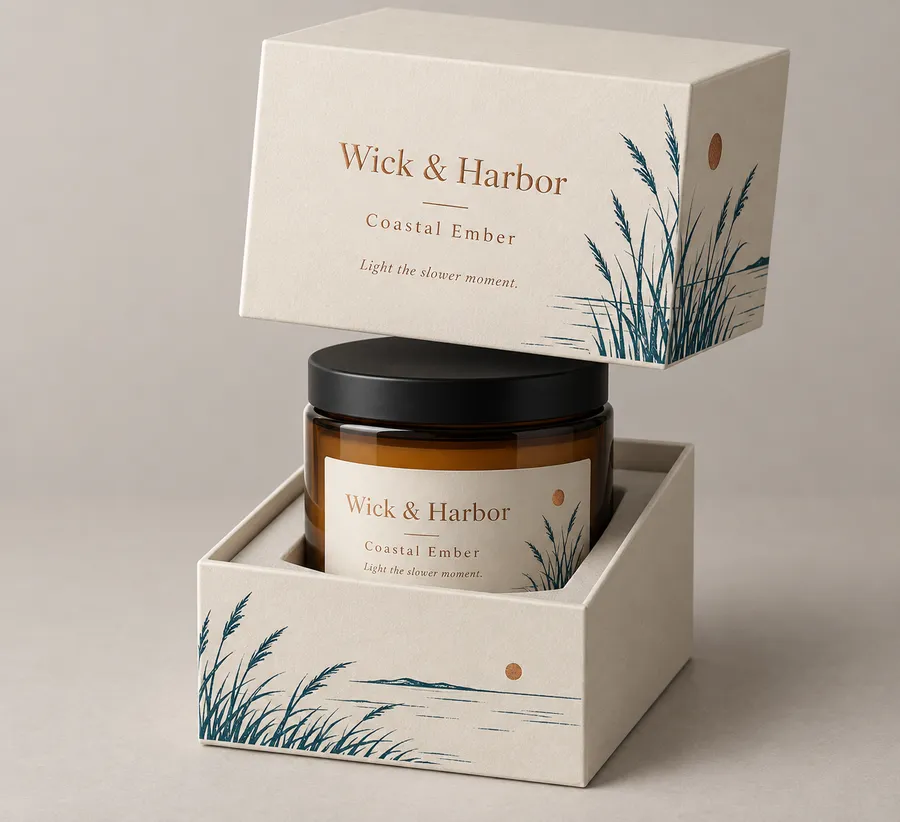
Lift-off lid (two-piece, or telescope box): the lid drops over the base like a hat. The lid interior must be slightly larger than the base exterior. A deeper lid covers more of the base. A shallow lid covers less.
Shoulder-neck: an inner neck sits under the lid and frames the product.
Hinged lid: the lid attaches along one edge and swings open like a book.
Slide-open sleeve and tray: a tray slides out of a sleeve. Size the sleeve and tray separately, with clearance so it slides smoothly.
Overlap depth in rigid box sizes is a design setting your manufacturer chooses. I couldn't find a published standard for it. Too tight and the lid binds. Too loose and it rattles. Ask for a sample.
Which should you choose?
Start from the product, then pick the structure. A single candle in a jar suits a lift-off lid or shoulder-neck box. A multi-vial healthcare kit needs a compartmented insert. A subscription box with several items wants a larger cavity and a tray. For kit-style structures, see our custom healthcare rigid kit boxes and custom supplement box kits.
If you're unsure about fit, order a sample first. Packaging samples catch lid and tolerance problems before the full run. Our manufacturing page shows how we build.
What to send your packaging manufacturer
Product dimensions, filled and sealed, in L × W × H mm, with the opening side marked.
Product weight and the number of items per box.
Photos of all four sides, plus a photo beside a ruler.
Insert type, depth and number of compartments.
Lid style: lift-off, shoulder-neck, hinged or sleeve and tray.
Board preference, wrap paper, printing and finishing.
Quantity, artwork status, destination and required date.
Key takeaway
Rigid box sizes always start with the filled, sealed product. Quote the inner cavity in millimeters. Add insert and lid allowances, then confirm the outer size on a sample.
Size bands and clearance figures are illustrative guidance, not a standard. Your manufacturer's specification governs.
Questions, answered
Frequently Asked Questions
What are the standard sizes for rigid boxes?+
There is no industry-standard rigid box size. Rigid boxes are a set-up format built around a specific product. Dimensions come from the filled, sealed container plus insert and lid allowances.
Are rigid box dimensions measured inside or outside?+
Makers specify rigid boxes by inner cavity dimensions. The outer size is larger by the board thickness on each wall. For 2 mm board, that's about 4 mm per axis.
Can rigid box sizes be fully customized?+
Yes. Rigid boxes are made to order around the product. Length, width, height, insert and lid style are all set per project. Easy Box Packaging rigid orders start from 50 units.
How do I know what size rigid box I need?+
Measure the product filled and sealed, with labels and seals on. Add clearance and any insert thickness. Send the maker L × W × H in millimeters, plus photos of four sides.
How thick is the board in a rigid box?+
Greyboard is classified by thickness, from about 0.8 mm to over 3 mm. QinPrinting uses 2 mm for smaller rigid boxes and 3 mm for large ones. Ask your maker for the board they'll use.
Why do people measure rigid boxes empty and get it wrong?+
Empty or unassembled measurements miss caps, labels, seals and trays. The filled, sealed unit is larger. A box sized to the bare product often won't close.
Does an insert change the box size?+
Yes. A thermoformed tray or foam block takes up space, so the cavity shrinks around it. Size the box to the insert's outside dimensions, not the bare product.
Does lid style change rigid box dimensions?+
Yes. A lift-off lid must be slightly larger than the base. A sleeve and tray are sized as two parts. Confirm lid style and lid depth on the quote.
Should I order a sample before a full run?+
For a new shape, yes. A sample shows lid fit, insert grip and tolerance before production. Tolerance varies by maker, so ask for yours in writing.
Start a packaging brief
Turn the article into a packaging brief.
Share the product, quantity, dimensions, and route to market. Easy Box Packaging will help connect those requirements to a practical structure and production path.