
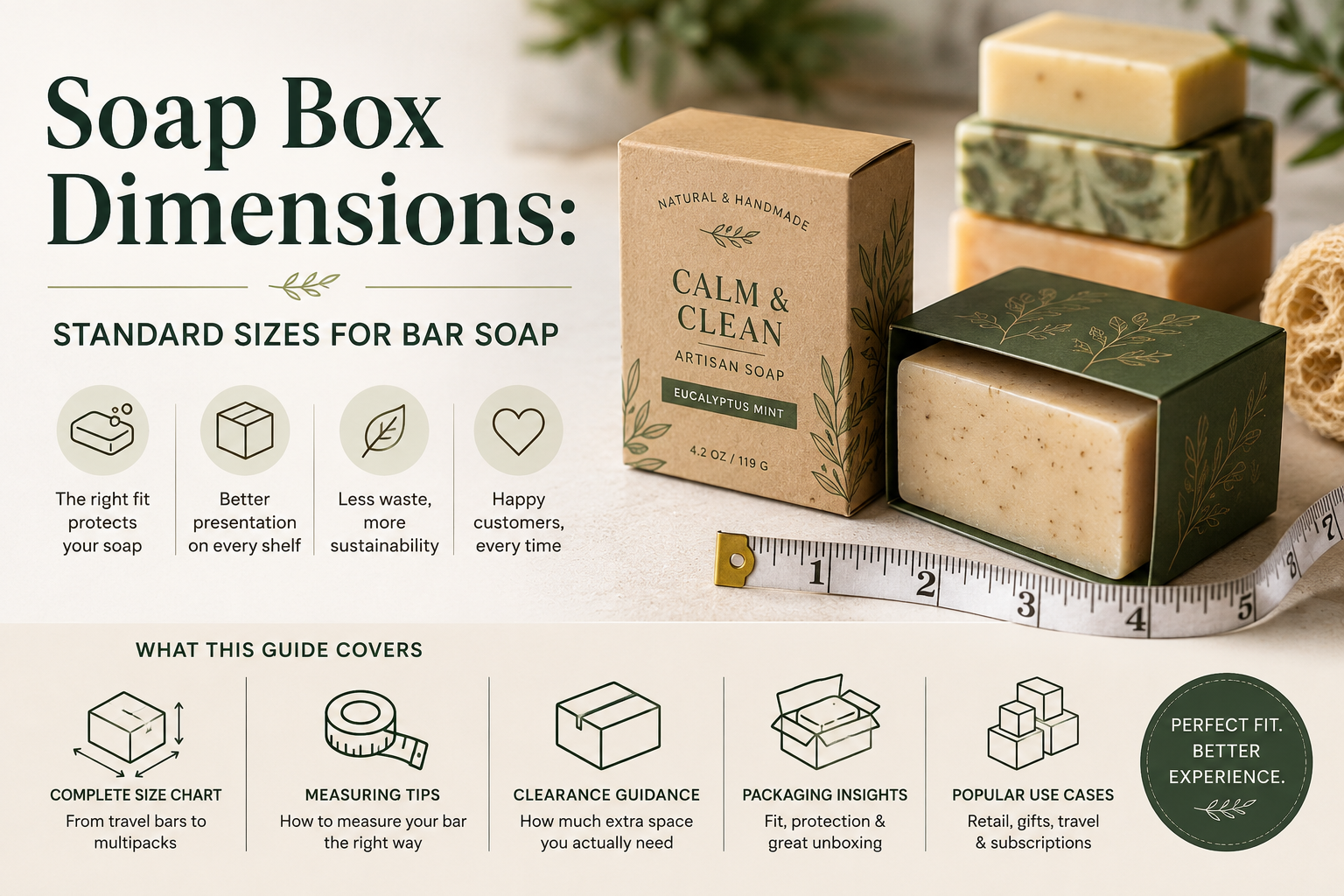
The most common soap box size runs 3.5 to 3.75 inches long. It’s 2.5 inches wide and 1 to 1.25 inches deep. That fits a standard 3.5 to 4.5 oz bath bar. This covers most of what’s sold at retail. Travel bars, gift sets, and multipacks all need their own dimensions, though. This guide charts the full range. It also shows how to measure a bar you’re boxing for the first time. It’s part of our size guide series alongside our candle box sizes and cake box sizes guides. For everything else, our full box size guide covers the rest.
Soap Box Size Chart
| Soap Type | Dimensions (L×W×H, inches) | Dimensions (cm) | Typical Use |
|---|---|---|---|
| Travel/Guest Bar (0.5–1 oz) | 2.5 × 1.5 × 0.75 in | 6.4 × 3.8 × 1.9 cm | Hotel amenities, sample sizes |
| Standard Bath Bar (3.5–4.5 oz) | 3.5–3.75 × 2.5 × 1–1.25 in | 8.9–9.5 × 6.4 × 2.5–3.2 cm | Most common single-bar retail size |
| Large Bath Bar (5–6 oz) | 4 × 3 × 1.5 in | 10.2 × 7.6 × 3.8 cm | Thicker or textured bars |
| Novelty/Irregular Bar | 4 × 3 × 2 in | 10.2 × 7.6 × 5.1 cm | Hand-molded or uneven shapes |
| Two-Bar Gift Set | 5 × 3 × 2 in | 12.7 × 7.6 × 5.1 cm | Holiday sets, gift bundles |
| Multipack (3–4 bars) | 6 × 4.5 × 2 in | 15.2 × 11.4 × 5.1 cm | Bulk packs, subscription boxes |
Sources vary a little on the standard single-bar size. Some list it closer to 3.5 × 2.5 × 1 inches. Others land closer to 3.75 × 2.5 × 1.25. Both fit the same weight range. The difference just comes down to how much clearance a given brand builds in around the bar.
Why Standard Bar Soap Doesn’t Mean One Size
A “standard bar” isn’t a fixed spec anywhere in the industry, according to Wikipedia’s overview of soap manufacturing. It’s just the range most bath bars converge on. That range fits comfortably in one hand. It also lathers without breaking apart too fast. A 3.5 oz bar and a 4.5 oz bar can look nearly identical on a shelf. The heavier one still needs an extra eighth of an inch of depth, though. Skip that extra room and the lid crushes its corners on close.
Hand-milled and cold-process bars complicate this further. They shrink as they cure. Two bars poured from the same mold can end up a few millimeters apart in the final size. That’s fine for a soapmaker selling at a farmers market. It becomes a real problem once those bars go into identical, pre-printed boxes and some don’t quite fit.
How to Measure a Bar of Soap for Its Box
Measure the bar at its widest point in every direction. Don’t do this right after unmolding. Weight loss during cure changes the dimensions, sometimes by a full eighth of an inch over a few weeks. Measure a fully cured bar instead. Otherwise you’ll size the box for a soap that no longer exists by the time it ships.
Add a quarter inch of clearance on length and width. Depth gets a little more, closer to a half inch. Bars swell slightly in humid storage, and a too-tight lid can crack a dry, brittle bar on removal. If the soap has a raised design or an embossed logo, measure over the highest point. Don’t measure from the flat base underneath it.
Sleeve, Tuck End, or Pillow Box: Which Style Fits Which Bar
A tuck-end box wraps the bar completely. It protects the bar best in shipping, but it hides the bar until the customer opens it. A sleeve or slide-drawer style shows a strip of the soap through an open end instead. That sells the scent and color before purchase. I’ve found the sleeve style works better for anything with visible texture or color swirls. That texture is usually the whole reason someone picks the bar up in the first place.
Pillow boxes look good sitting on a shelf. They’re the weakest of the three under any real shipping pressure, though. The curved shape that makes them attractive also means there’s no flat panel to stack weight against. Save pillow boxes for retail display or local delivery. Skip them for anything going into a mailer.
Board weight matters more for soap than for most products in this cluster. Soap gets handled with damp hands more often than any other item we cover. That’s true for a customer testing a bar in a shop. It’s just as true for a gift recipient unwrapping one at a bathroom sink. A thin, low-caliper stock softens and dents at the fold within a single damp touch. A heavier stock holds its crease and keeps the tuck flap snapping shut the way it did on day one.
Custom Soap Box Sizes
The chart above covers common bar shapes. Hand-poured, irregular, or oversized bars fall outside it fast. A lavender bar cut freehand from a loaf never comes out exactly the same twice. A box built for a perfect rectangle won’t fit it.
Easy Box Packaging builds soap boxes to the bar’s actual cured dimensions, sleeve or tuck-end, either way works. Custom sizing matters more here than almost anywhere else in packaging. A soap box that’s too tight will crack a dry bar. One that’s too loose lets it rattle and chip corners in transit.
Frequently Asked Questions
What size box fits a standard bar of soap? Most standard 3.5 to 4.5 oz bath bars fit a box around 3.5 to 3.75 inches long. That’s 2.5 inches wide and 1 to 1.25 inches deep. Measure your specific bar first, since hand-poured soap varies more than machine-milled soap does.
Do gift-set soap boxes need different dimensions than single bars? Yes. A two-bar gift set needs roughly 5 × 3 × 2 inches. Three or four bars packed together need closer to 6 × 4.5 × 2 inches. That extra room keeps the bars from crushing against each other in transit.
The Bottom Line
Soap box size comes down to the cured bar’s actual dimensions, not the ounce weight on the label. Measure the bar after it’s done shrinking. Add a quarter inch of clearance, and pick a style that matches how the bar needs to travel. Get a quote and get a soap box sized to the bar you’re actually shipping.